Adventures in Namibia Episode 10 by Guest Blogger Cathy

Ngepi and Windhoek

We were sorry to leave the Zambezi Mubala camp as we had enjoyed our stay there, even though the Vervets caused us some grief! The drive back to Divundu went smoothly and the traffic stops were not too onerous.

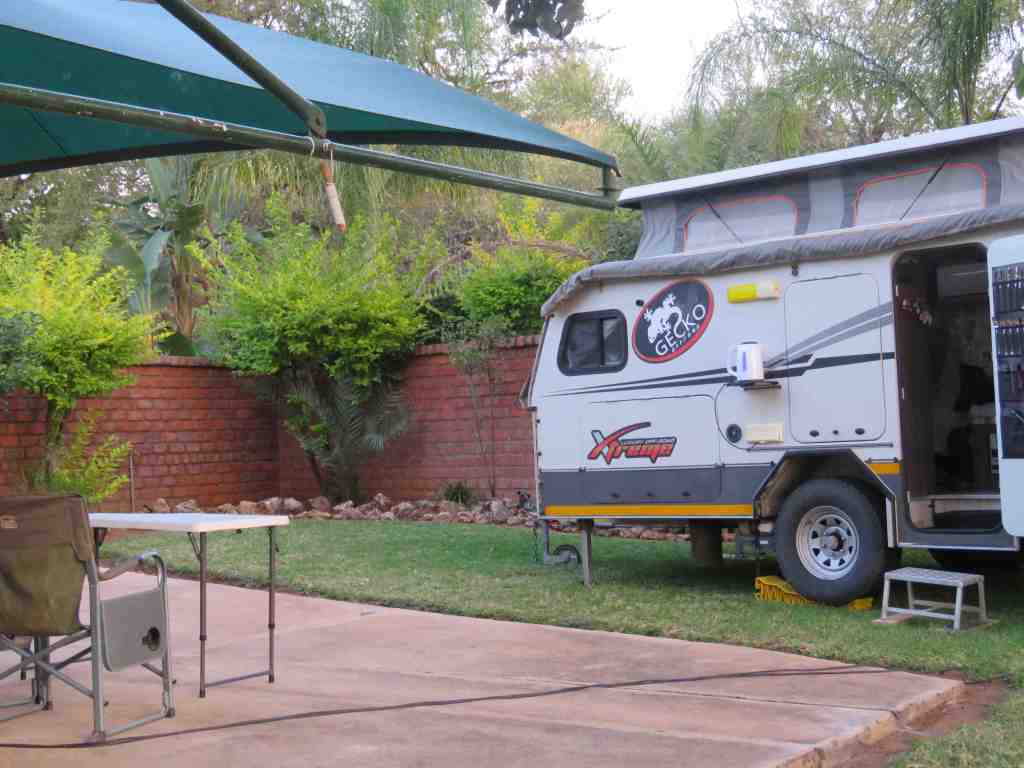
Two Geckos leave Zambezi Mubala

We turned into the access road to Ngepi, with no idea of how bad these four kilometers would be. Not only are there parts thick with sand, but there are also dips, bumps and rocks to contend with along with the usual dogs, kids, cows, goats and donkeys! We had to smile at the signboard that said “About halfway” after almost two kilometers. We eventually arrived at the reception desk and were allocated campsites 16 and 17.
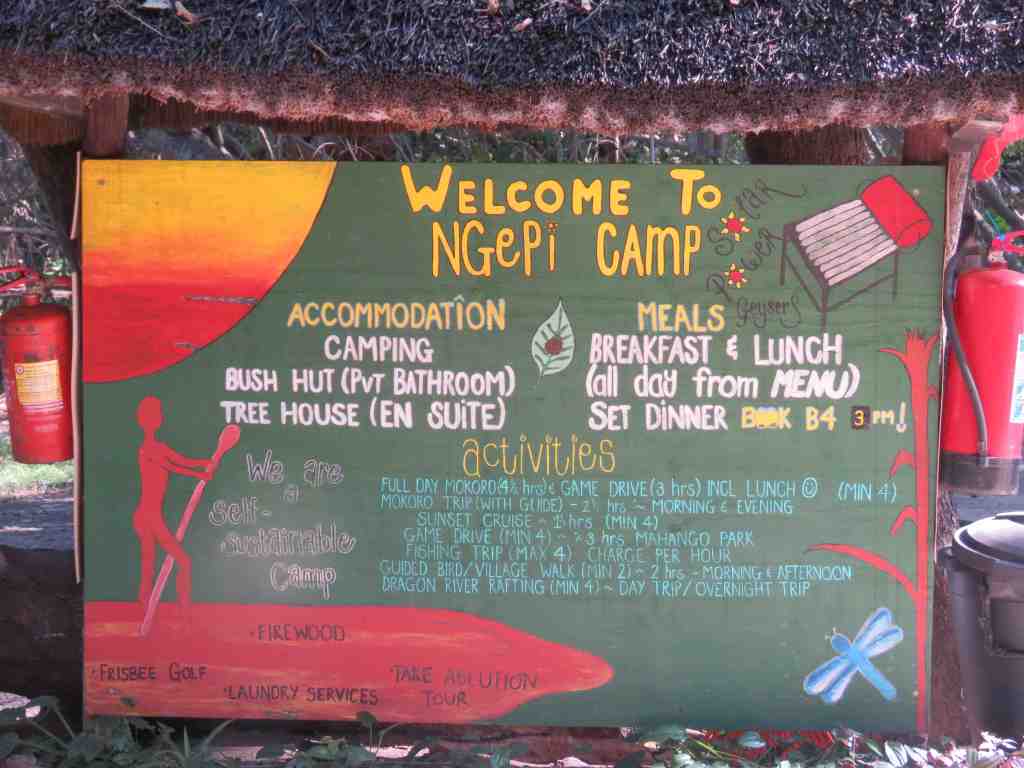
Ngepi Camp
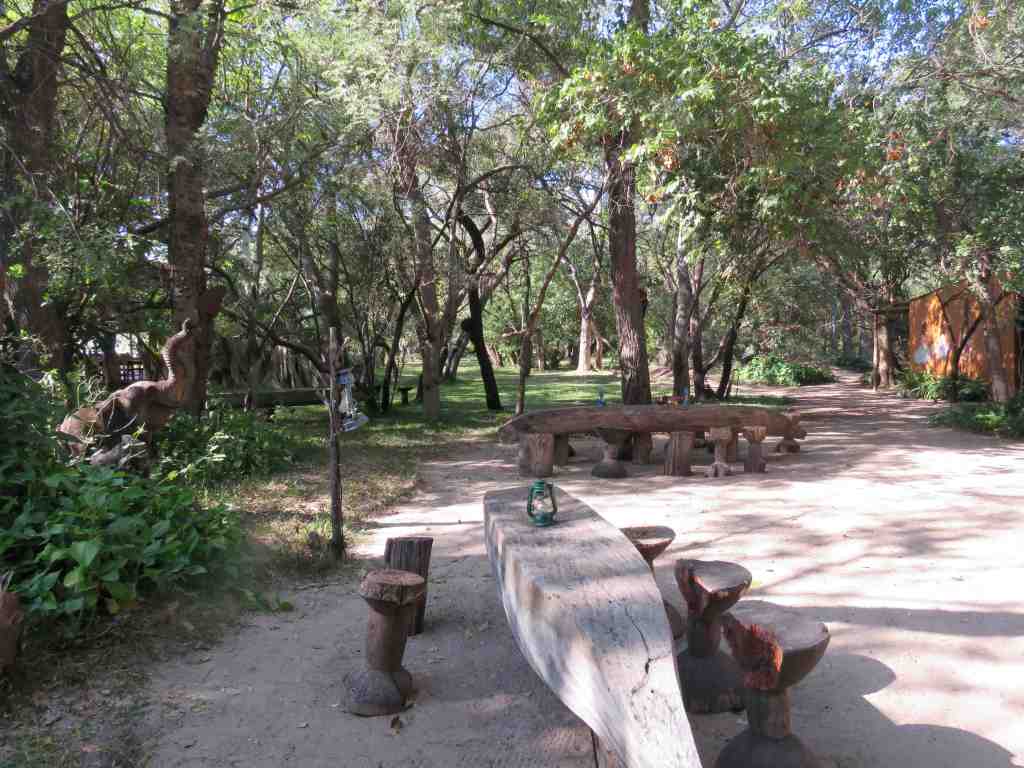
Seating around Ngepi
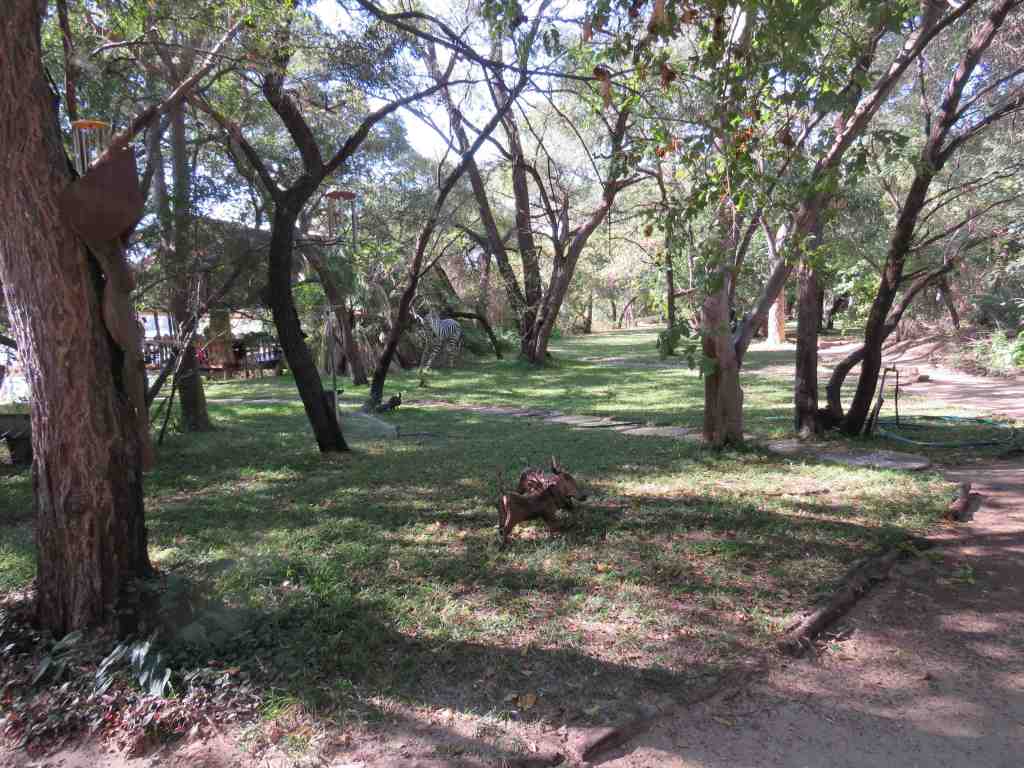
Looking across the grounds to the dining area
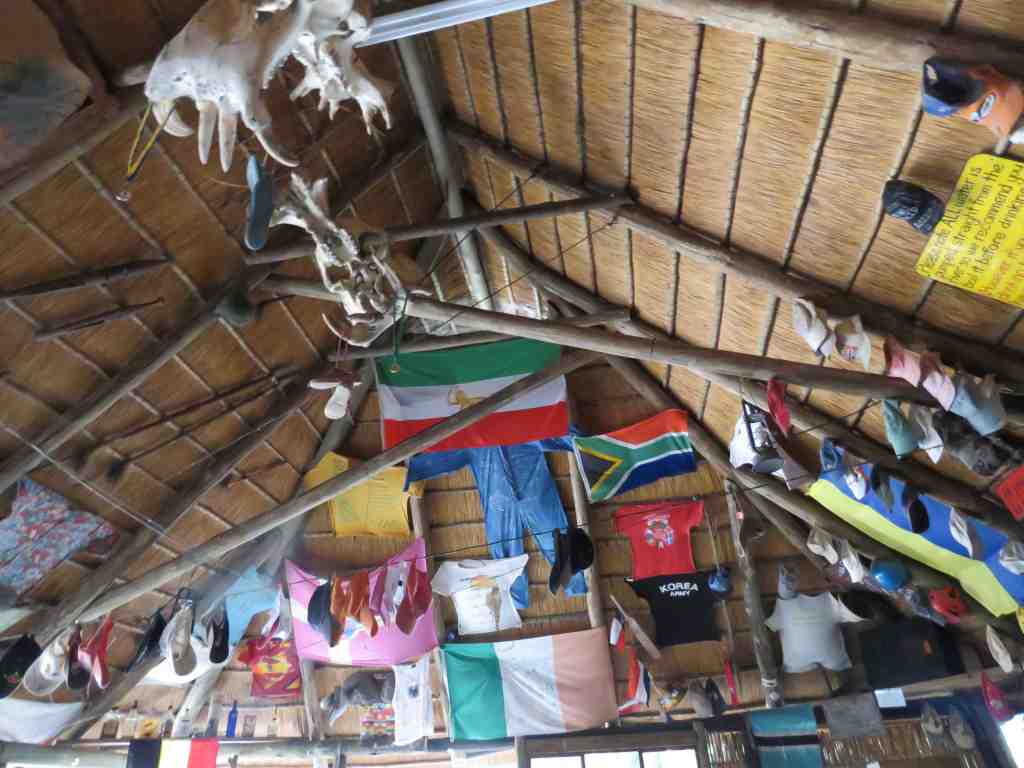
The Pub
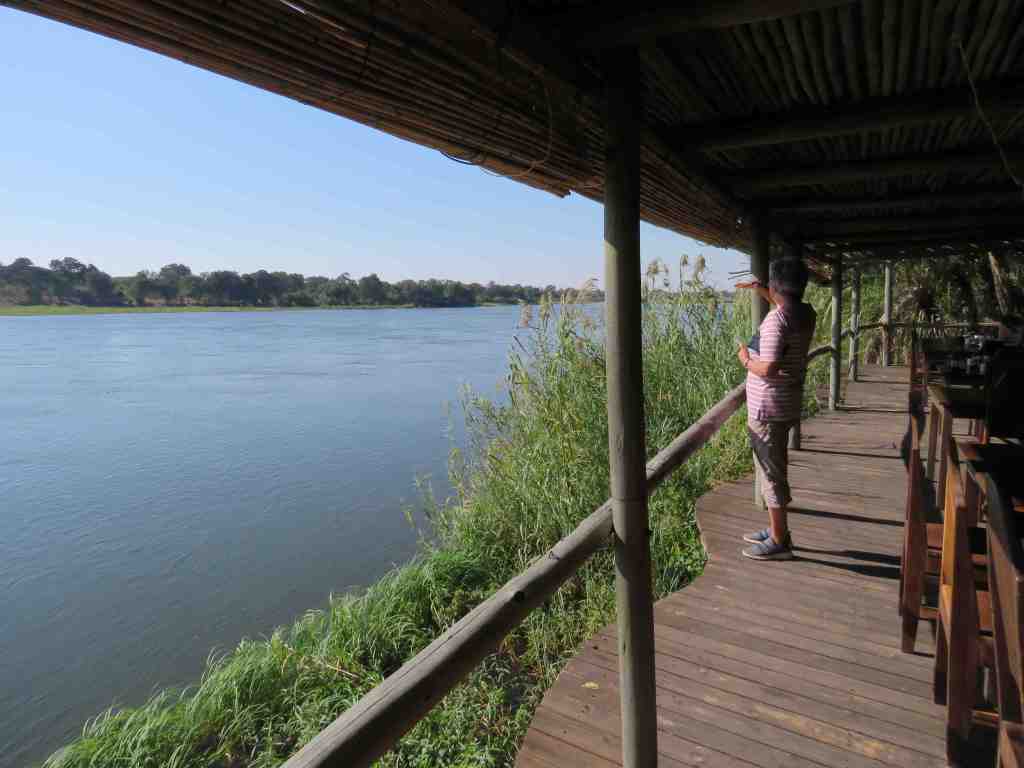
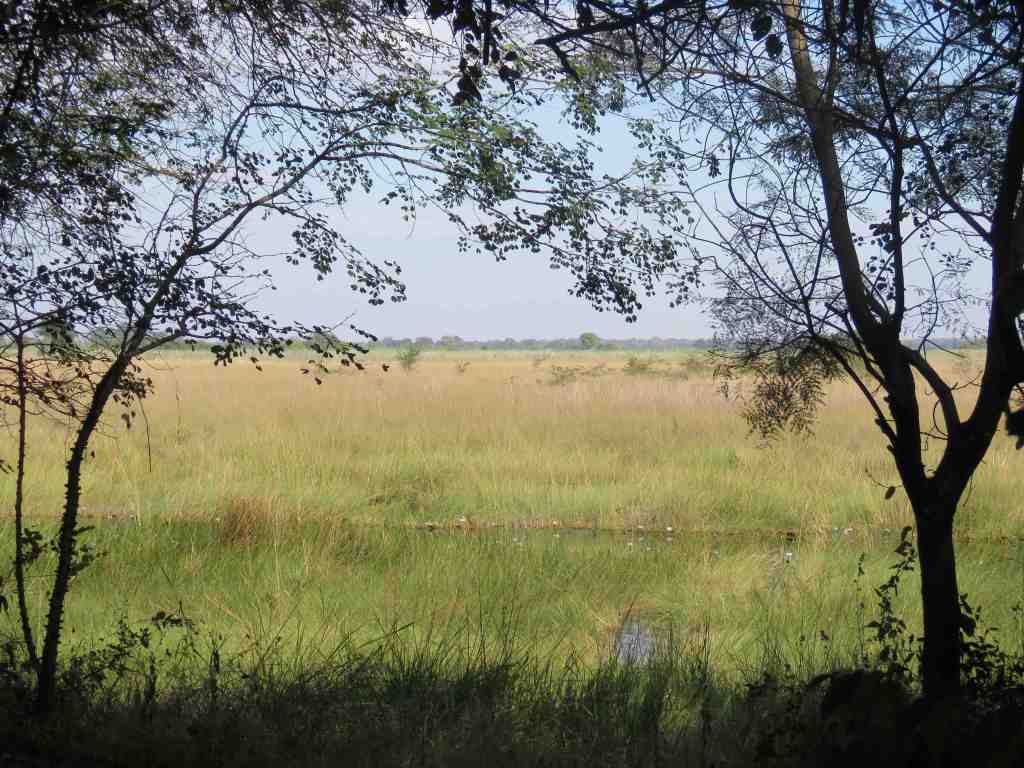
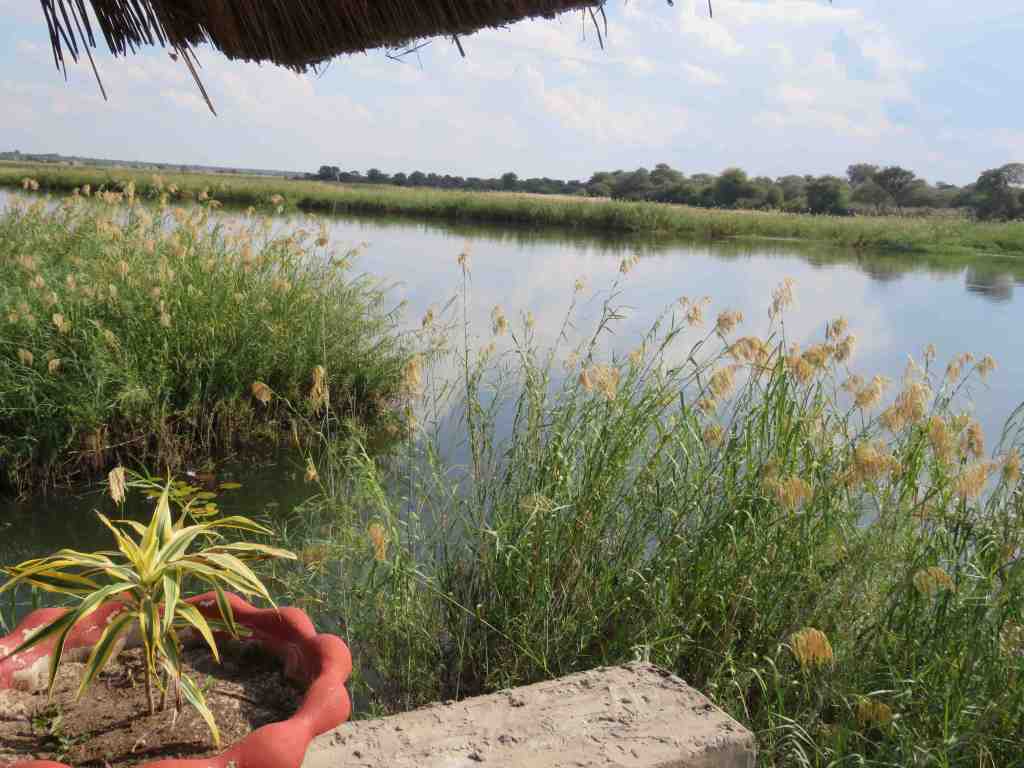
The Okavango from the dining area

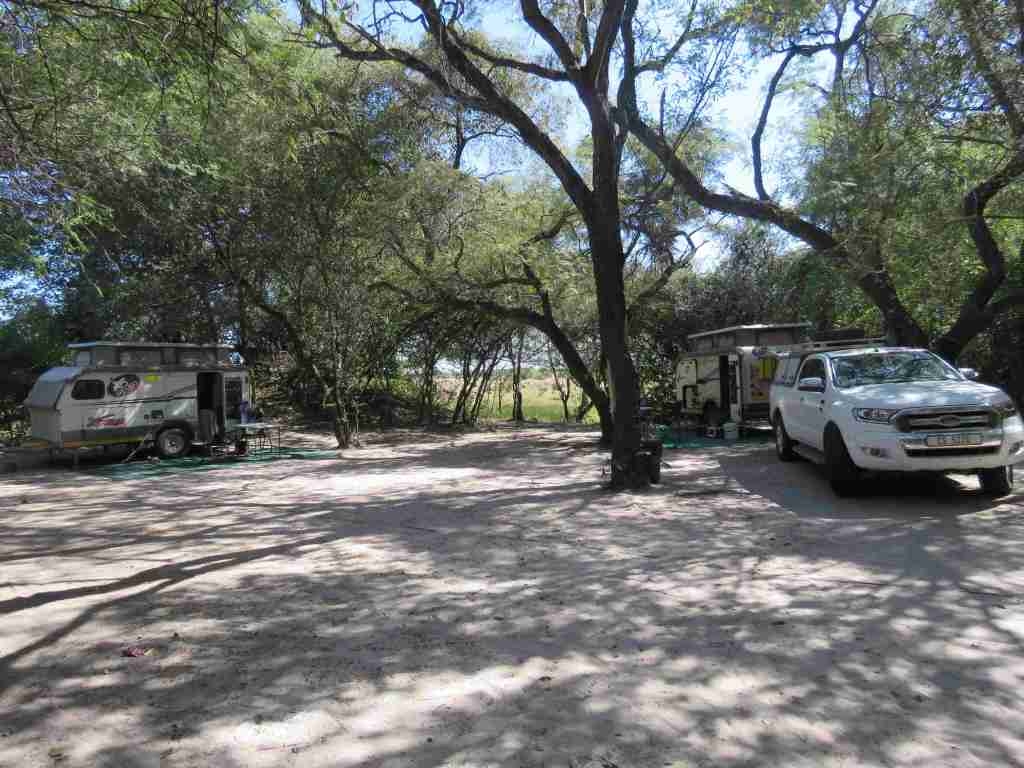
We found our camps and settled in, only to be told that we had parked on the grass, which would incur a $100 per night “fine”. This caused no end of confusion as the entire site was grassed so where we were supposed to place the van was a bit of a mystery! Eventually, we worked out that there was a line of small poles with a gap in the middle. Apparently, we were not supposed to park beyond the poles. The problem was there was no shade before the poles so we decided to argue the fact if we were asked to pay this fine. Fortunately, no one arrived to ask us to pay the fine so we let the matter lie.

Negi is a fun camp where the reception and pub areas are decorated with shirts, caps and other pieces of clothing, that have messages from various campers written on them, and then pinned onto the wall. There are lots of places to sit, none awfully comfy as they seemed to be mokoros (canoes) turned upside down, but the rest of the visitors (mostly 20-something folk from Europe) enjoyed sitting on them, chatting and using the abysmally slow wifi.

The campsites were along the river and had a nice view of the water.

Our view of the Okavango River

The ablutions at Ngepi were a sight to behold. The loos and showers are unisex and built with reed walls. There was no door as such, just a pole across the entrance. If the pole was up, then someone was in there and if it was down, well just go on in! The loo was placed on top of a platform that was reached by four steps. Great fun in the daylight, but not so much when it was dark. There is just solar lighting which gave little or no light so a torch was a necessity!
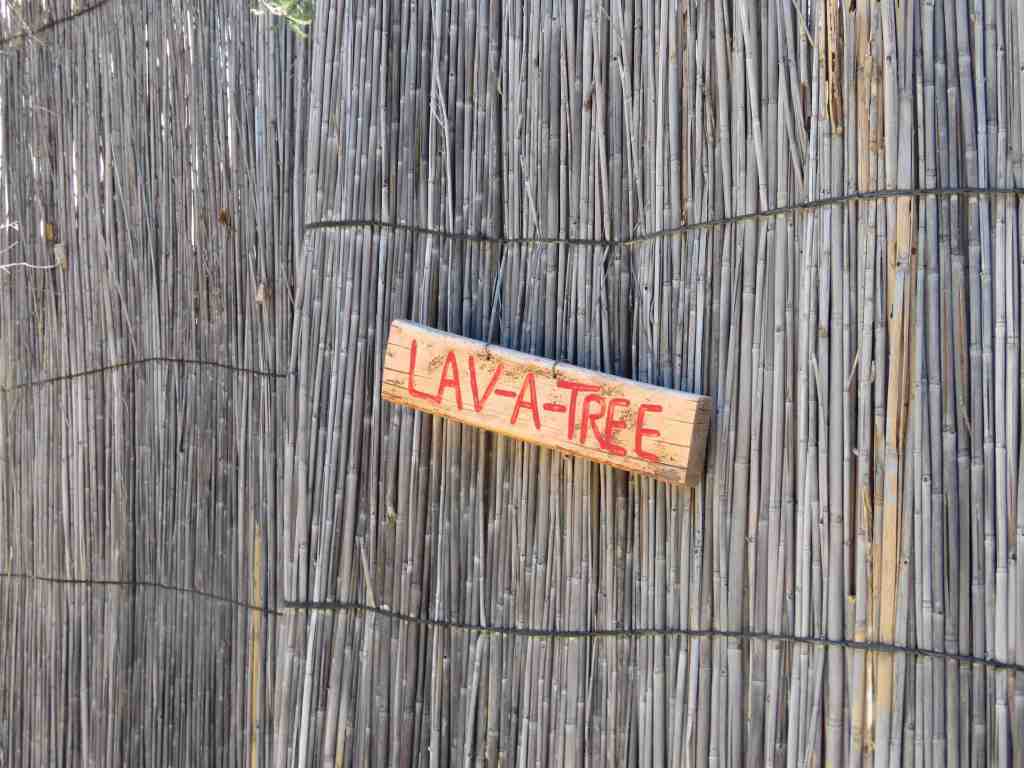
The sign for the loo
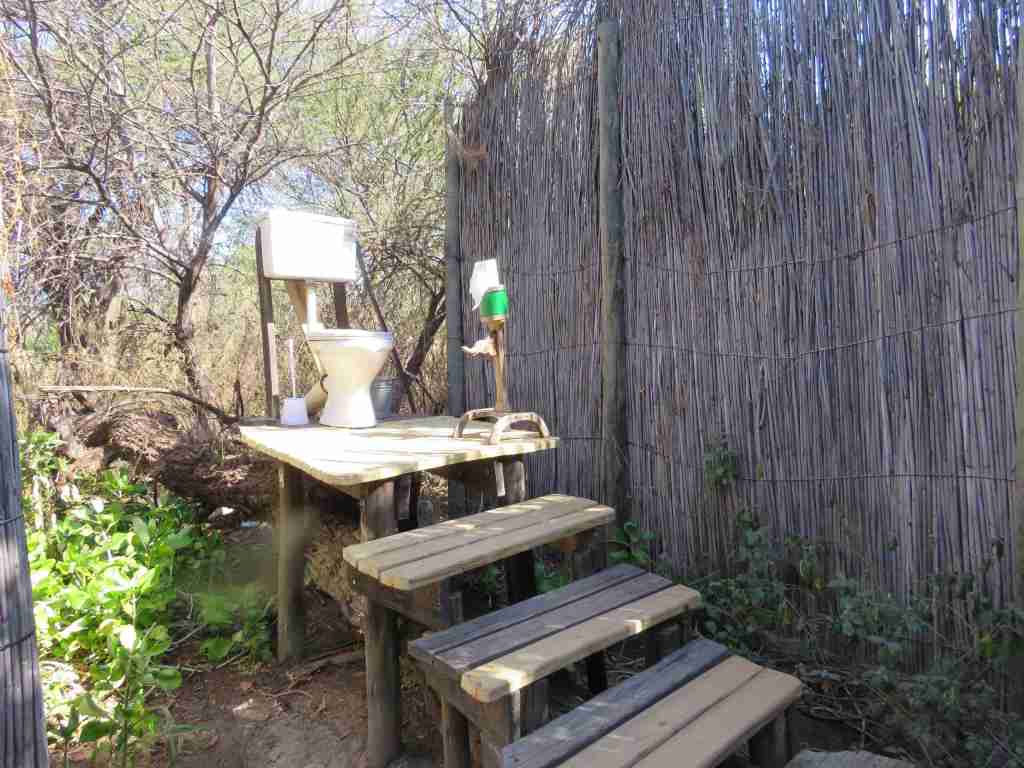
Steps up to the throne

The door!

The showers were built in a similar fashion but unfortunately, the hot water was only a solar geyser, as they have stopped using their donkeys. This meant that the first person that showered in the evening had hot water but after that, it got progressively cooler until it was ice cold. The first night we were lucky and got the first shower so it was great but the second night was cold so the third night we used our own shower rather than “enjoy” another cold shower.

The shower

The shower itself

Alvan and I had made inquiries about a game drive that was advertised.  The minimum number of people for the drive was four, so if we wanted to go we would have to pay the full price for four people ($2400). That was out of the question, but on further questioning, the receptionist admitted that we could take a self-drive. The game area was part of the BwaBwata National Park, which was a short drive along the main road.

We took a drive through this very pretty park, where there were long drives along the flood plain where we found a number of animals. This was a great drive and is thoroughly recommended for anyone staying in the area.

Bwabwata National Park

A beautiful kudu cow

Zebras by the dozen
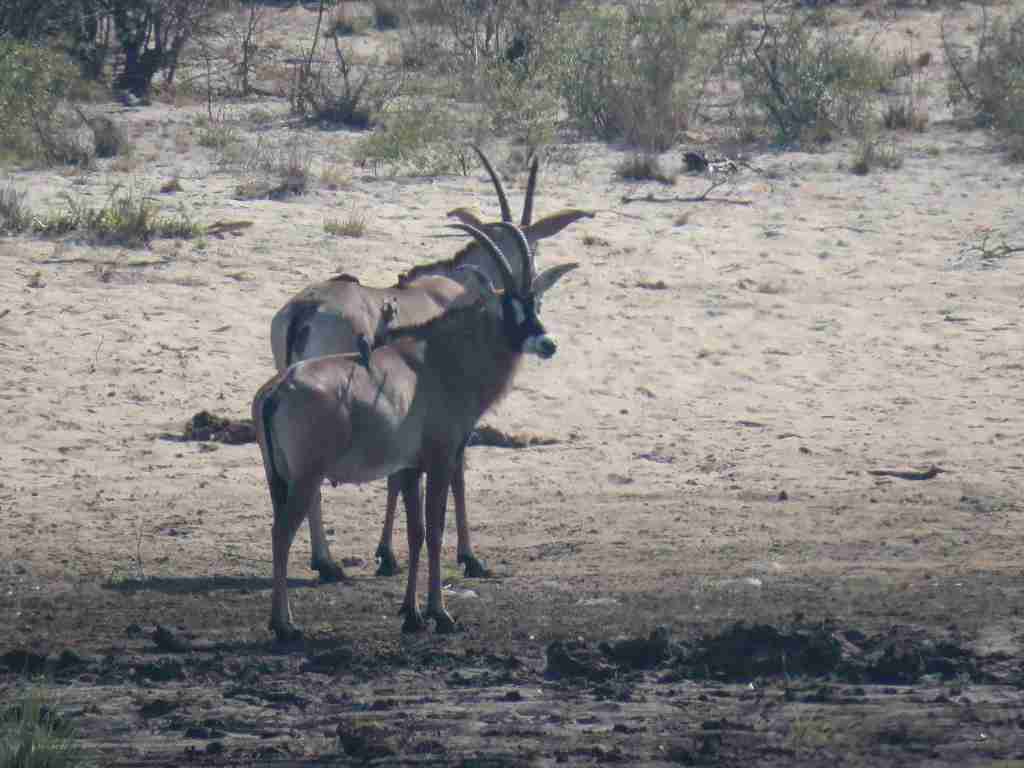
Two lovely Roan antelope

More Impala than we could count!
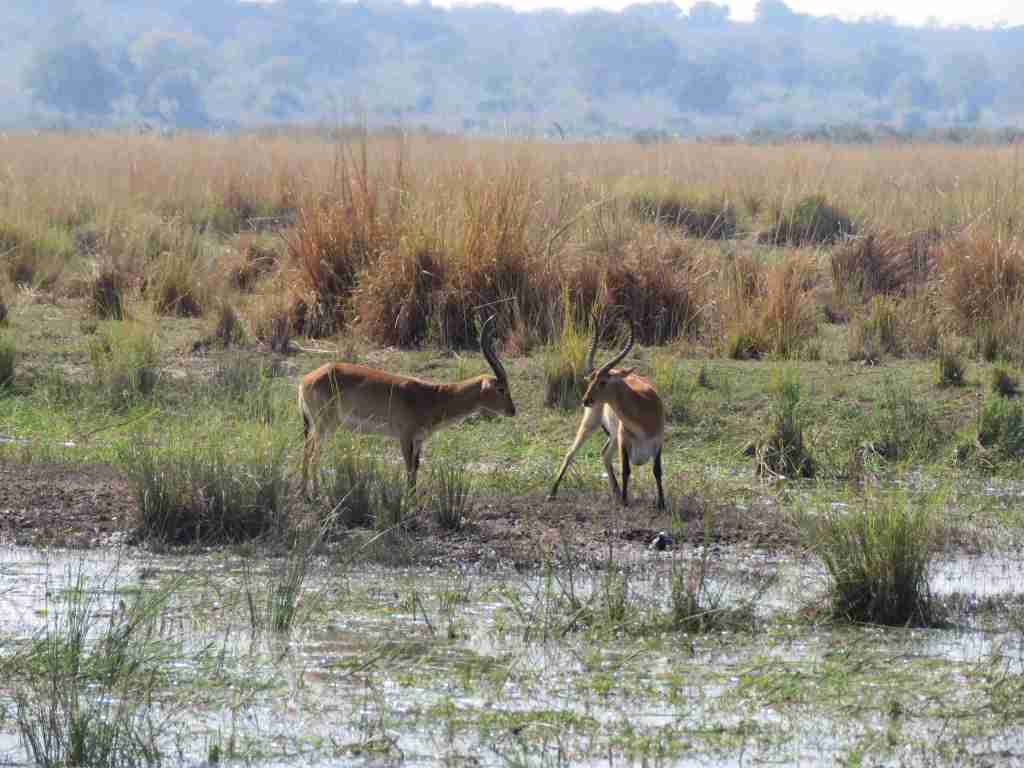
Just as many Lechwe!

Lucky to see a hippo out of the water during the day

Look at this lad’s impressive tusks
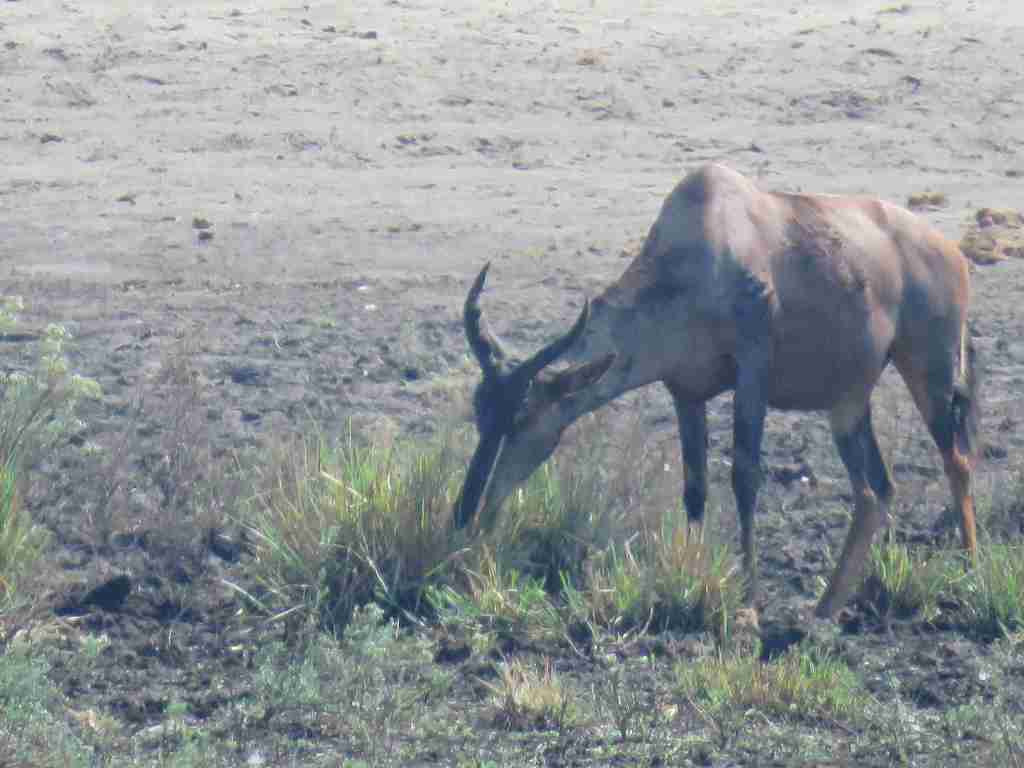
A small herd of Tsessebe

Of course around the camp and its surroundings were loads of beautiful birds.

Yellow-bellied Greenbul, which begged for crumbs every day!

Red-billed Spurfowl, who were also professional beggars for crumbs!

Yellow-billed storks – photo taken at max zoom

Little Bee-eaters all in a row
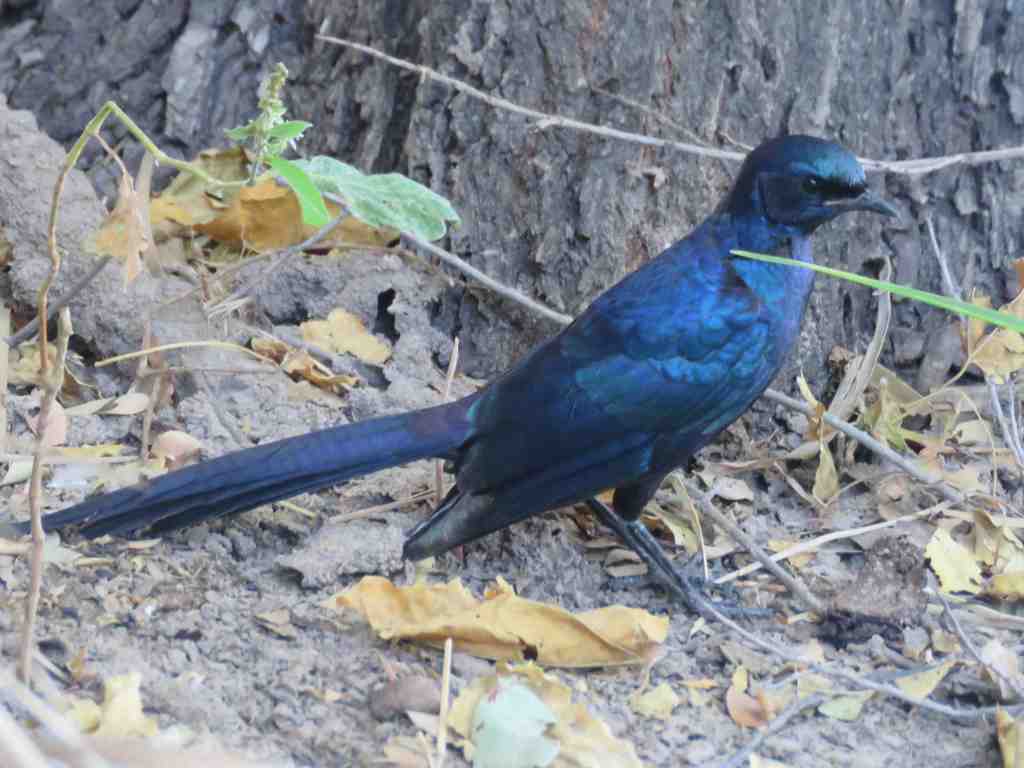
Meves’s Starling

Grey-backed Camaroptera. This little bird was the most energetic, tiny thing.

Beautiful Goliath Heron stalking its prey

We enjoyed our time at Ngepi and all too soon it was time to pack up again and head back toward Rundu. Now we started the long drive back home as the sun had set on our Namibian adventure.
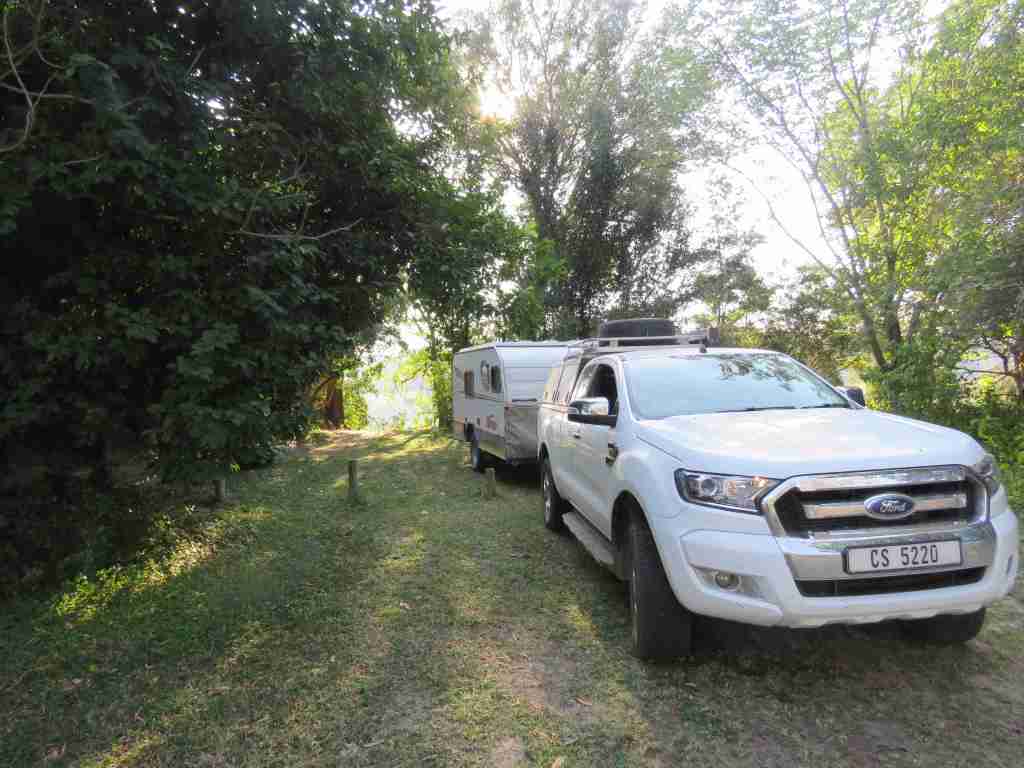
Leaving Ngepi

Alvan and Ray chose to drive the 700 kilometers from Divundu to Windhoek, but we couldn’t face such a long drive so we chose to break it up at Otavi. We stayed at the Palmnecke Guesthouse which was very comfy. Lovely rooms and a home-cooked breakfast.

We arrived in Windhoek yesterday and booked into the Urban Camp. After setting up we were relaxing inside when we heard an almighty crash and the alarm in the Ford was going mad. We rushed outside to find a branch had fallen off a tree, and slammed into the windscreen of the Ford, smashing it and leaving a dent in the roof. I could have cried! Seven thousand kilometers with no problems and then right at the end a branch causes this! Oy Vey! Well, PG Glass will replace the windscreen today and we’ll have to get the dent repaired when we return home.

It was great, however, to chat with Colin and Diane, who are on their way to the Caprivi, and Ray and Alvan. Ray and Alvan left for Keetmanshoop today and we’ll be off down the B1 tomorrow.

The offending branch

The damage done to the windscreen and roof

We have thoroughly enjoyed our Namibian adventure and have had a great deal of fun over the past six weeks. We have seen some fantastic sights, driven around seven thousand kilometers and made lots of new friends along the way.

The weather has gone from blazing hot in the south, to cold and wet at Henties Bay, to lovely and warm along the Caprivi but in Windhoek last night it was freezing at two degrees centigrade! The camps have mostly been marvelous but the ablutions have in many places left something to the imagination! I have grown to heartily dislike gas-powered showers that are not well-regulated so you either freeze or cook! You have to constantly adjust the water and dive in when it’s warm and exit quickly before it’s too cold or boiling hot!

I will definitely remember the people. They have been unfailingly welcoming and friendly.  It made no difference whether they were camp staff, petrol attendants or people serving in coffee shops or restaurants, we were met with a friendly greeting and made to feel welcome. Even a lady we stopped on the side of the road to ask for directions wished us a happy holiday and told us to enjoy her beautiful country.

We especially loved the ladies that manage the restrooms at the garages. Unlike in SA, these restrooms are spotlessly clean and are guarded religiously by one lady. It seems these ladies have the rights to keep the bathrooms clean, but you have to pay to use them. I can remember the first time we came up against this practice. I wandered off the loo and was chased by a lady carrying a box of rolled-up pieces of loo paper. She explained that it cost $3 to use the bathroom and when I paid she gave me a little roll of five or six pieces of loo paper and the door was unlocked. We soon discovered that this was an almost universal practice and the only place we were disappointed was at Kamanjab, where the bathroom was horrid!

Thanks to Helen for allowing me to share her blog and to everyone that has taken the time to read about our adventure.

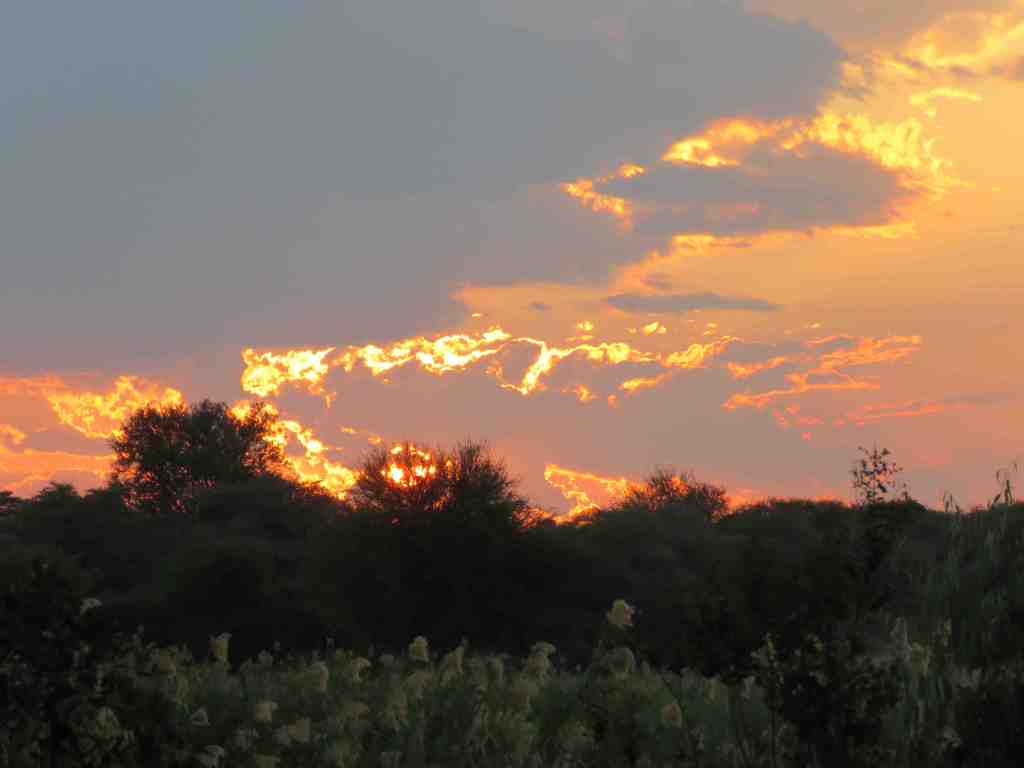
The sun has set on our Namibian Adventure

Share Your World Monday, 29 May 2023

Here are my answers to this week’s questions from pensitivity101

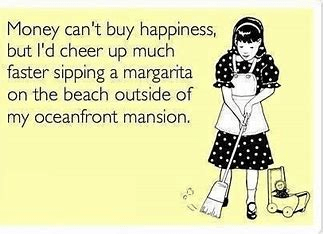
If money was no object, what would be your ideal holiday?

If money was no object then a world cruise would definitely be something I would consider Having said that, a cruise is not my ideal holiday. I am lucky enough to have had many different kinds of holidays and cruising, and caravanning in game reserves are the type of holidays I enjoy most. I always enjoy travelling and I’ve stayed in both luxury and budget accommodations. It’s the experience that matters to me. There are holidays that I enjoyed when I was young that give me the most pleasurable memories but I won’t do those again because I know Age is against me. This is why I tell younger people to embrace every opportunity and not put adventures off because ‘one day’ will be too late.

Do you save for a holiday or put it on plastic to pay off later?

My holidays must fit my budget. Paying later is not an option for a retiree. I would love to go on a very expensive 50-day Pacific Ocean Cruise but I can’t afford it so I think the next cruise will be a shorter one somewhere more affordable.

Have you ever been on a cruise?

The best cruise I did was in 2019 – wasn’t that lucky – just before COVID hit. It was from Mauritius to Venice and took 30 days. My blogs about it are headed, Cruising with Costa.

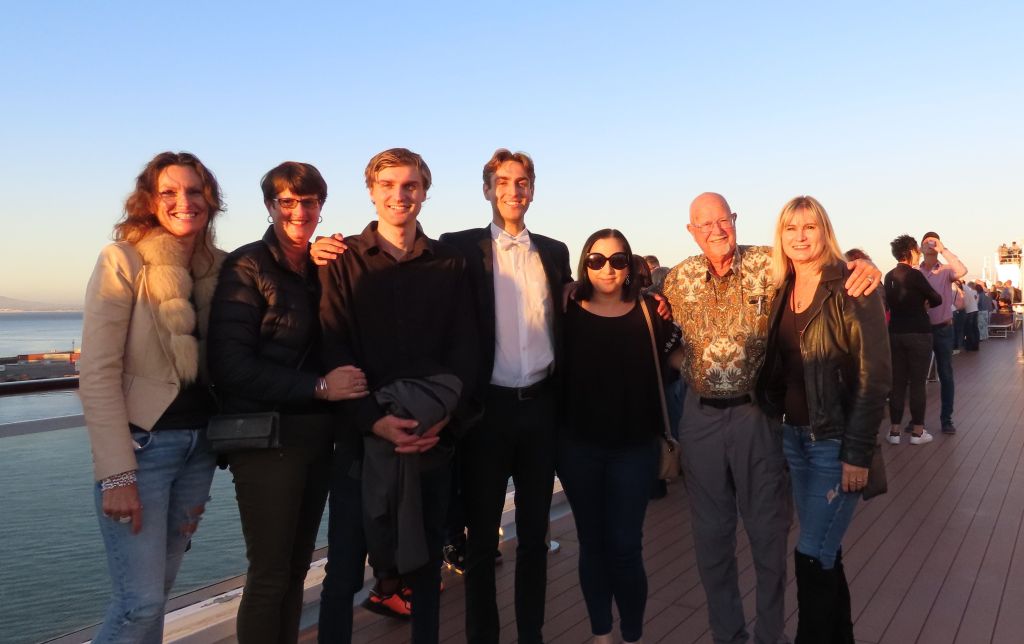
We have also done a few shorter cruises. Last year we did a 7-day pelagic cruise with BirdLife South Africa which took us from Cape Town via Marion Island to Durban. This year we did a 2-day fun cruise from Cape Town to nowhere and back with our children daughters and grandsons.

On board MSC Orchestra with our kids (I took the photo)

Do you send postcards or buy mementos?

I don’t. I blog as much as possible while travelling so that friends and family can see my own photos and know that I am enjoying myself. I might buy one or two mementos if I really see something I like. The South African Rand does not go very far overseas so I am very careful spending unnecessarily.

Gratitude:  Sometimes, just having someone by your side is enough.

I am grateful that my hubby and I are by each other’s side 24/7 and that we are usually on the same page when making decisions about what to do each day and where to go on holiday!

Adventures in Namibia by Guest Blogger, Cathy Episode 9

Mokolo Camp  and Zambezi Mubala Camp

We made an early start from n’Kwazi as we had 400 kilometers to drive to Mokolo, our next camp. Now somewhat experienced at driving in the north of Namibia we knew this was going to be a start/stop drive.  What we didn’t expect was to run into roadworks just outside Rundu.  They were rebuilding the road so there were managed stops with stop/go controls, but a bit hit-and-miss. We stopped at a block and soon were flagged to continue. Imagine our surprise when halfway through the detour we came across an 18-wheeler coming in the opposite direction! Fortunately, there was a wide verge to allow everyone to move off the road and the 18-wheeler sailed past! One can only speculate how the traffic stops managed to miss an 18-wheeler.

Driving along the B8 through the Caprivi is a lovely drive. There is lots of thick bush and some of the most beautiful trees I have seen in a long time. Huge trees with wide shady canopies. It was absolutely thrilling to see so many beautiful trees, which had been left in place. Many others, though, had been cut down judging by the many firewood sellers that we passed.

We also passed many settlements alongside the road. Each group of houses was neatly fenced by either a pole fence, reed fences, or in some cases thatching grass. The houses inside the fences were a mix of traditional huts with mud walls, thatched with reeds or grass, corrugated iron shacks and brick-built homes. There were also pens for cattle and goats but all very neatly laid out and no litter or rubbish tips that we could see. What we did not see, however, was any indication of commercial-size farming using the river water for irrigation. I really expected to see something similar to what we saw along the Orange River.

It was sad to see how many of these households still had no access to running water. We passed many ladies carrying water on their heads but there were also many sleds in use. Water barrels were piled onto a wooden sled that was harnessed to two oxen. The oxen then pulled the water back to the homestead. I guess the sled was easier to maneuver in the bush compared to wheels.

We arrived safely at Mukolo and were met by the owners Hennie and Veronica. We were shown to our campsite, #3, and were immediately struck by how much this camp reminded us of Tsendze at Kruger. Each campsite was carved out of the bush, with lovely big trees shading the site. All the sites are private and have their own ablutions. The camp is served by solar energy, so there was power to the van and car but we were asked not to use an electric kettle, or anything similar that drew a large current.

We settled in and the view over the floodplain was wonderful. The water lilies were in full bloom and the white flowers against the dark water and golden grass were a gorgeous sight. This camp has a lovely pub and veranda where we found interesting people to chat to.

Campsite #3 at Mukolo
Our view over the Kwando floodplain from campsite #3
Beautiful waterlilies in the river

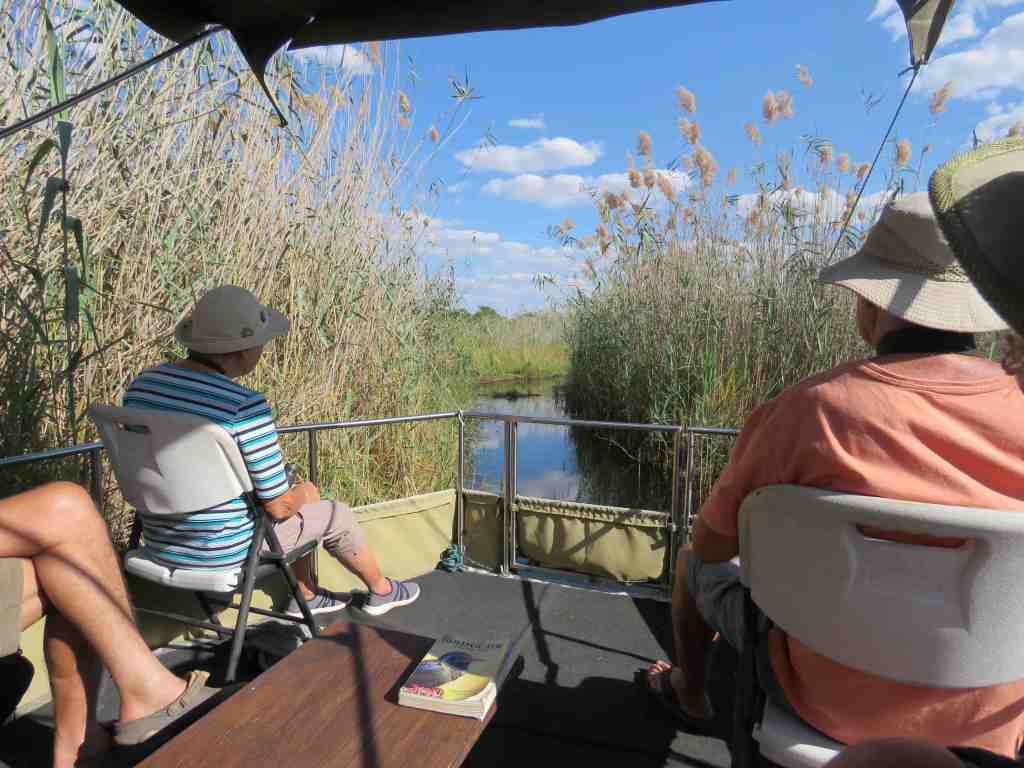
We took a boat trip one evening. The trip lasted three hours and it was worth every cent! Our guide, Admire, was very knowledgeable about the animals and birds in the area and was quick to identify what we were seeing. Also, he had the eyes of a hawk and picked out game very quickly. Unfortunately, most of the game was on the western side of the water so trying to take photos into the setting sun was impossible. We did see lechwe and sitatunga, neither of which we had seen before, as well as buffalo, elephant, kudu, and waterbuck. We also saw several Nile Monitors and one small crocodile.

Our guide, Admire, talking about the trip
Creeping through the reedbed
Male Lechwe
Female Lechwe
A group of Kudu cows
A group of Waterbuck

Admire, knew where a pod of hippos could be found, so we made our way there and sat for a while, enjoying the cool of the evening and a drink. It was lovely, with the hippo grunting, the water lapping at the side of the boat and the soft sound of the wind in the reeds. Another tough day in Africa!

The pod of hippo
I see you!

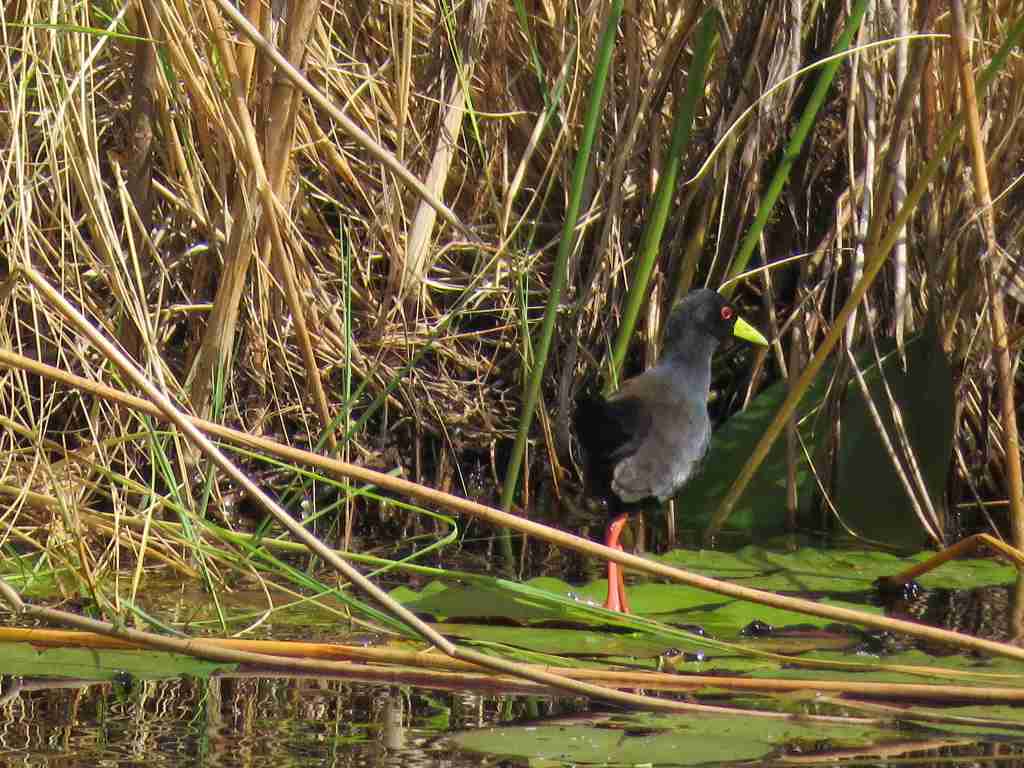
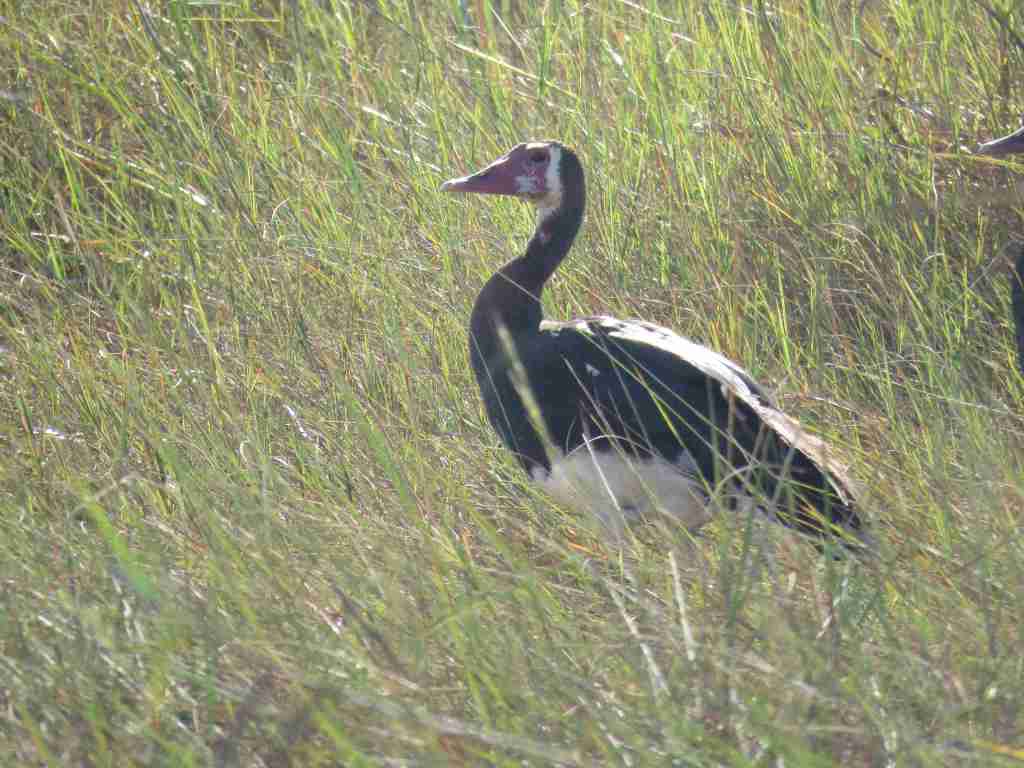
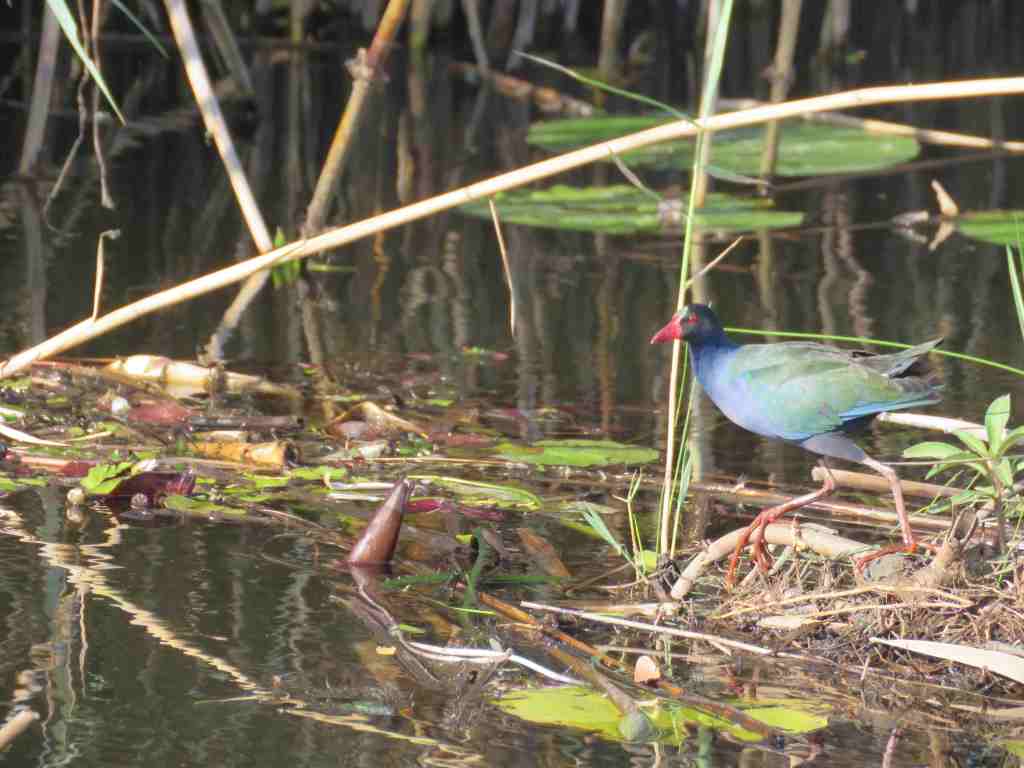
Needless to say, there were numerous birds as well. Admire identified them very quickly, and explained diet, breeding, and other habits for us. It made the entire trip fascinating and the three hours sped past.

Black Crake
Spurwing Goose
Allen’s Gallinule (Editor’s Note – Amazing sighting – I have never seen one before!)
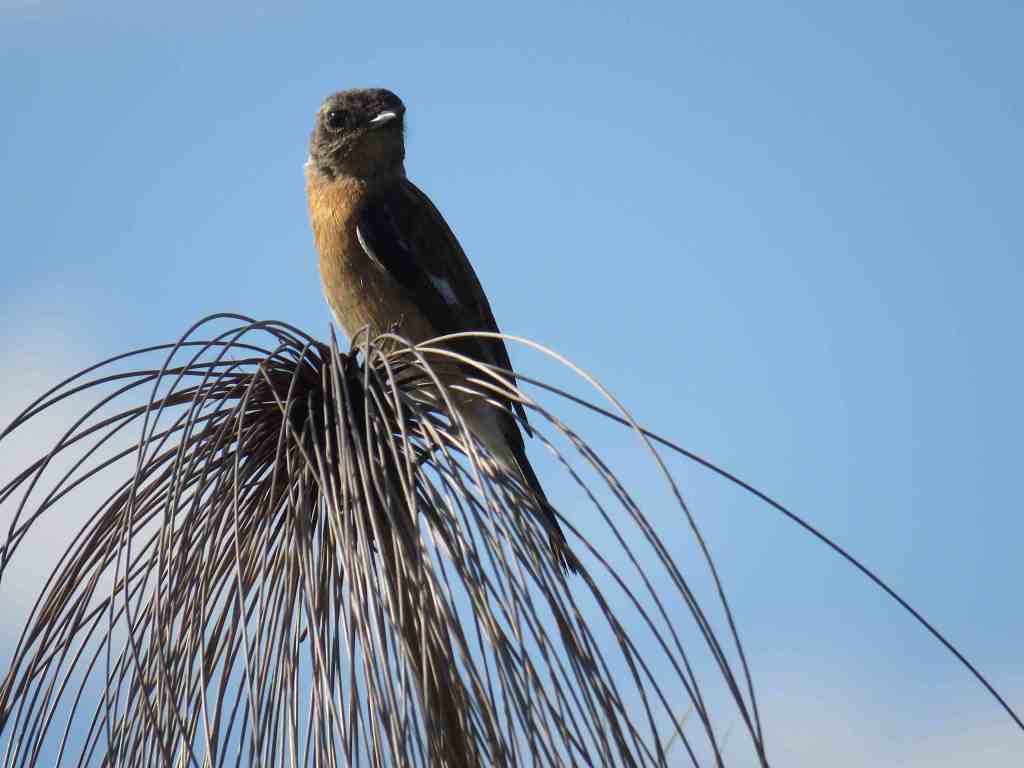
Female African Stonechat
African Jacana
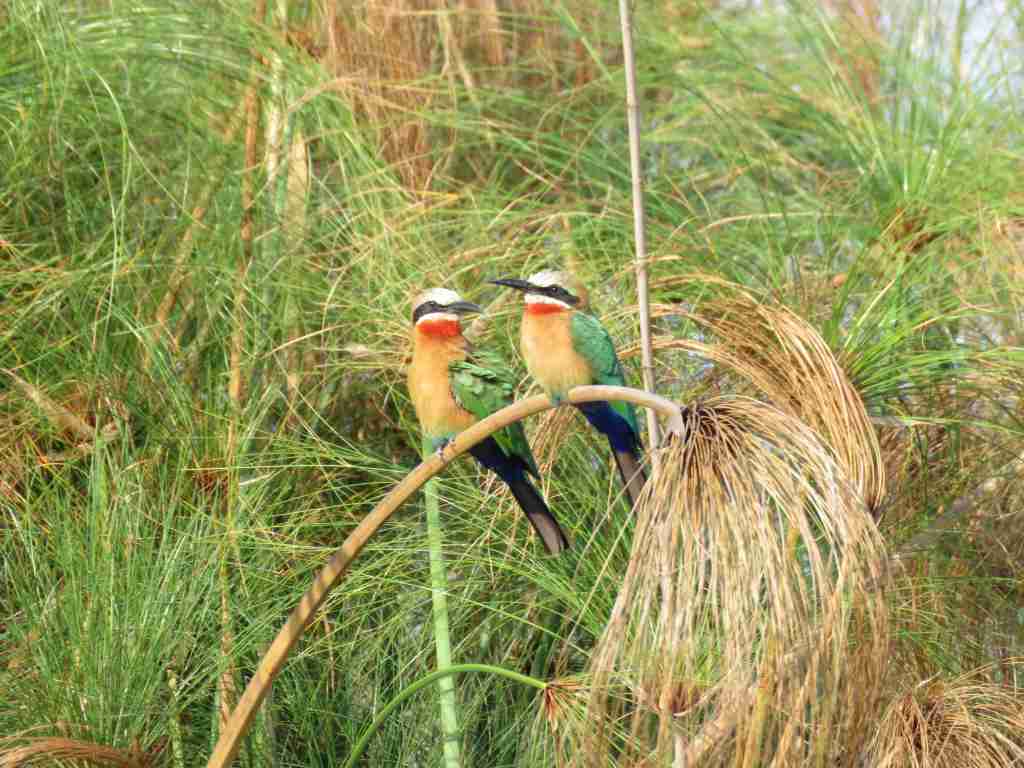
White-fronted Bee-eaters
Coppery-tailed Coucal
African Darter

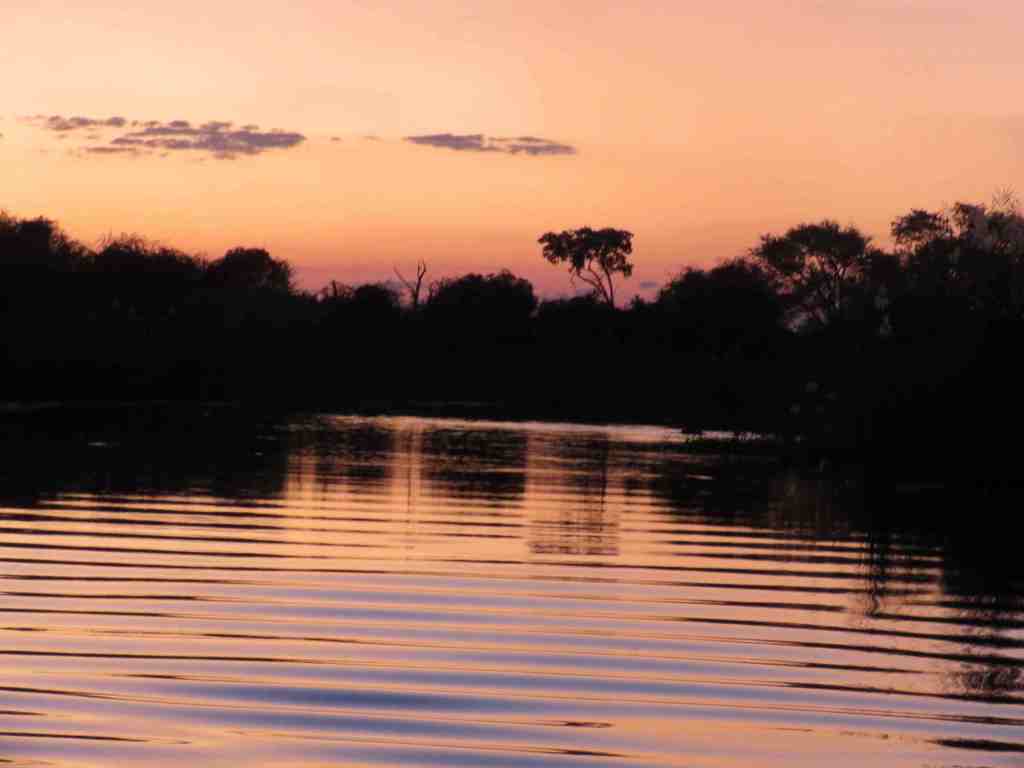
On our way back to the camp we enjoyed the last of the daylight with a magnificent African sunset.

Sunset
Red Ripples

The next morning, we were up early as we had a 400-kilometer drive to Katimo Mulilo. We were now at the westernmost point of our trip and almost 3,000 kilometers from home. We stopped in Katimo Mulilo at the Pick and Pay to buy a few necessities. There I discovered that you cannot buy alcohol in Namibia on a Sunday. Sadly, I put the two bottles of wine back on the shelf and decided to share Alec’s beers for the few days at Zambezi Mubala Camp, our next stop. This camp is close to Katimo Mulilo and on the banks of the Zambezi River.

This is a Gondwana camp and I cannot praise it enough. The staff, especially Katerina the camp manager, were marvelous, the sites were grassed and the separate ablutions were very nice.

Our campsite at Zambezi Mubala
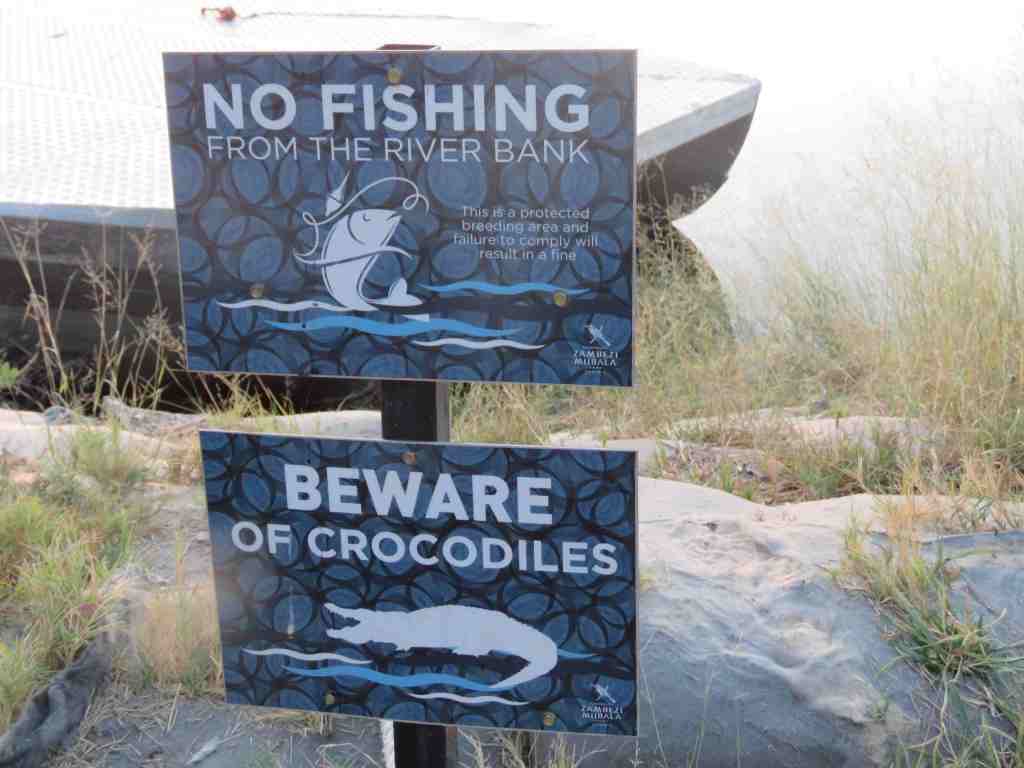
Enter the water at your own risk!
Alvan and Ray catch up with the outside world on the deck
Alec looking for fish

We thoroughly enjoyed our time at this camp, with the only downside being the Vervet Monkeys that tended to cause havoc with anything left open. Still, they were part of our adventure and having experienced them many times before, we simply kept the doors closed.
Little pests!

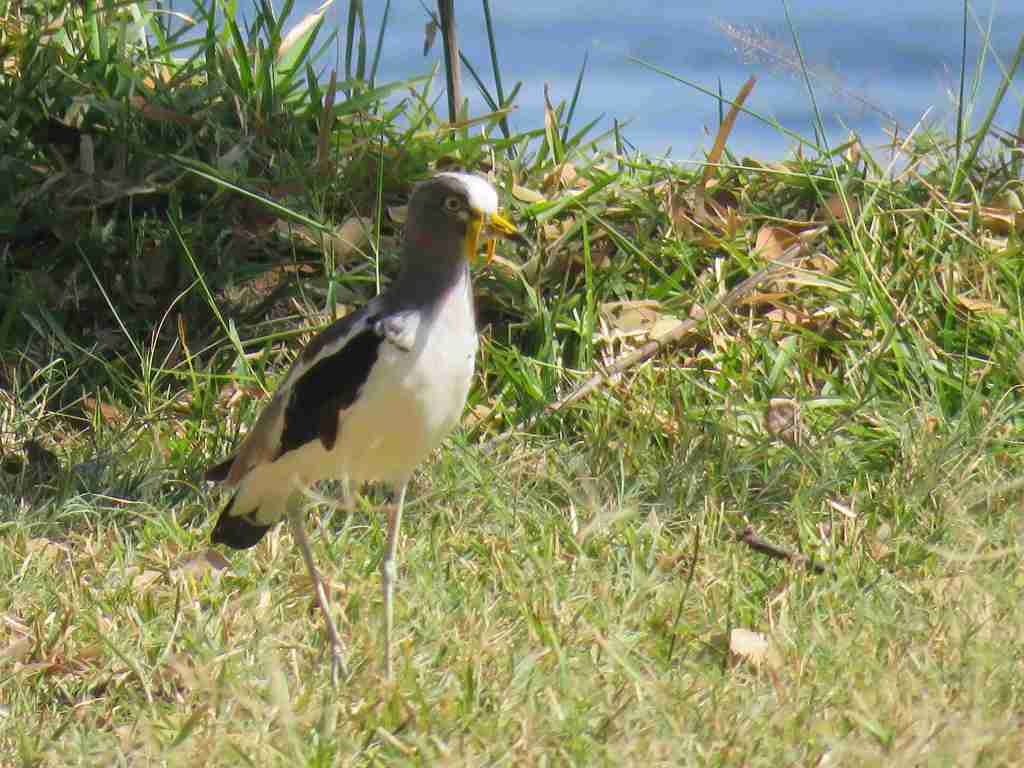
We had a lovely lazy time at this camp and enjoyed the antics of the White-crowned Lapwings and the squirrels.

White-crowned Lapwings
Playful squirrel

On our last evening, we again took a boat trip on the Zambezi and our guide, Valentine, was fantastic. She identified the birds, and though we saw no animals, it was a lovely sundowner cruise with snacks and drinks included in the cost of the trip. Katerina had arranged for the four of us to have our own boat so we drifted along, looking at the birds and marveling at the size of the Zambezi River.

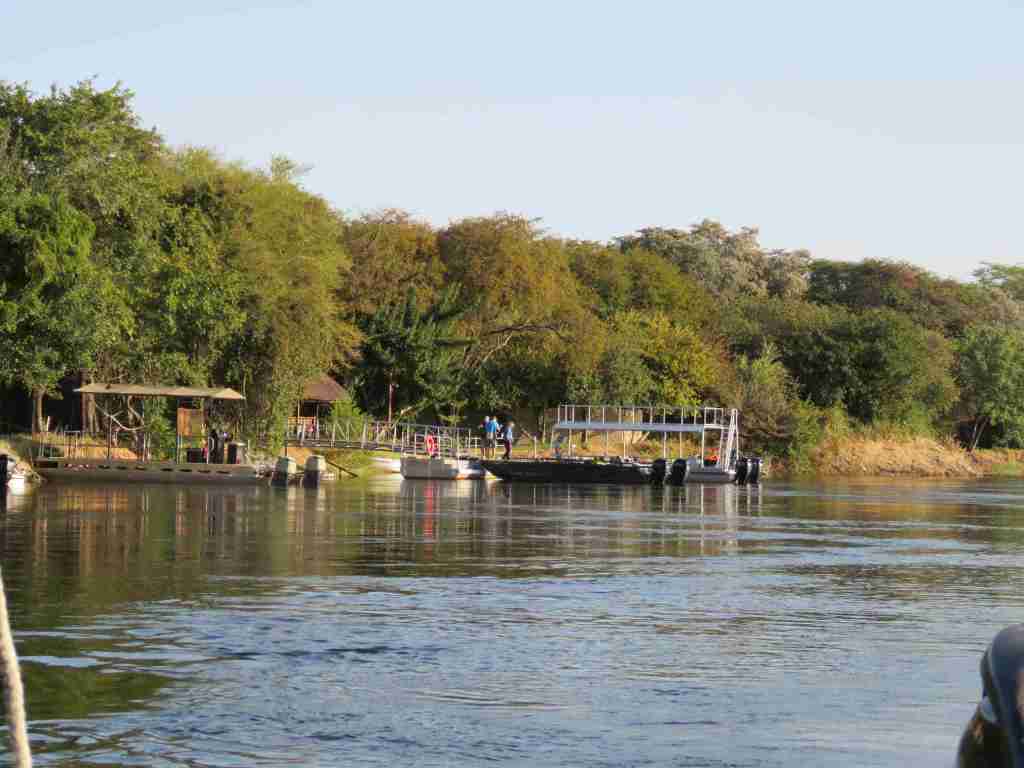
Leaving the dock at Zambezi Mubala
Our guide, Valentine
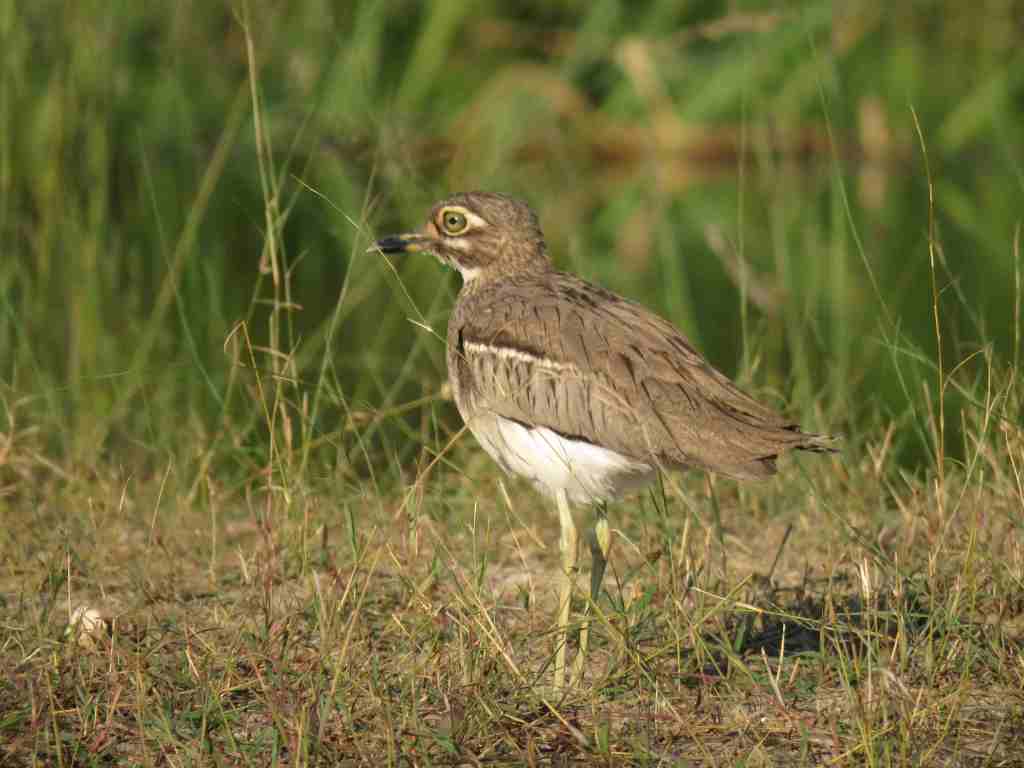
Water Thick-knee
Squacco Heron
Great or Yellow-billed Egret

Editors Note – I’m inclined to go for Great Egret as the top of the legs are black. YB /Intermediate has bicoloured legs where the top of legs are greenish yellow

A tiny Nile Monitor basking in a tree

Again, we were treated to the most magical sunset over the Zambezi River. The trees are on the Zambian bank.

Another magical sunset, over the Zambezi

Having arrived back a little late, we treated ourselves to a delicious dinner in the restaurant. A fantastic way to end a lovely stay at a great camp.

Delicious dinner at the restaurant

Tomorrow morning, we are off to our last camp along the Caprivi, Ngepi Camp at Divundu.

Till then everyone, take care.

Share Your World Monday 22 May 2023

Here are my answers to this week’s Share Your World from pensitivity101

Growing up, were you closer to your mother or father, or was it a balance of both depending on the circumstances?

When I was small I was a real Daddy’s Girl and I adored my father but I was definitely closer to my mother. To me, she was everything a mother should be and I felt sorry for the other kids because their moms were not as lovely as mine. She was a perfect mother to a teenage girl and encouraged me to reach for my dreams.

My father had a huge influence on the lives of my siblings and me. We all had to be in the lounge when he came home from work as from then until bedtime it was family time. He would talk to us about all sorts of things and was always interested in what we had been up to. He was a great storyteller and we learned many life lessons at my father’s knee. He was also an amazing grandfather and all his grandchildren adored him.

What was your favourite toy as a child, and do you still have it?

No, I don’t have any toys from my childhood. When my baby brother was born my sister and I both received life-like baby dolls for Christmas. Those dolls were our favourites for many years and did last till we were adults but I can’t remember what happened to them in the end.

My sister and me with our dolls. Big brother behind us

All my children’s toys were donated to others when they outgrew them except for a few. My brother gave my youngest a Paddington Bear when she was nine. She is now 43 and still has it.

Paddington popped into my class Teddy Bear Picnic some years ago. I think he was in search of a marmalade sandwich or two?

My girls owned wicker dolls prams and we still had them when our baby grandsons came to live with us. The girls used to play with them gently. The boys on the other hand had Teddy flying out of them as they did wheelies down the passage. The younger boy could still fit into the bigger pram and his brother would push him at a great pace around the house too. I still have the smaller pram and it is being used when my domestic helper brings her little girl to work with her. It is an absolute winner!

Did you have any secrets?

I am sure I did but I can’t remember now what they were! Oh yes – there was the time, when I was 21, and my boyfriend gave me a kitten that he had rescued from being drowned. We had a dog and my mother didn’t like cats and would definitely have said no to having yet another pet. So I hid the kitty in my bedroom and fed it in secret and hid a litterbox under the bed. After a few days, my baby brother (14) discovered my secret and ‘the cat was out of the bag!” So I had to find a home for Linus. My boyfriend and I decided to ask our friends who had a five-year-old little girl if they’d like a pet for her. We took the kitty around and knocked on the door. They couldn’t believe their eyes! Before they’d put their little one down for her nap she’d said a prayer, “Please Lord Jesus, send me a pet cat!” So when she awoke her prayer was answered!

Linus looked just like this cute kitten

What did you want to be when you grew up, and are you anywhere close?

I used to think about being a teacher quite a lot when I was small and loved playing ‘school-school’. Often I would say to my friends, “If I ever become a teacher, I will not do what Miss X does!” Not that any of our teachers were bad. I just thought I could do better. Anyway I never actually fixed on the idea until my last year of high school. My parents had suggested I take up subjects like accounting, typing, and shorthand so that I could go straight into a high-paying secretarial job. They were probably right – I would have been an excellent secretary and I don’t regret learning those skills but I got ‘the call’ and ended up as a very happy primary school teacher.

Gratitude:
There is something to be grateful for every day, embrace it.

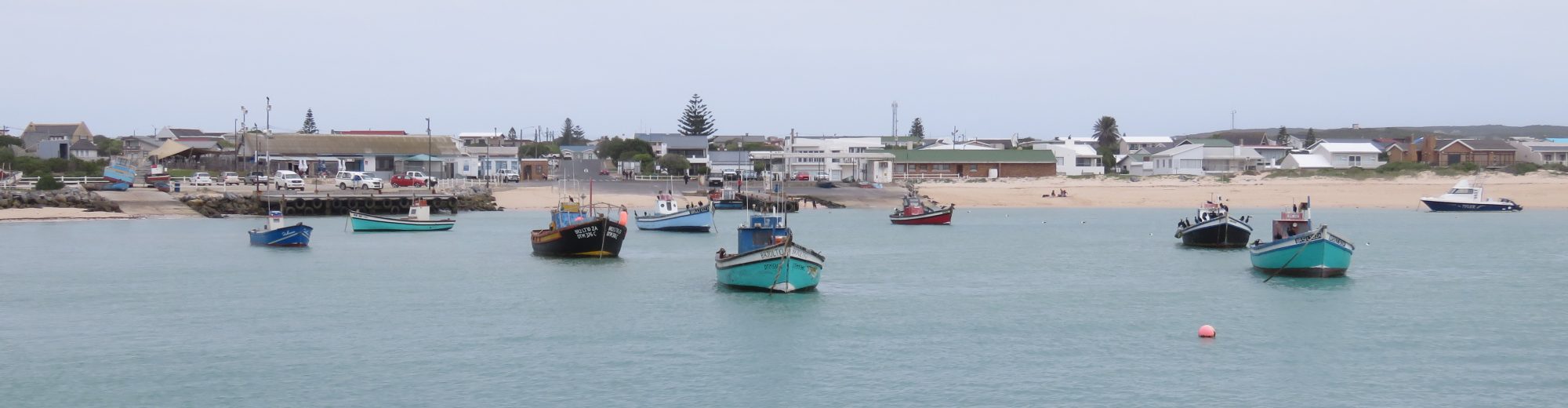
It certainly is a feeling. Every so often feelings of gratitude overcome me like when I look at our beautiful little harbour, walk along the long white sands of our beach, watch the sunset after a perfect day, and have a sushi supper at the harbour restaurant. I am so privileged to live in this beautiful safe little town at the southern tip of Africa. Priceless.

Sushi Supper
View from the restaurant

Adventures in Namibia by Guest Blogger Cathy Episode 8

Simanya River Lodge and n’Kwazi

In my last blog I spoke of our decision not to travel to Epupa due to the road conditions. Well, Ray and Alvan did make the trip and said that the first 100 kilometers of the road were okay but the last 60 or so kilometers were dreadful. The road was badly corrugated and not very nice to drive. In fact, most of the time taken to make the journey was spent in the last part.

They were thrilled with the views of the falls, and said it was very beautiful. The major downside was the heat. Alvan told me that it was unbearably hot and it did not cool down in the evenings. She said it only started to cool in the early hours of the morning so for the three nights they were there they hardly slept as it was so hot. Compounding the heat was a lack of electricity so their fan wasn’t much help!

These photos were taken by Ray Mandy during their visit to Epupa.

Ray outside the caravan at Epupa
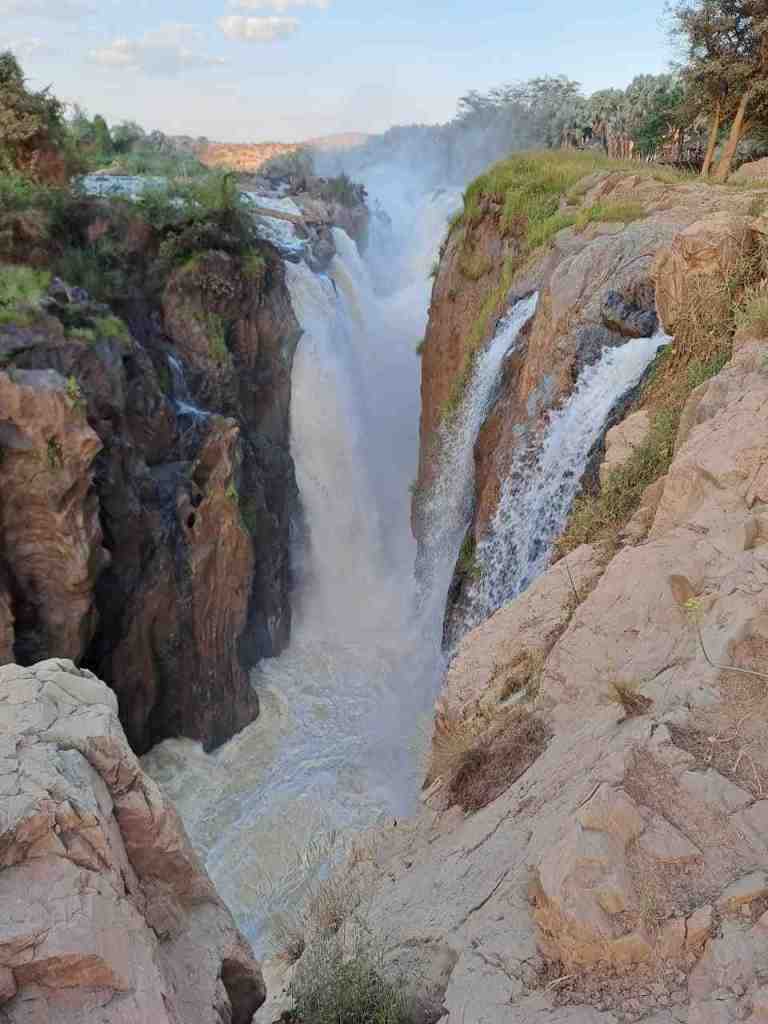
Epupa Falls
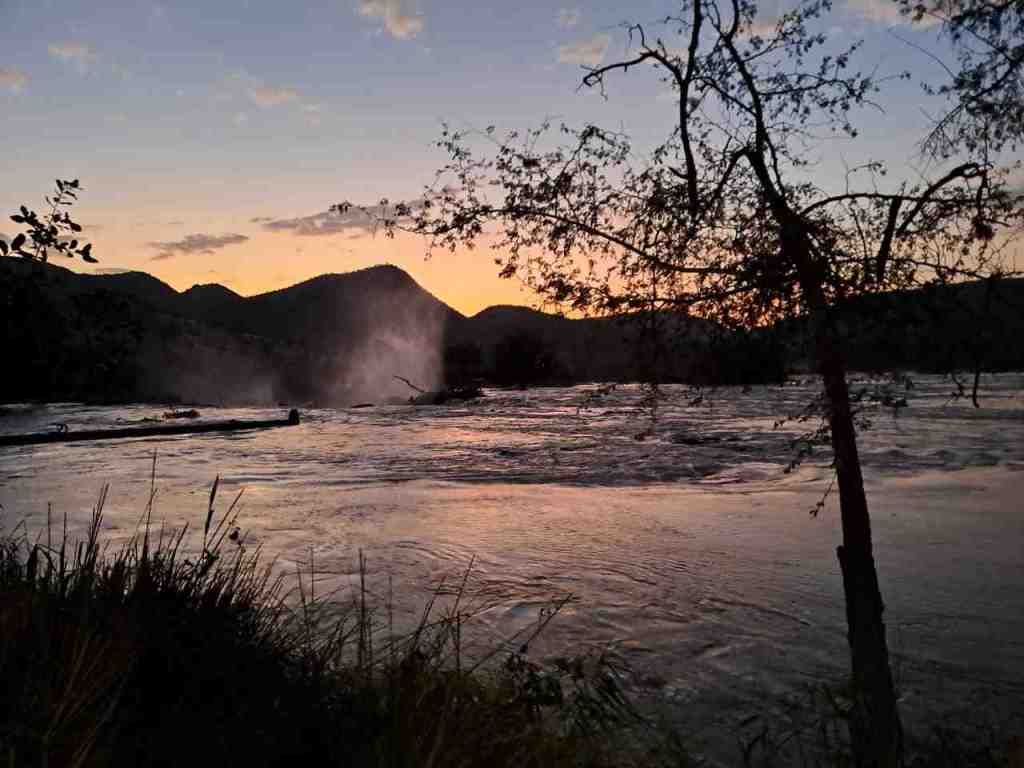
Sunset at Epupa

They did get a chance to take a very early morning walk with a bird guide, and saw some birds that they would not normally have been able to see.

For us, Epupa is back on the bucket list and we’ll see in a couple of years.

Driving around northern Namibia is an experience in itself. When we drove in Oupuwo we hit the first of hundreds of traffic calming devices or as we know them speed-bumps. Very few are clearly marked either by signs on the side of the road or painted road markings. It seems the authorities dare you to take them on, and you do so at your peril in many cases. The first one into Opuwo rattled our teeth and Lizzie leapt over it! After that we were much more circumspect but still misjudged many. Every town, village and settlement has more than its fair share of speed-bumps. We became adept at watching the cars coming towards us. If they bounced, we slowed down!

Accompanying them are the standard riffles, that warn you of something ahead. In Namibia, most often, it was a school. Most of these riffles were just a “rrrrrrrr” under the wheels but every now and again, the authorities threw us a curved ball and you came across one where the individual lines were around 3 or 4 inches deep so you had to go very slowly, otherwise you shook car and caravan to pieces.

Where there were no speed-bumps to keep you on your toes, the cows, goats, donkeys and occasional dog did their best to calm the traffic. The animals in Namibia’s north take their job seriously and often we would see them quite far off the road, but as we drew closer, they made a mad, suicidal dash to the tar to fulfill their traffic calming duties! Alec swears blind that the engine note of the Ford has mystical animal calling properties!

When we left Opuwo, after Ray and Alvan had gone to Epupa, we made our way to Ondangwa. The drive was exciting as I’ve described and we had made arrangements to stay at the Fantasia Guesthouse in Ondangwa, as they advertise campsites. On arriving the campsite was not very nice, just two dusty stands against the back wall of the property.

We spoke to Pieta Potgieter, the proprietor at Fantasia, and asked if we could rather have a room and park the caravan under the shade cloth outside the room. She was very happy to do so and we were soon settled into a very nice room, with Lizzie and the Ford safely parked in the shade.

The not so nice campsite at Fantasia
Lizzie and the Ford under cover
The lovely veranda at Fantasia

Fantasia was a nice place to stay with a restaurant on the premises where we enjoyed our supper. There is a lovely veranda where you can sit and chat to the other guests, while enjoying a drink and dinner. Breakfast was included in the tariff so next morning we enjoyed a breakfast before setting off for Simanya River Lodge.

Simanya River Lodge

Simanya River Lodge is on the banks of the Kunene River, approximately 140 kilometers west of Rundu. We arrived and were shown to a very pretty campsite. The story of this lodge is very sad. Apparently, it is owned by a wealthy Namibian family and the lodge was the pet project of the lady of the house. She started her project by building the campsite, and it is clear that no expense was spared. The sites each have their own ablutions, a concrete slab covered with shade cloth and an attractive grassed area, bordered with a garden. She then built the lodge, swimming pool and chalets. Sadly, she passed away before completing the project, and though all the furniture is there, the lodge was never opened. With her death, her husband froze all further development and he has now put the lodge on the market.

The very pretty sites at Simanya

 Sadly, these sites were not designed with caravans in mind, as it was impossible to get a van onto the concrete slab as there was a step of a good couple of inches. No problem, there was lots of shade so we parked Lizzie on the grass and settled in to enjoy a few days downtime.

The swimming pool at the lodge is magnificent. It is an infinity pool that overlooks the Kunene. It’s just the place to lie on a hot evening, sipping a cool drink, gazing at the river, listening to the hippos grunting while the sky is painted in pinks and golds. Sometimes, it’s just so tough to live in Africa!

The beautiful infinity pool at Simanya. The right-hand bank is in Angola.

Being at Simanya gave us some time to clear up some housekeeping issues and try to get rid of some of the dust in the back of the Ford. Alec pulled most of the stuff out so it could be dusted down but it will still need a thorough clean when we get home. Namibia has some tenacious dust – it hangs on and doesn’t let go easily!

Alec’s house-keeping efforts!

Leaving Simanya, we moved on through Rundu to our new home n’Kwazi Lodge about 15 kilometers east of Rundu, where we were to meet Alvan and Ray again.

While going through Rundu we took the opportunity to do a little shopping. We had been advised to go to the Woermann Brock Supermarket. That was excellent advice as this was a great place to shop with everything under one roof.

Before going into the supermarket, we stopped at a Shell garage opposite, for fuel. While cleaning the driver’s window, one of the attendants noticed the rear-view camera that Alec had installed on Lizzie. The camera is combined with a small screen for the driver and it works all the time so its useful to see what’s coming up behind as well as for reversing. The attendant was amazed to see one of his friends walking behind the van, and soon we were surrounded by attendants all wanting to see a friend on the camera!

We continued to n’Kwazi, which is on the banks of the Okavango River. We were following the GPS and when it told us to turn, we both looked dubious as the road looked little more than a track. We saw a little, faded sign that said n’Kwazi, so we turned and followed a track through a few homesteads until be arrived at a gate. Going through we found we had arrived at the right place, a lovely grassed, shady campsite where we had the pick of the sites. The ablutions are, I guess the word is rustic, but perhaps a little more rustic than just rustic, with half reed walls, wasps , frogs and very fat geckos as bathing companions! Our adventure continues….

Ray and Alvan arrived and it was great to catch up again with what they had been doing. After supper we all fell into bed, only to be awakened in the middle of the night by a frantic thunderstorm. Lightning flashed and the thunder was deafening but there wasn’t too much rain. Early in the morning I visited the loo, and coming back was amazed to see a magnificent starry sky – it was stunning. That lovely sky was soon enveloped in cloud again and another thunderstorm broke around six in the morning with drizzle on and off for the next few hours. No problem, bed and a book were my companions with a lovely cup of coffee made by my ever-patient, but slightly damp, hubby.

The weather cleared later in the morning and the dreaded laundry raised its ugly head, so that was a chore to be completed. After that we went for a walk to look for birds. There are lots of birds around but with the thick vegetation and tall trees it was impossible to get good photos. We enjoyed our walk and ended by sitting enjoying the view of the river, as the sun slowly set.

The campsite at nKwazi
Alec enjoying the view over the Okavango
The Okavango, with Angola on the right bank
Contemplation!
Our last sunset at nKwazi

Tomorrow we are off once again to Mukolo Camp in Kongola. Hopefully there is WIFI so I can get this off to Helen. Take care everyone..

 ,

Share Your World Monday 15 May 2023

Here are my answers to this week’s questions from pensitivity101

Children aside, do you celebrate your birthday/anniversary or is it just a normal day for you?

I usually do something special on my birthday. If we’re at home I might invite a few friends over for a meal. Gifts are not necessary but some insist on bringing something small which is nice. It’s the thought that counts.

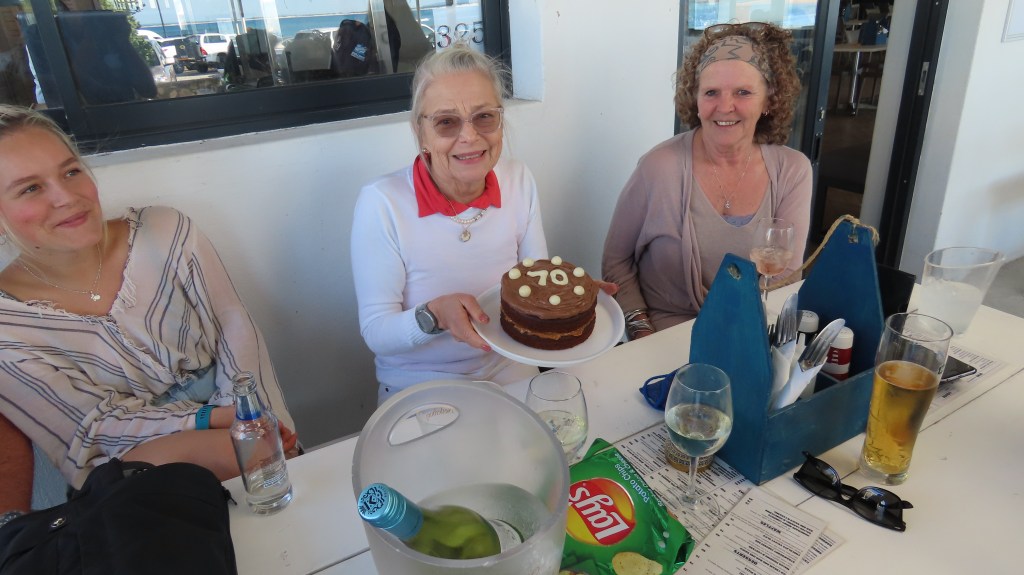
I’ve already written about my surprise celebration for my 70th which fortunately happened a month earlier than the actual date. On the ‘real’ day, I was still recovering from a short stay in hospital. I had inteneded to have some people round but instead asked them to drinks at the harbour. One of my friend’s organised a surprise cake. It is lovely to be celebrated on your birthday!

Do/did you always give your child a birthday party when they were young?

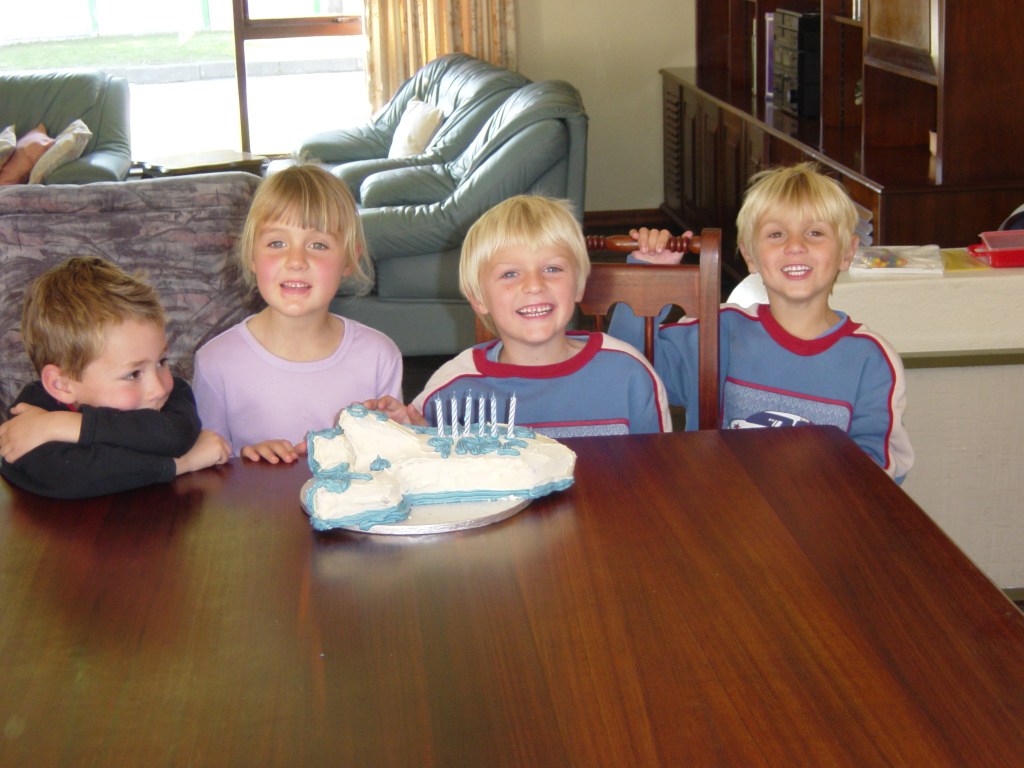
Absolutely. It’s the highlight of a child’s year. With my own I would make a special cake. Later, when helping raise grandchildren we would get somebody to do a cake in a shape the boys’ requested.

Grandson, Jay’s Sixth Birthday – with his brother right and two of the party guests left

If your child was born on Christmas Day (or a few days either side of the 25th), did they have a ‘half birthday’ in June, two presents/celebrations, or something else?

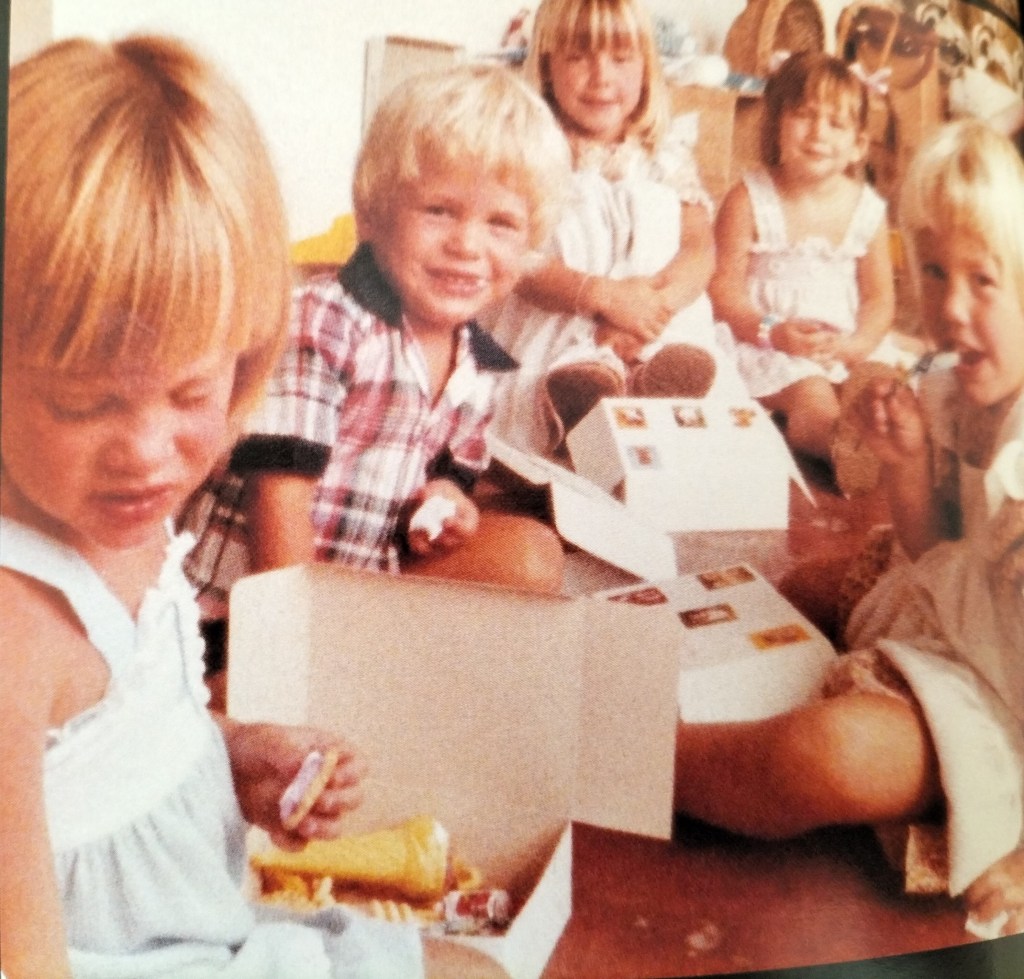
No, we did not do a half-year celebration for our 29-December baby. Before she started school we had a party on the day and invited cousins and friends who had not gone away for the holidays. When she started school, we threw a big party inviting all the kids in her class on the last day of term, before everybody had holiday plans. It is summer in December in South Africa so it was usually a pool party.

Laurie’s second birthday She is fourth from the left – 29 December 1981 – Birthday Boxes packed with party snacks were the thing

As far as the gifts went, she received one for Christmas and one for her birthday when she was small. So December was a mega month for her. As she grew older she would sometimes request an expensive combined gift which she would receive on Christmas day. We would still give an inexpensive one on her birthday.

November and December are full of birthdays in our family. Among our children and grandchildren, we have 16, 22, 30 November and 22 and 29 December. Among my siblings we have 22 and 25 November and 6 December. The fourth one is a month later than Christmas so it was still a hectic three months for my parents! Then there are several cousins in November too!

Would you prefer to give your child a party, or take them and a few friends on a special outing?

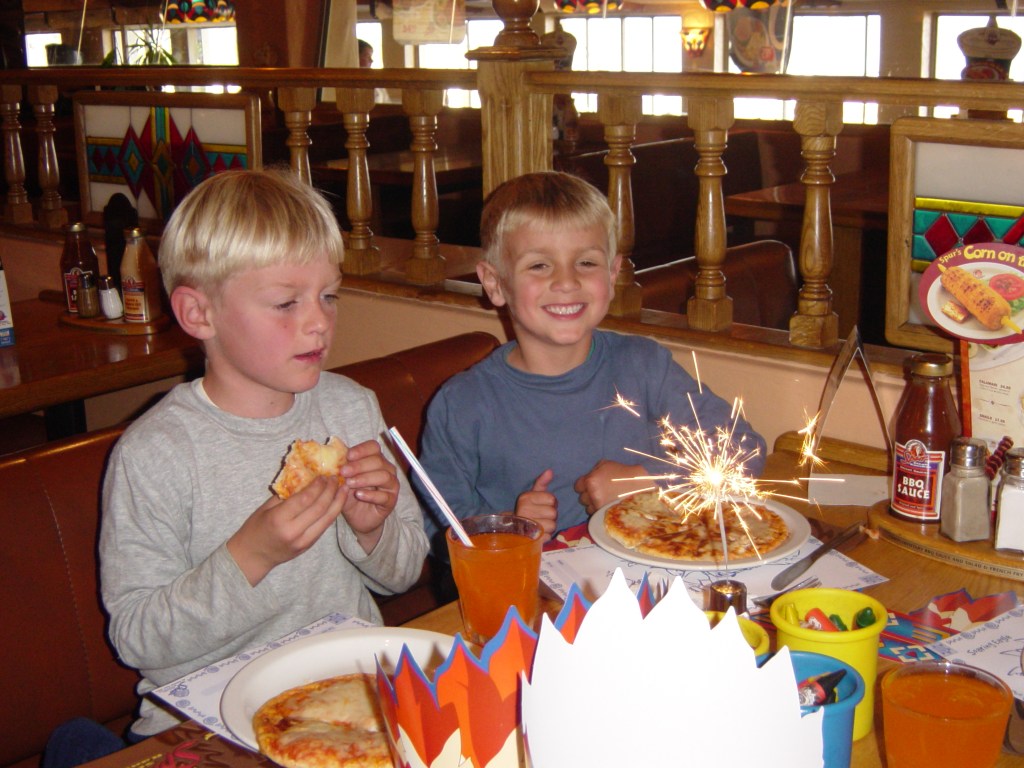
When we were helping our daughter raise her two boys we did a mix of the two. When they were very small we had birthday parties. In primary school, they could choose to take a few friends to a child-friendly restaurant like MacDonalds or Spur. The staff of these establishments would do something special like sing a birthday song and bring a sparkler instead of candles.

Joshua’s sixth birthday at Spur

Gratitude
A child’s laughter is infectious, contagious and a bringer of memories to those of us in our twilight years.

I am hugely grateful for all the little ones in my life. They have always made me laugh. My grandchildren are grown now but they can still get me to crack up laughing.

Adventures in Namibia Episode 7 by Guest Blogger Cathy

Etosha

We left Twyfelfontein and viewed the gravel road leading to Khorixas with some trepidation. Our experiences with the roads in the area for the past couple of days had been so bad that we were expecting the worst. Fortunately, our fears were largely unfounded. The C39 to Khorixas started out with a good road surface and it was only the last 20 or so kilometers of gravel that was not good.

We drove through Khorixas, revelling in the tarred surface, and made our way to Outjo We filled up with fuel and then were lucky enough to find parking near the Outjo Spar. What a great shop this was and a fantastic place to stock up with food for our trip to Etosha.

Opposite the Spar, you can find The Outjo Bakkery Now this is a must-stop if you are in the area. They serve the most delicious coffee and decadent apple crumble and apple strudel.  The apple crumble and strudel far outstripped the famous apple treats to be found in Solitaire!

With full larders again we set off for Etosha. Before entering at the Anderson Gate, we stopped at the Gondwana Etosha Safari Park, where we were to stay for a couple of days after leaving Okaukuejo. We had made arrangements to leave any meat, which we would not consume while in Etosha, with them. The exit regulations at the Anderson Gate are very strict and any meat from cloven hoof animals is confiscated as this is the veterinary line.

We entered the park and drove the 17 kilometers to Okaukuejo, where we were to spend our first couple of days. Okaukuejo is the administrative centre for the park and as a result, is fantastically busy. We checked in, paid our conservation fees, and slowly made our way to the campsite. As you can imagine, this campsite is huge and we had been allocated a site with absolutely no shade. The whole campsite at Okaukeujo has few sites with good shade, but when we saw our site, we approached the camp guard and he moved us to an alternate site with a little shade.

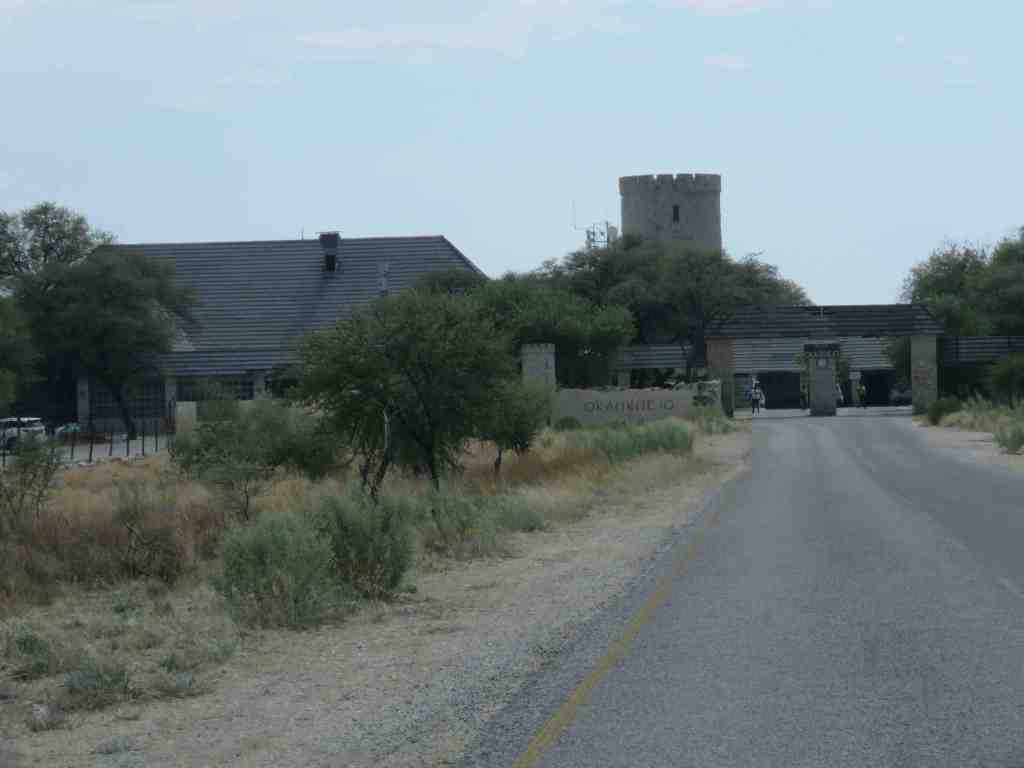
Okaukuejo Camp gate

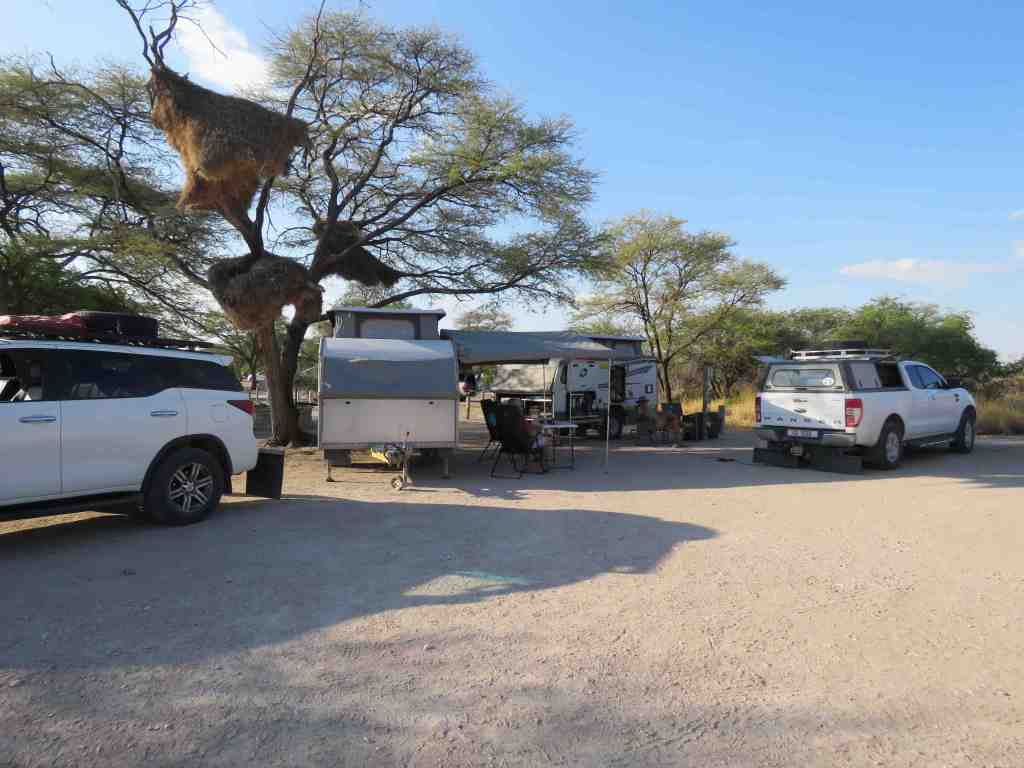
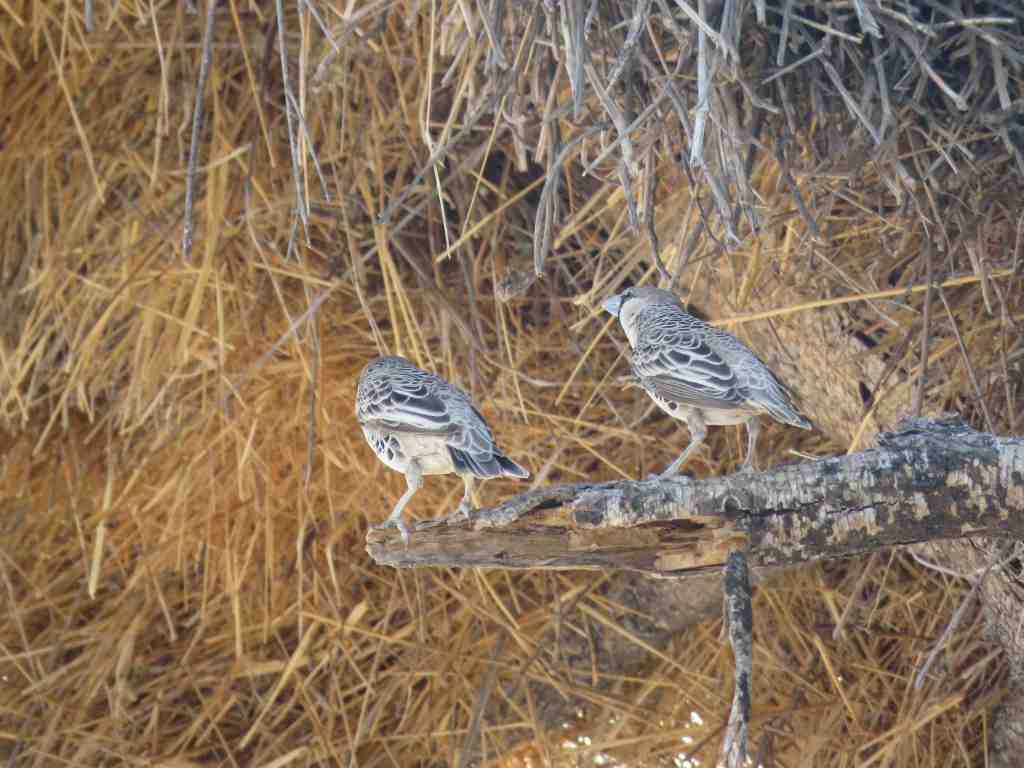
We set up camp and the temperature was soaring into the high 30s again. We sat for a while, recovering our breath and watching the antics of the Sociable Weavers that were nesting in the tree that provided our shade. The antics of these little birds provided a lot of entertainment.

Two Geckos get friendly with the Sociable Weavers
Two Sociable Weavers discuss alterations to the nest

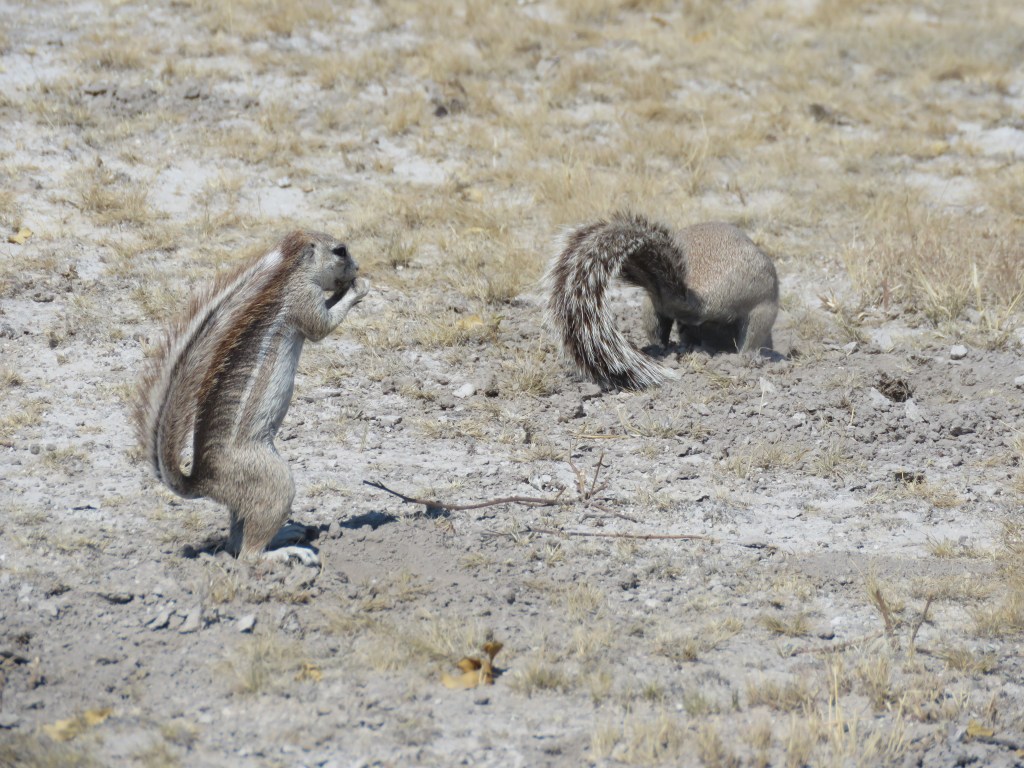
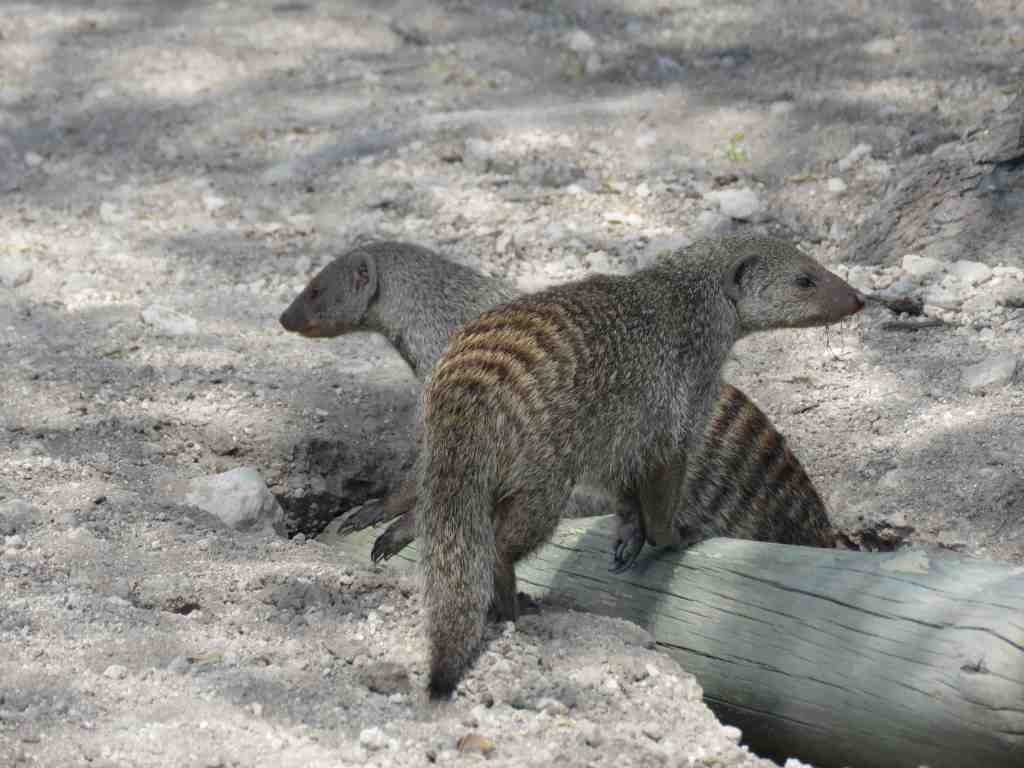
We were quickly invaded by these two little critters. The squirrels and banded mongoose have become very accomplished beggars and made the rounds of the cam making sure to visit every vehicle in the hopes of getting some nibbles!

Ground Squirrels – beggars #1
Banded Mongoose – beggars #2

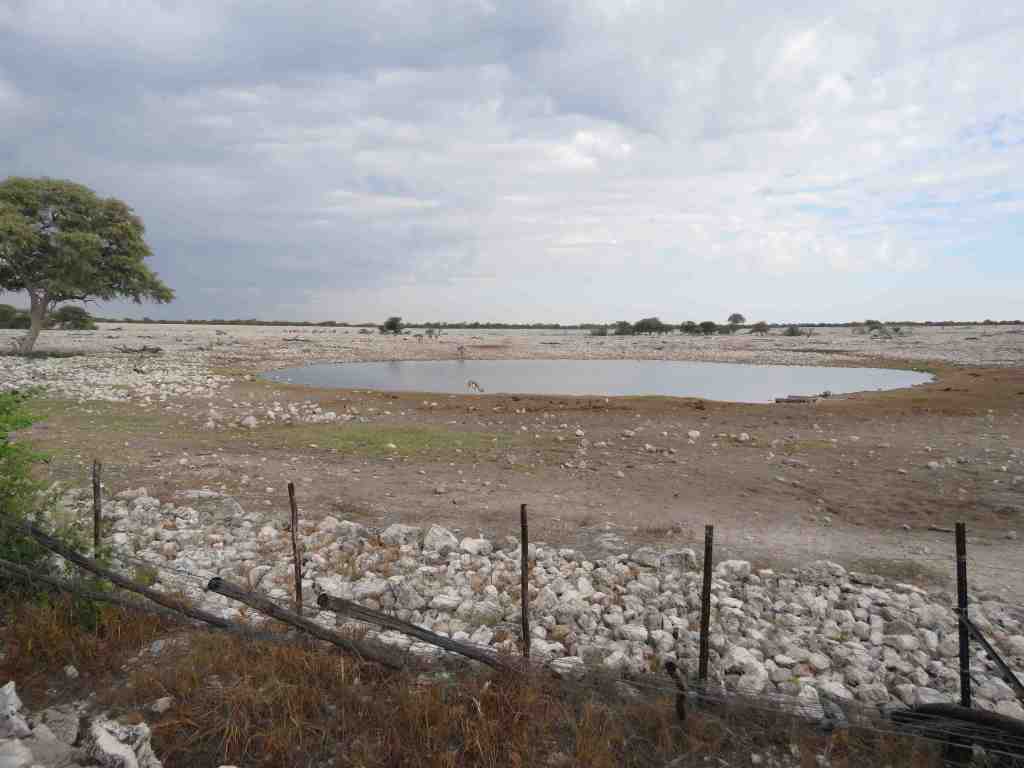
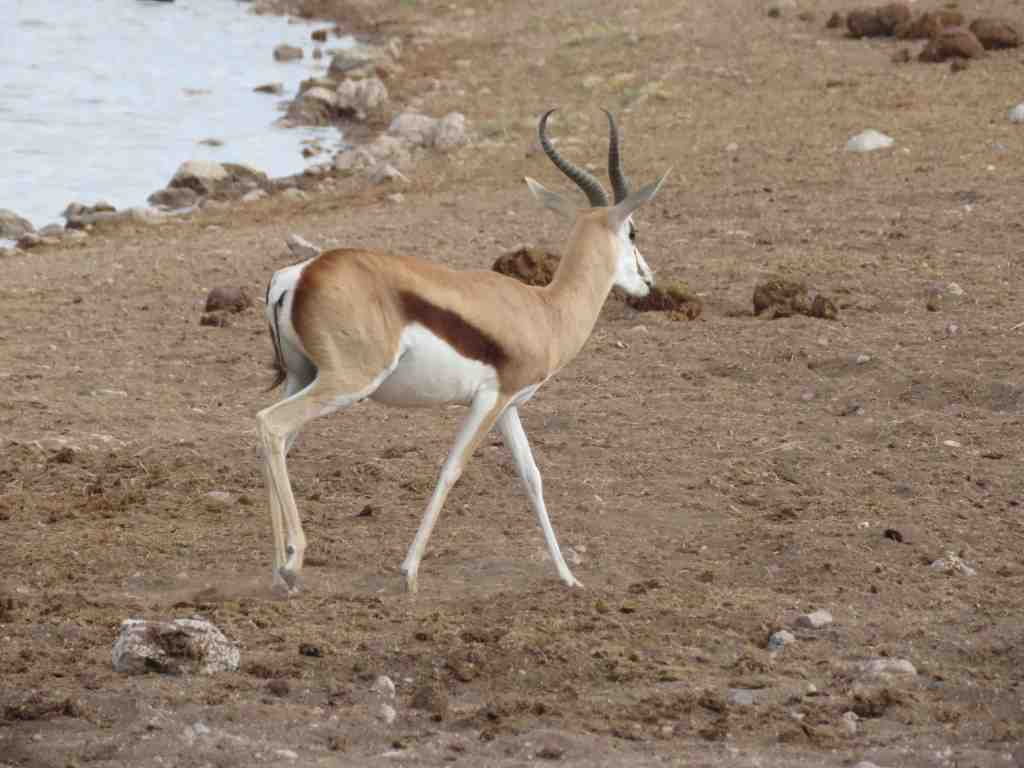
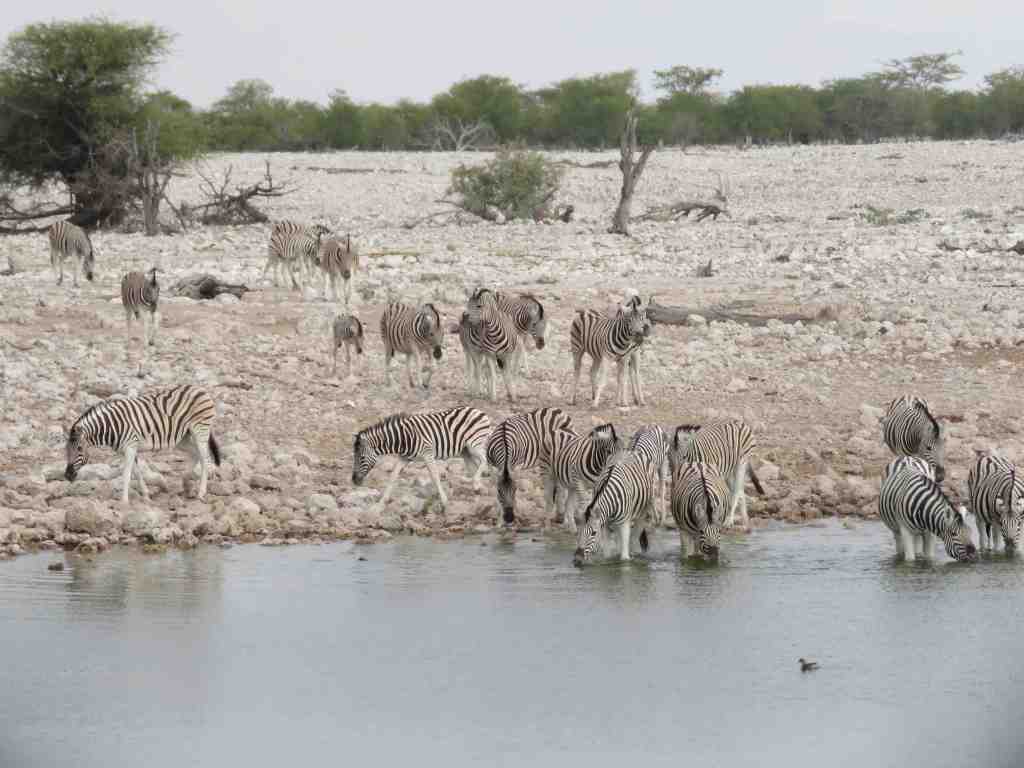
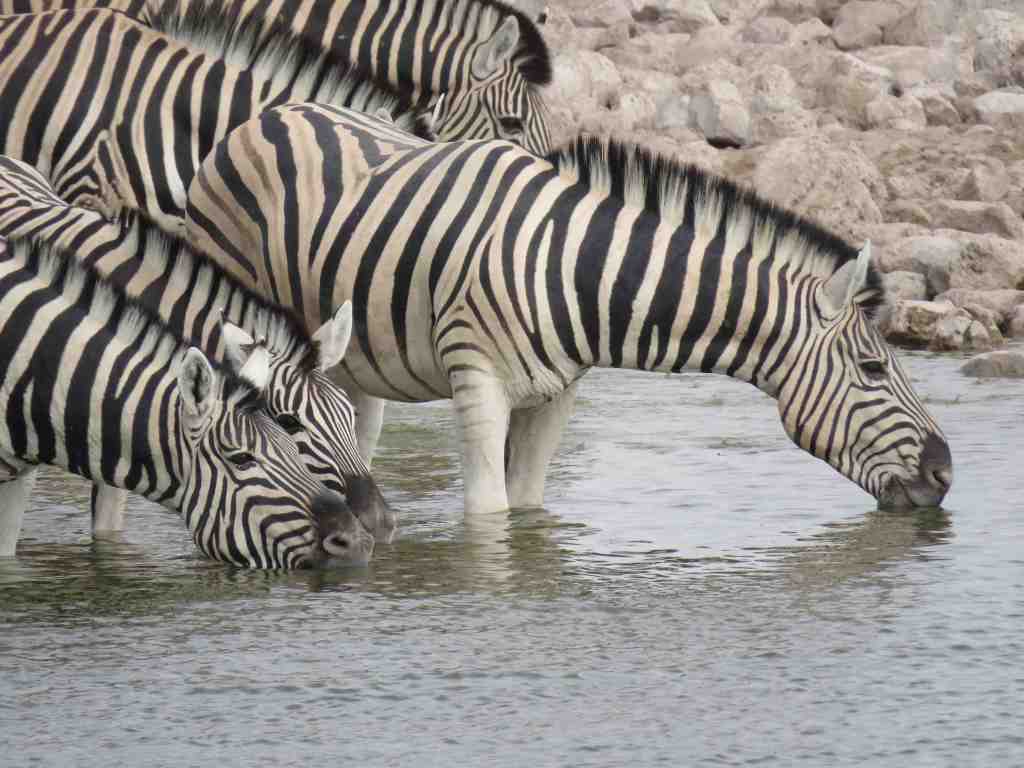
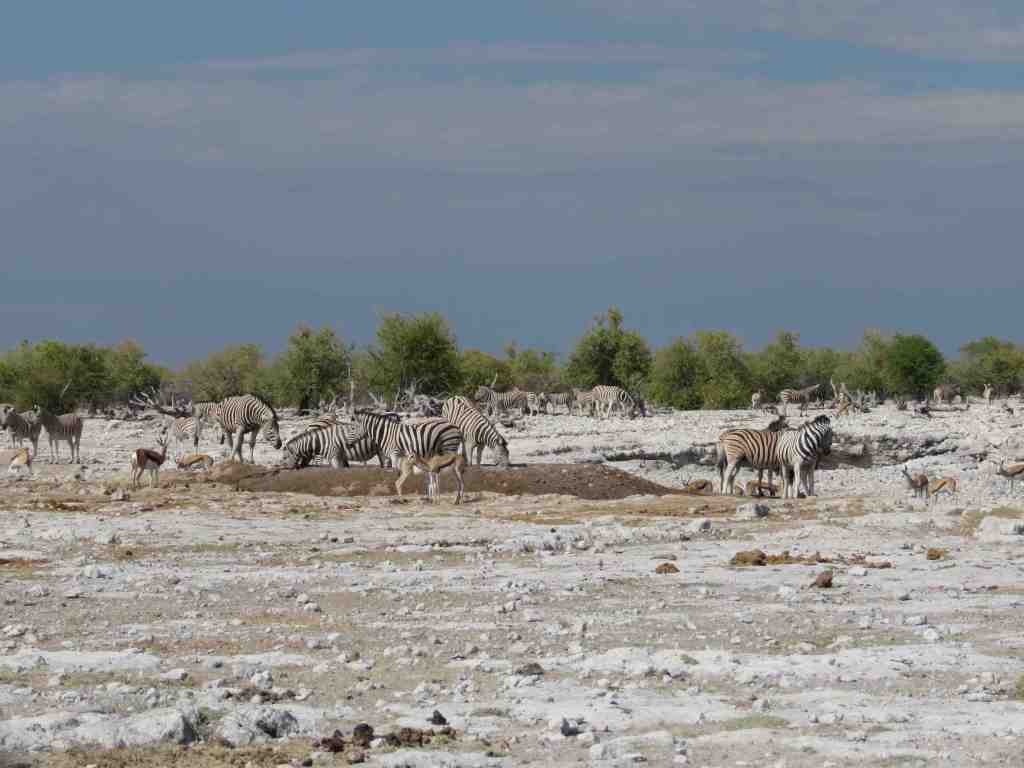
Later in the afternoon Ray and Alvan chose to take an afternoon drive, while Alec and I chose to sit and enjoy the waterhole at the camp. There were the ubiquitous springbok which we saw everywhere – but they are so dainty and gorgeous that seeing them every few minutes was still a pleasure. Then a lovely herd of zebra came down. They made a fantastic sight against the white background at the waterhole. It was a pleasure to sit comfortably and watch them come down to drink. Viewing wildlife has got to be one of the best past times there are!

The waterhole at Okaukuejo
Springbok were everywhere, but this chap refused to look at me
Zebra arrive at the waterhole to drink
Zebra drinking
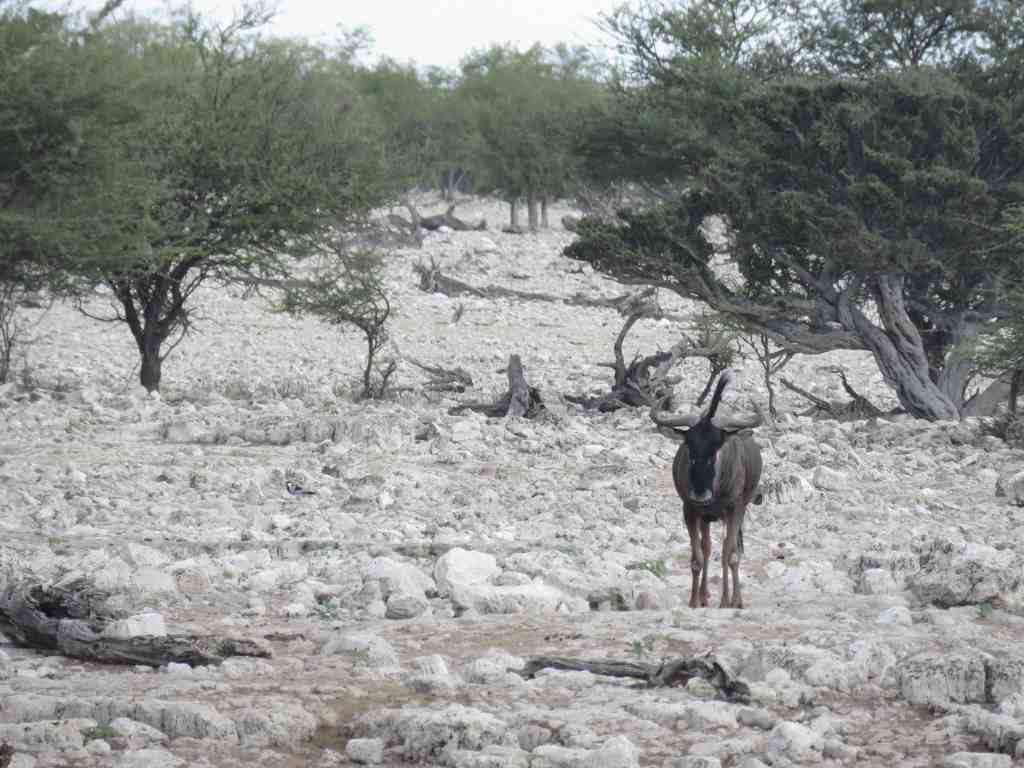
A lone Wildebeest also paid us a visit

Before we had gone to sit by the waterhole, Alec mentioned that the campsite seemed rather empty but we thought nothing of it. Coming back from the waterhole in the early evening we were astounded at the change in the camp. Swarms of hire vehicles with rooftop tents had descended on the camp and the place was packed. We could only stand and gape at the difference, and we found that this seemed to be the way things worked. Each day the camp emptied and in the early evening, the droves arrived again and the place went mad! It was just too busy for us, and we looked forward to being able to move somewhere quieter.

The first evening we decided to give ourselves a treat and eat out at the restaurant.  Very fortunately we had booked a table as the restaurant was absolutely packed. Unfortunately, the service suffered and the poor serving staff was rushed off their feet. Very rarely did one hear English or Afrikaans spoken; it was mostly French, Dutch and German.

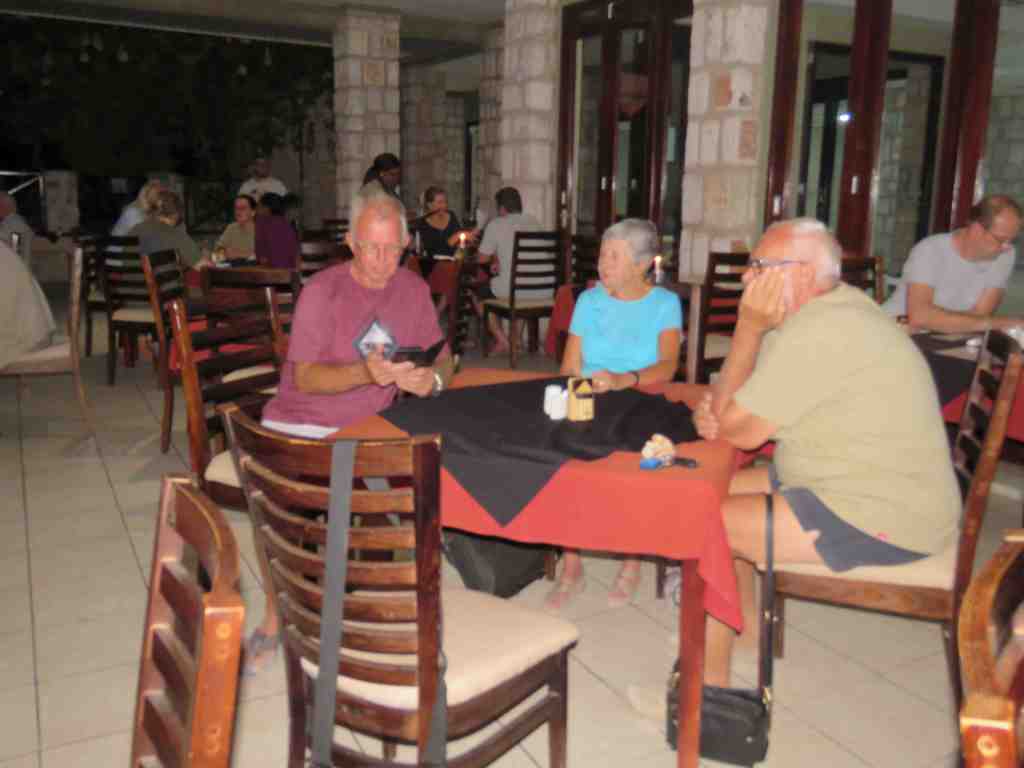
Alec, Ray and Alvan enjoying the restaurant at Okaukuejo

We also tried the WIFI but there were just so many people all trying to use the same bandwidth that getting connected was a very hit-and-miss affair. Alvan connected her phone but Ray and I just couldn’t get a look in anywhere. Eventually, we gave up and trotted off to our camp. After a quick shower, we fell asleep to the accompaniment of the jackals shrieking in the distance.

The next morning it was off to explore the park and find a nice waterhole to enjoy. With the heat still being felt by late morning, it was pointless trying to drive around as there was nothing to see. We chose our waterhole and watched the zebra, springbok, gemsbok, kudu and wildebeest come to drink. After a while, the heat drove us back to camp.

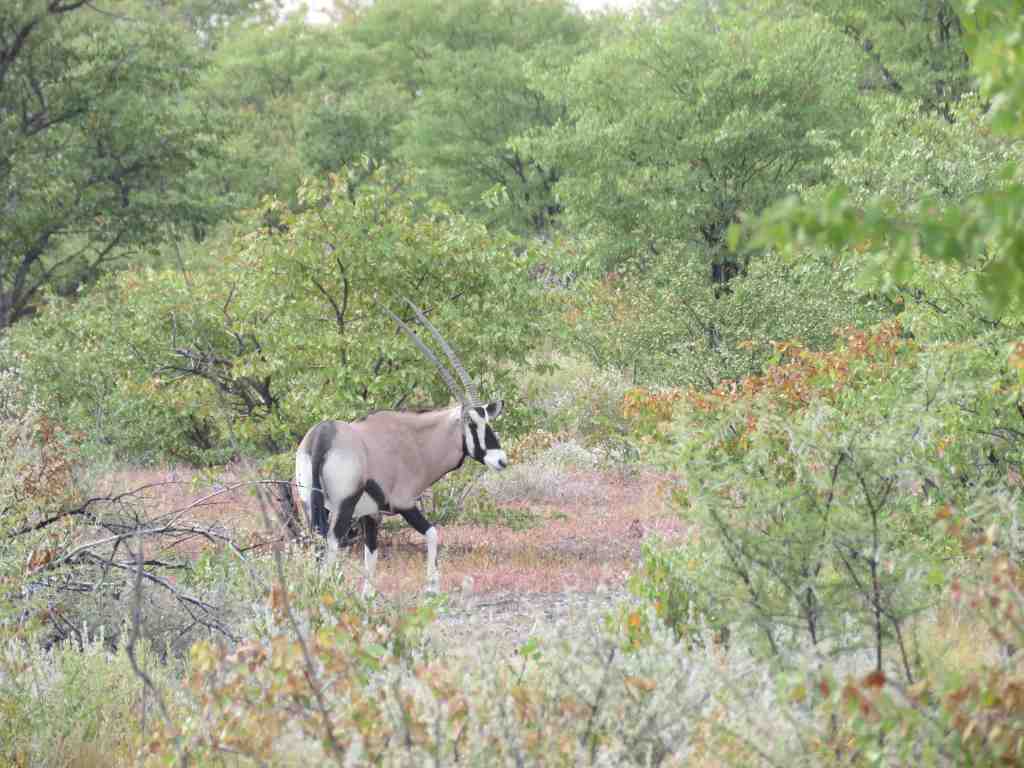
Handsome gemsbok but why do I always get the rear or tourist view?
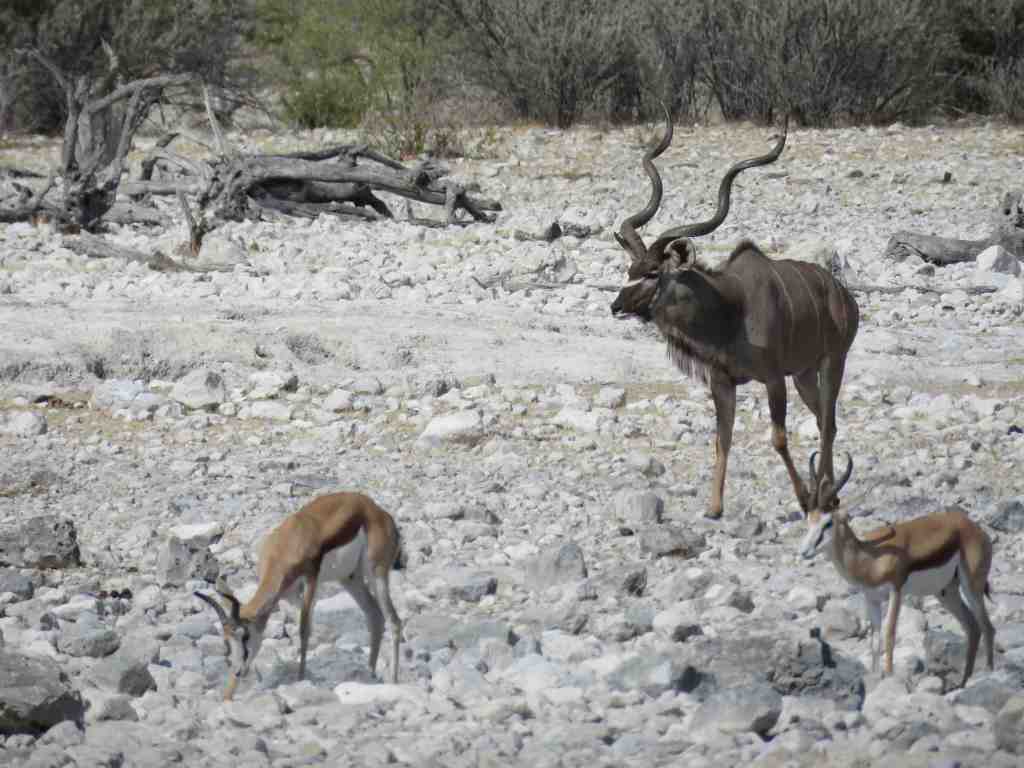
A magnificent kudu bull strides arrogantly past the springbok
Needless to say the zebra were there too

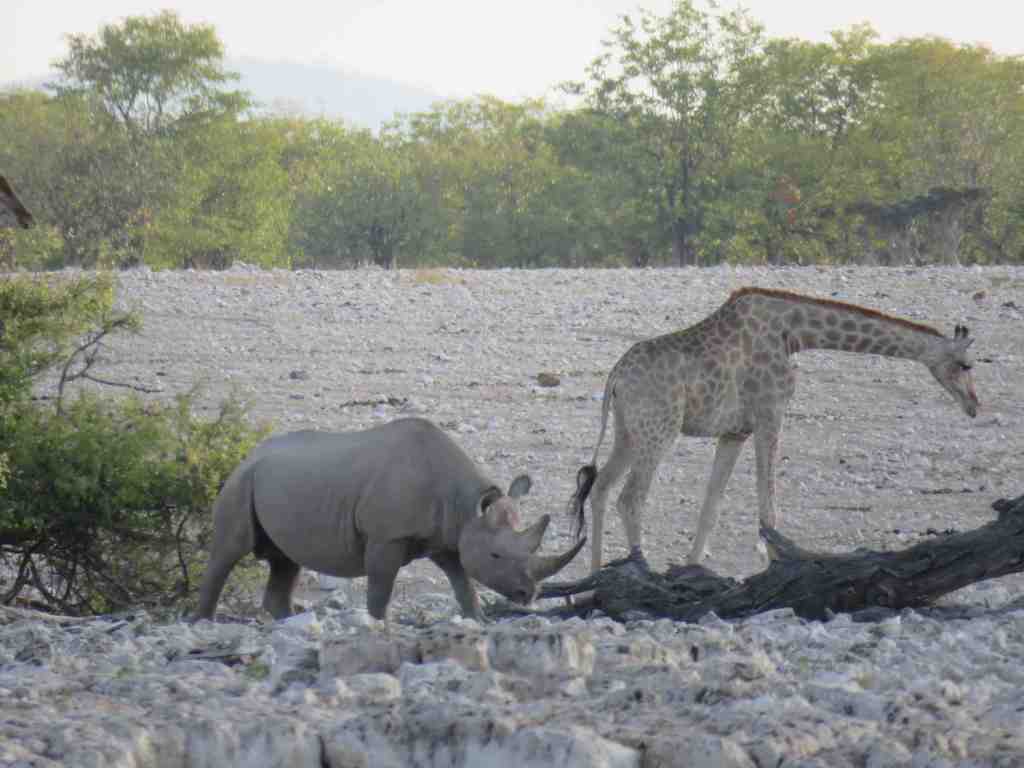
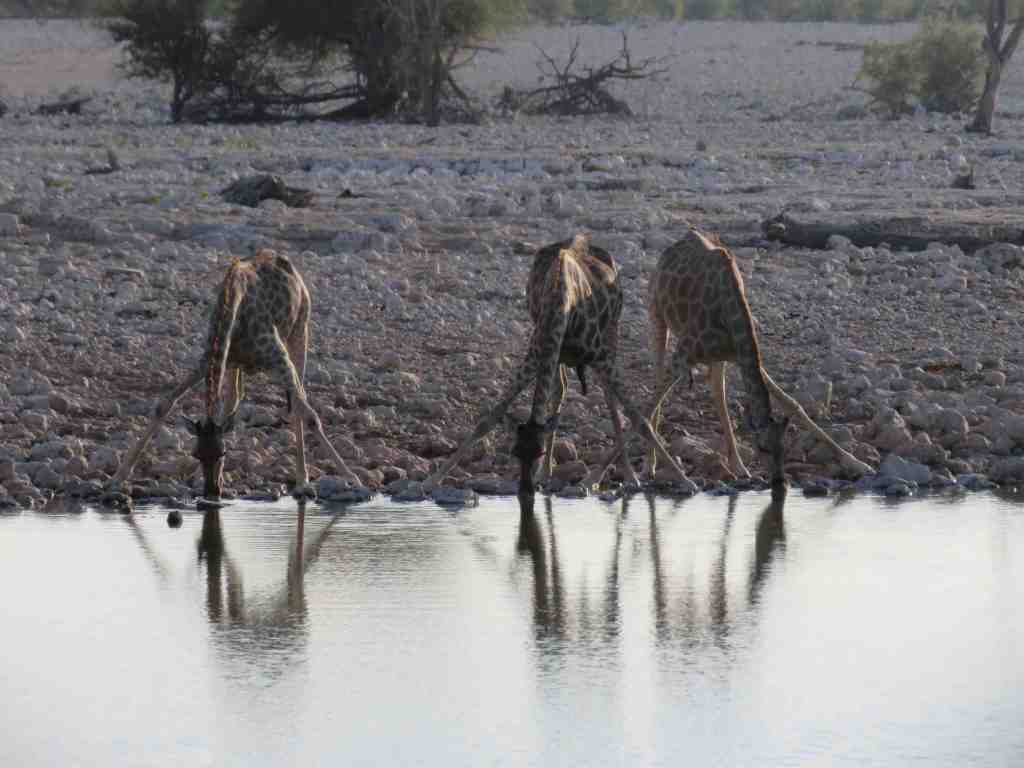
We again visited the waterhole in the afternoon and we were lucky enough to have a Black Rhino come to drink with five giraffe.

Lovely to see a Black Rhino with its horn
Giraffe drinking

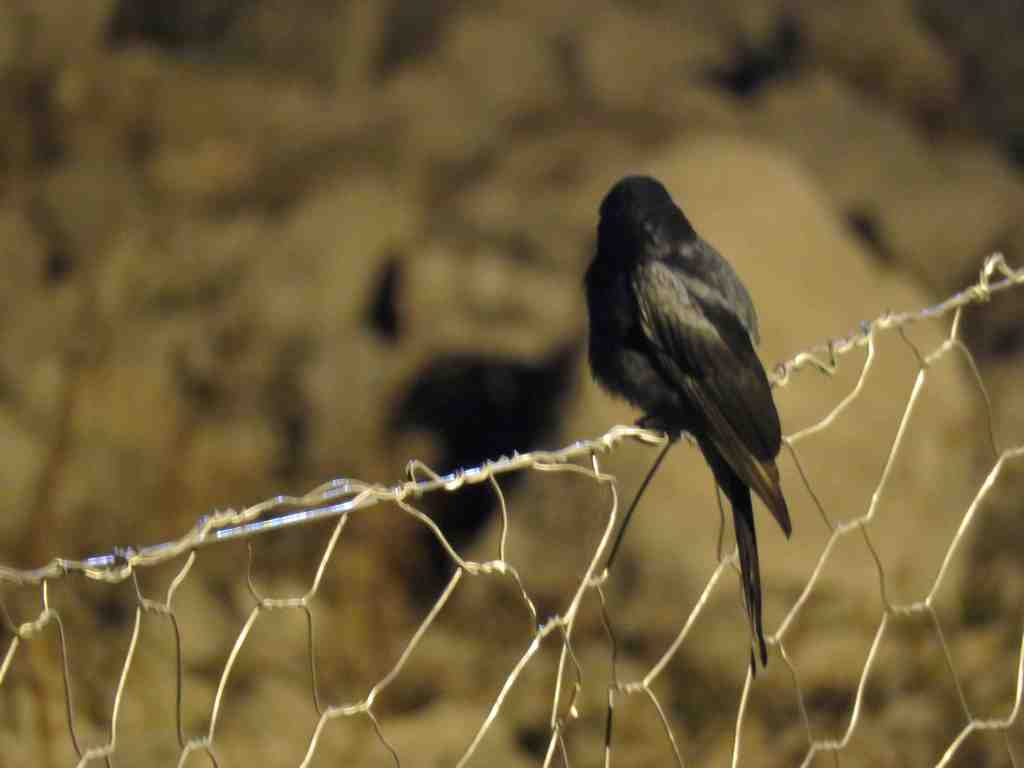
After supper, we spent more time at the waterhole enjoying the cool evening and the floodlit water. I was surprised to see a Fork-Tailed Drongo hawking for insects in the light. He should have been tucked up in bed by that time, but had learned that he could catch insects in the light of the waterhole.

This Fork-Tailed Drongo has learned to hawk for insects in the lights

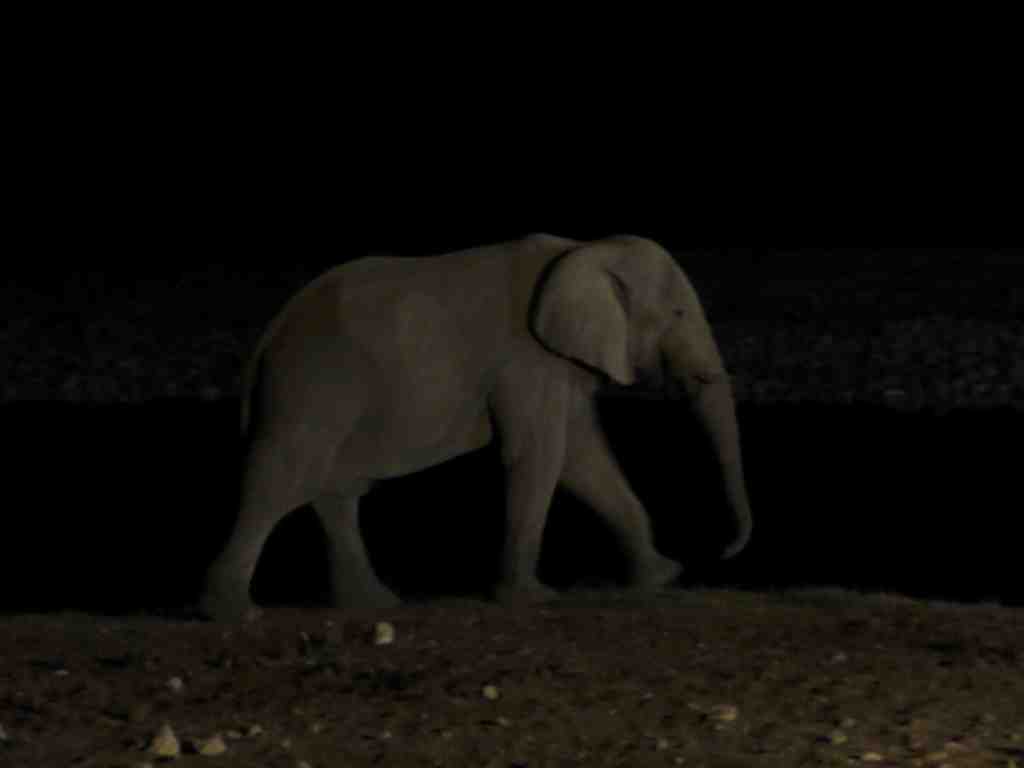
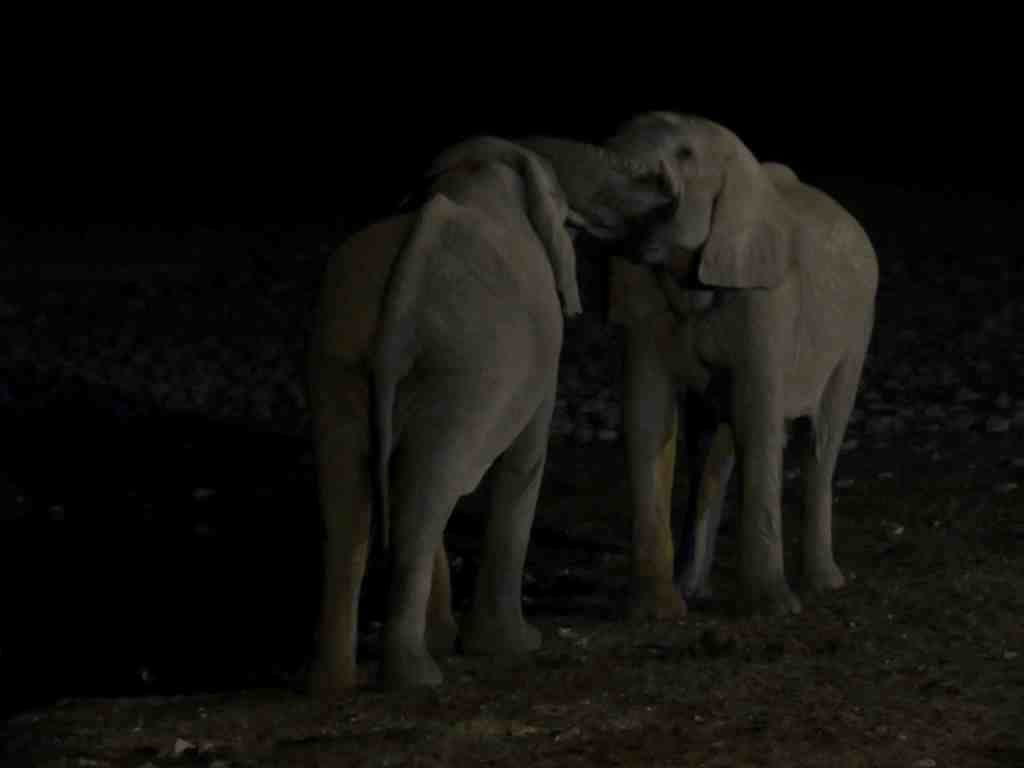
We sat quietly listening to the night sounds when faintly we heard footsteps and the pebbles crunching as something approached. Out of the darkness appeared a large elephant bull. With his white coat of dust, he appeared as a ghost, and he slowly made his way around the pool to the place he wanted to drink. Majestic! Five black rhino also appeared and kept to the far side of the pool, when another elephant bull slowly appeared in the light. It was a pleasure to sit and watch the interaction between the bulls.

He slowly appeared, like a ghost
The two bulls knew each other and greeted each other enthusiastically

Bed was calling and we had to pack up as we were to leave for the Safari Lodge the next day.

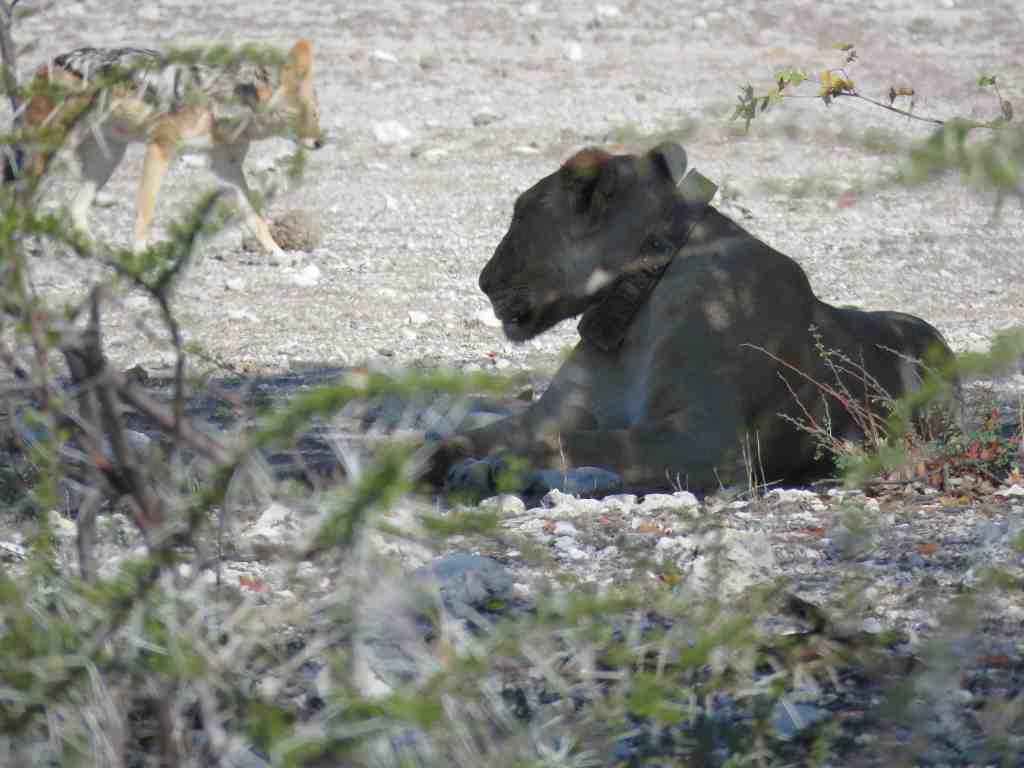
On our way out to the Safari Lodge, we came across a couple of cars parked on the side of the road. They showed us where there were lions, who had killed a giraffe the night before. Needless to say, the lions were mostly lying fast asleep but we did manage to get one quick shot of one of the lionesses. Continuing on we stopped at a waterhole to enjoy the zebra and springbok.

This lioness haughtily eyeing the pesky jackals

On leaving Anderson Gate you are searched for meat. This is a Veterinary Control Point and you are asked to sign a declaration that you do not have any meat from cloven hoof animals (beef, goat, lamb etc). You have to open your fridge and freezer, and the inspectors examine everything that is in there, removing anything that contravenes the regulations. As were aware of this we had nothing confiscated as our meat was safely in the freezer at the Safari Lodge.

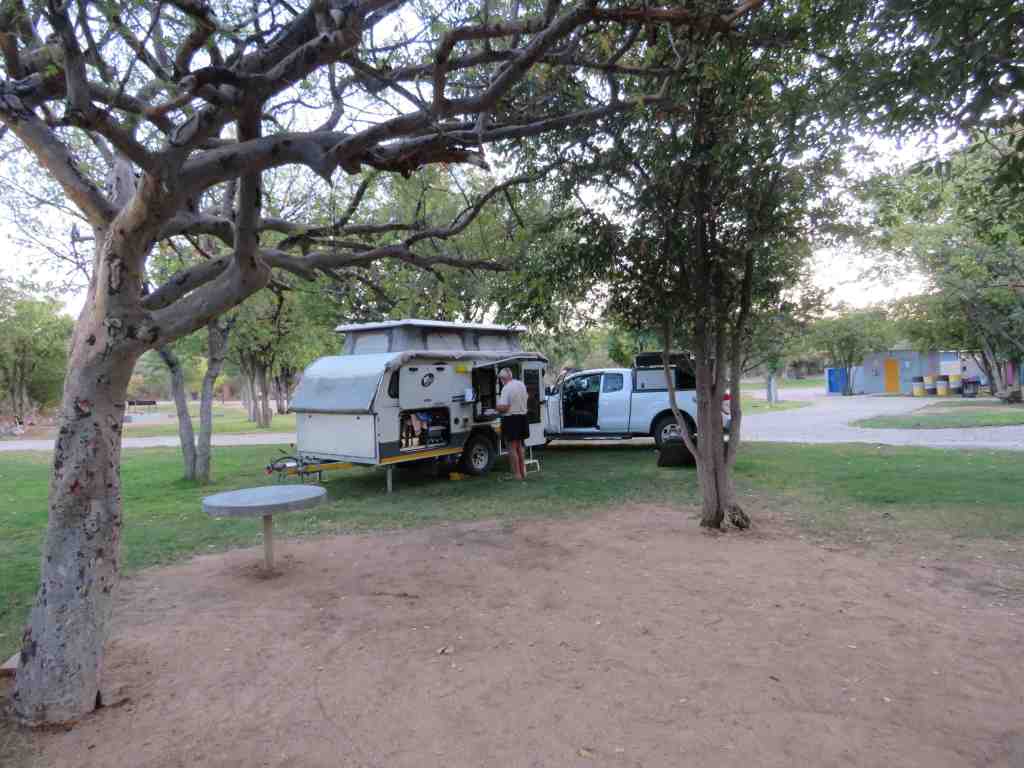
The camp at the Safari Lodge (12km from Anderson Gate) was a great change; there was grass and lots of trees! We set up camp and simply reveled in walking barefoot on the grass. There were lots of lovely birds to keep us occupied.

Our camp at the Etosha Safari Park
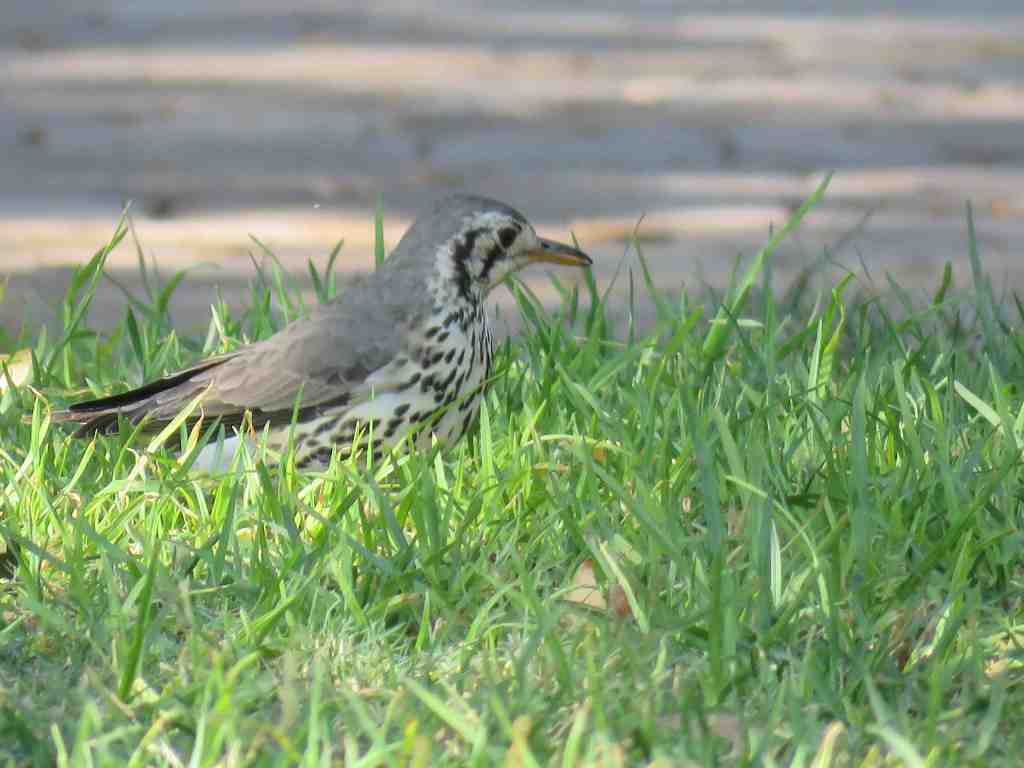
Groundscraper Thrush
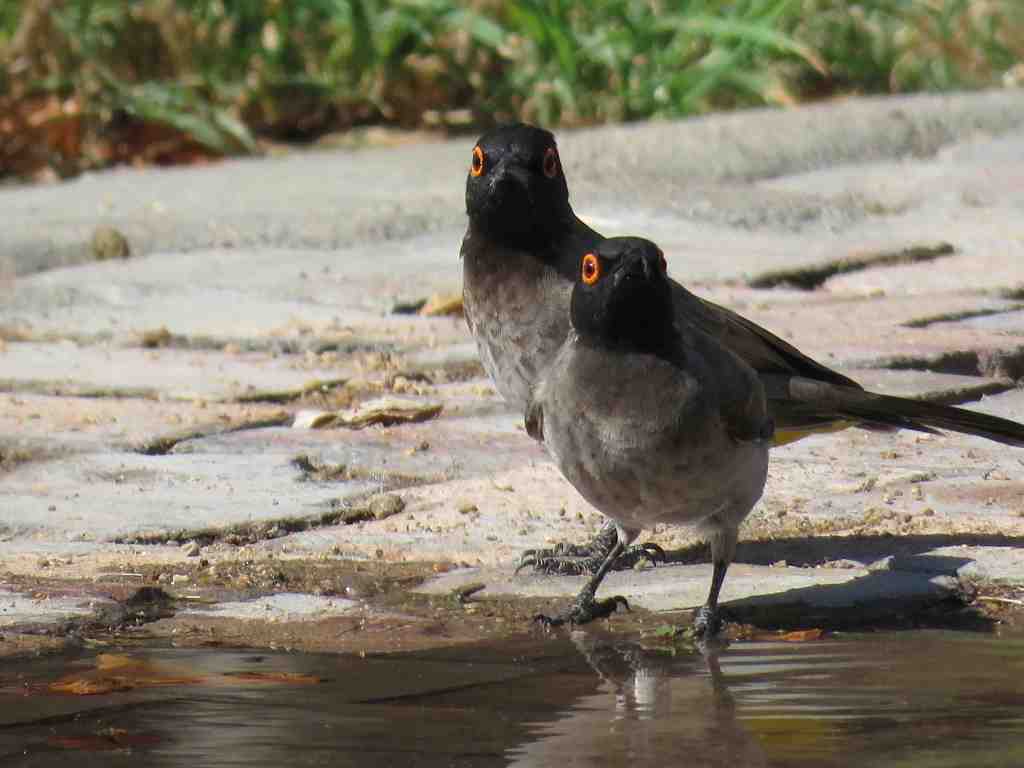
African Red-eyed Bulbul

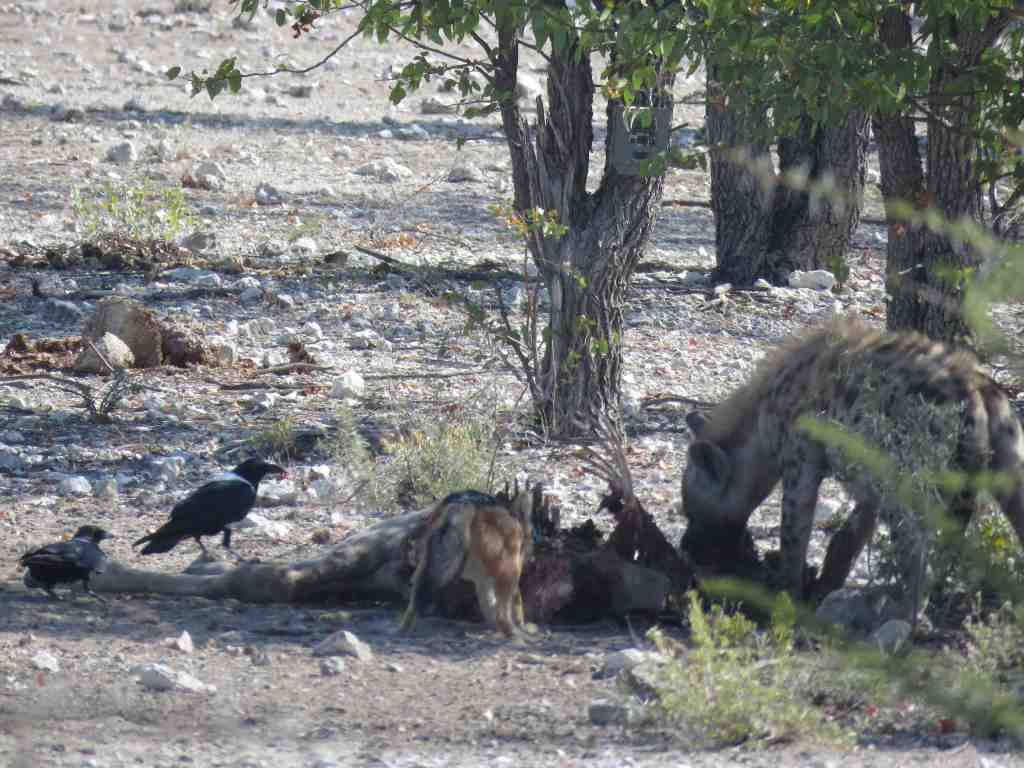
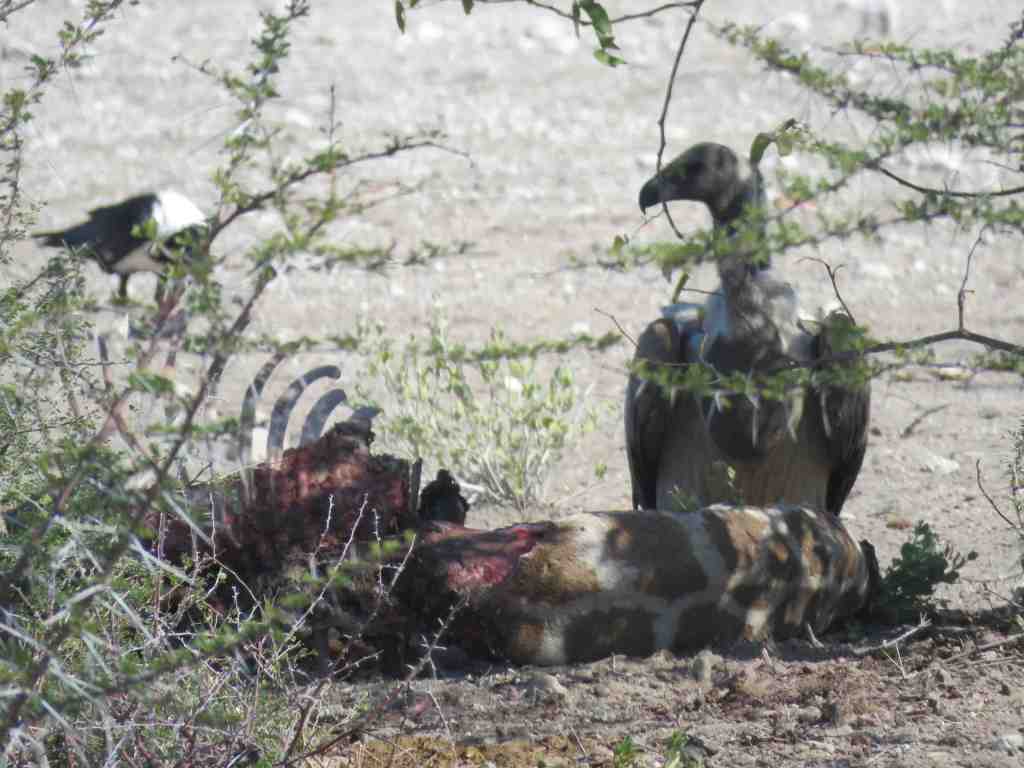
The next day we drove back to the Park and came across the lion kill again. Now the lions had departed and there was a Spotted Hyena, Jackals, and Vultures enjoying the scraps that were left.

Spotted Hyena and Black-Backed Jackal searching for scraps
White-backed Vultures were also in attendance

We went on to enjoy a lovely game drive toward Halali. Again we saw the usual suspects such as springbok, gemsbok, zebra and wildebeest but we were also lucky enough to see a beautiful Kudu bull and a small herd of Impala. I was surprised to see Impala in the Park. I thought it would be too dry for them. We also came across several elephant bulls standing out starkly against the vegetation. Of course, there were several birds that caught our eye.

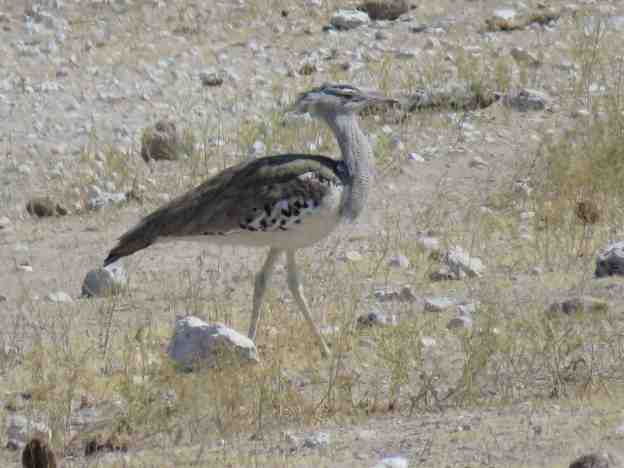
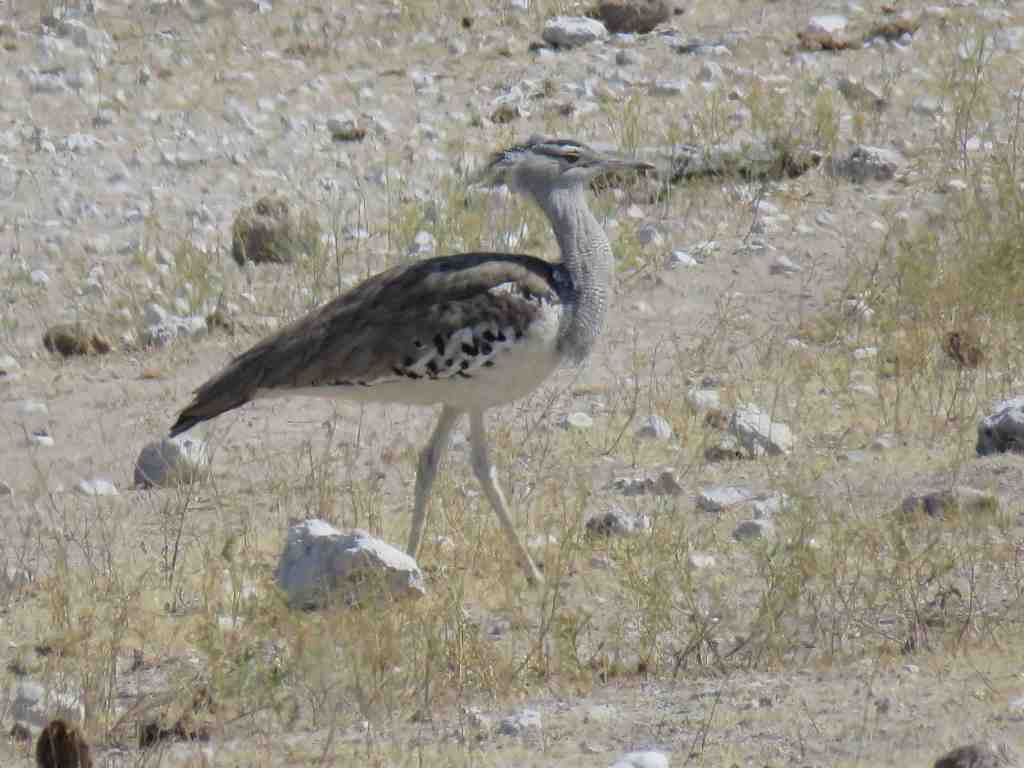
A Kori Bustard – our largest flying bird
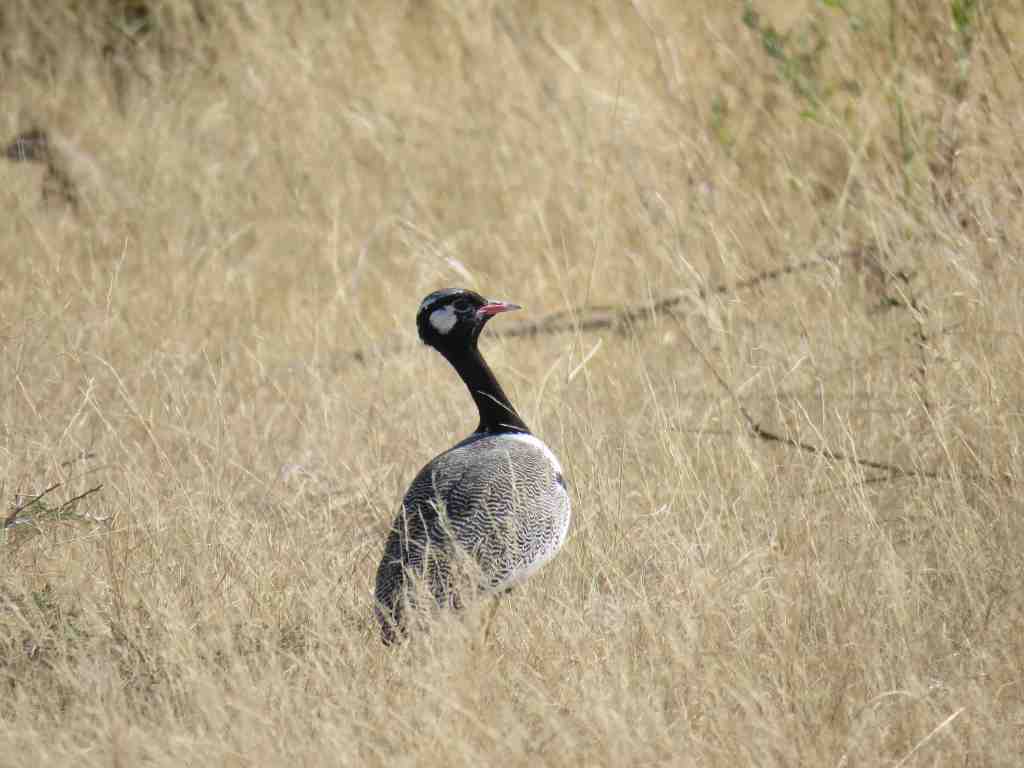
Northern Black Korhaan gave us a quick peek before dashing into the grass
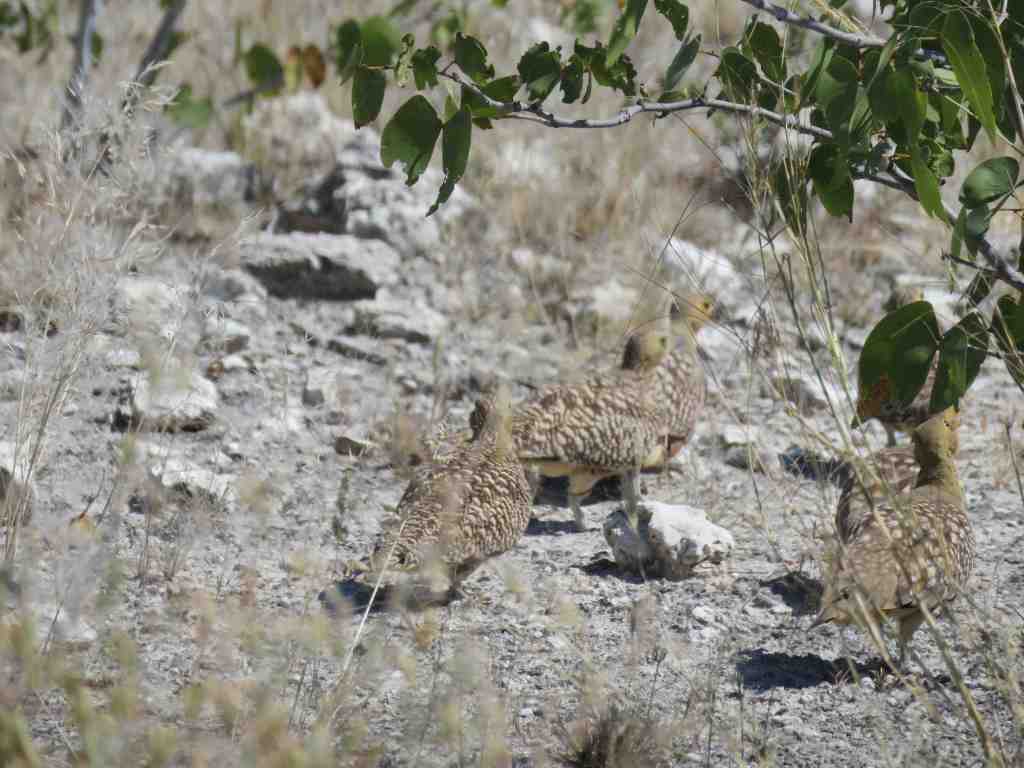
Namaqua Sandgrouse
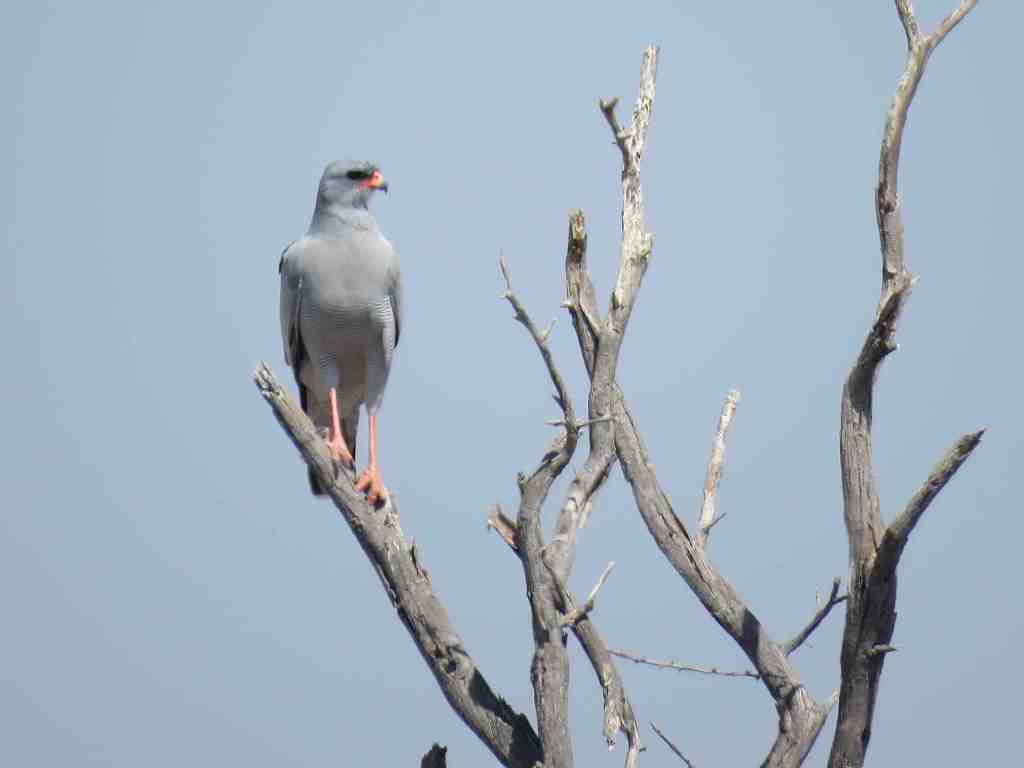
Pale Chanting Goshawk standing proud
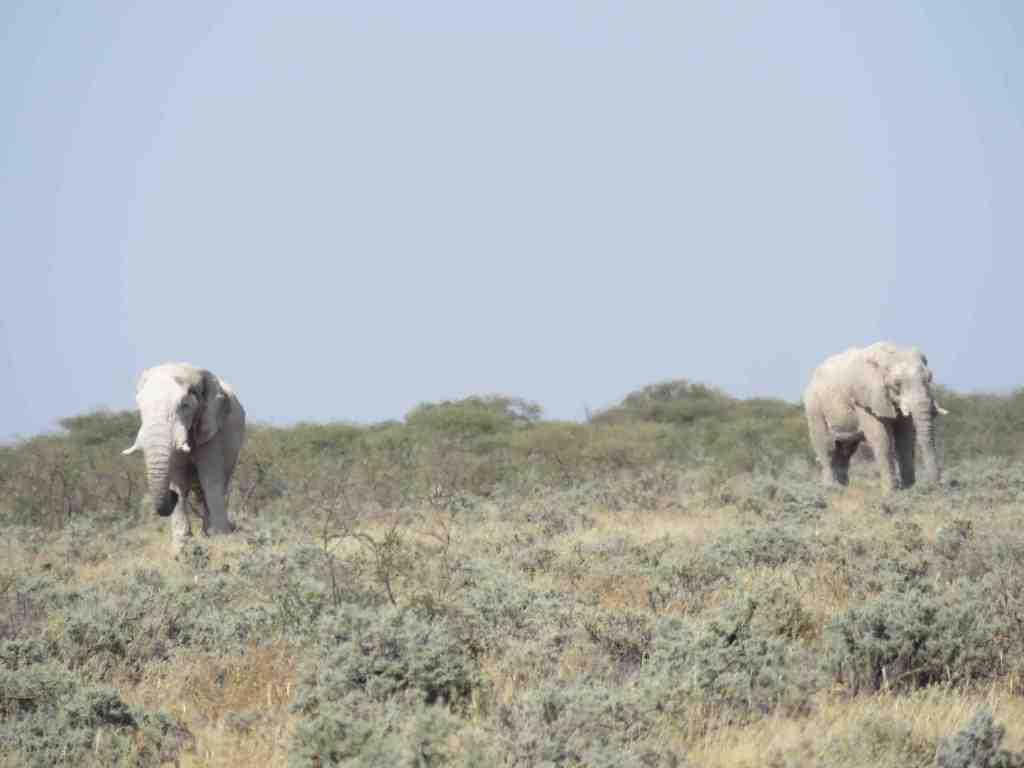
Elephant bulls browsing
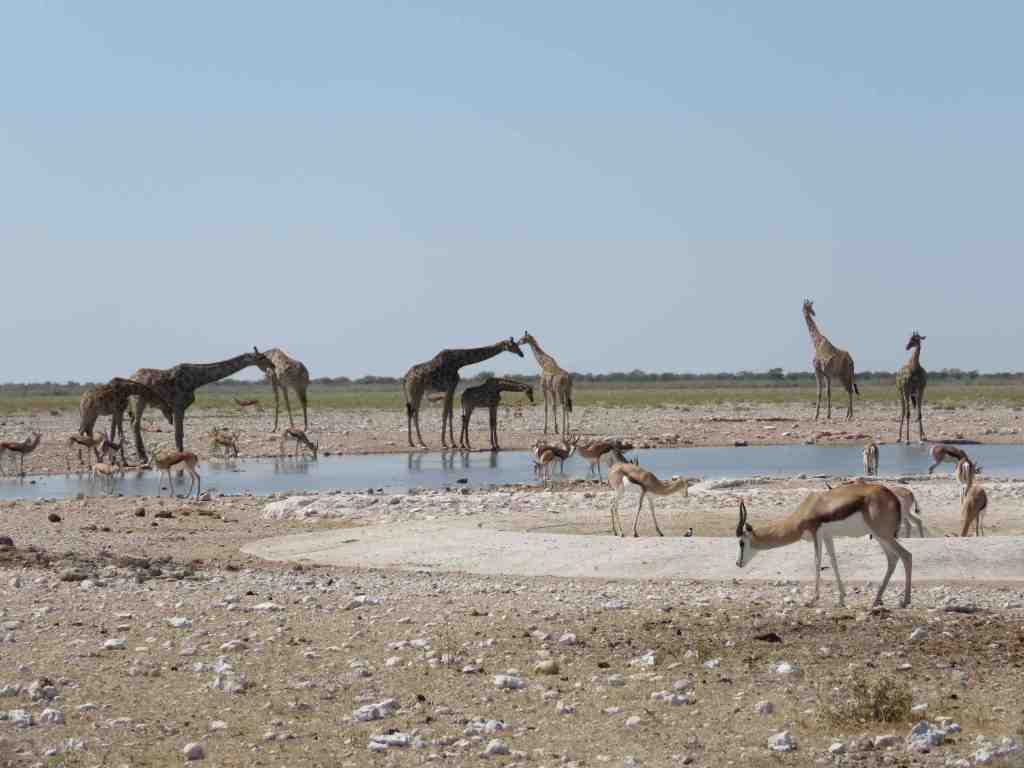
Busy morning at a waterhole
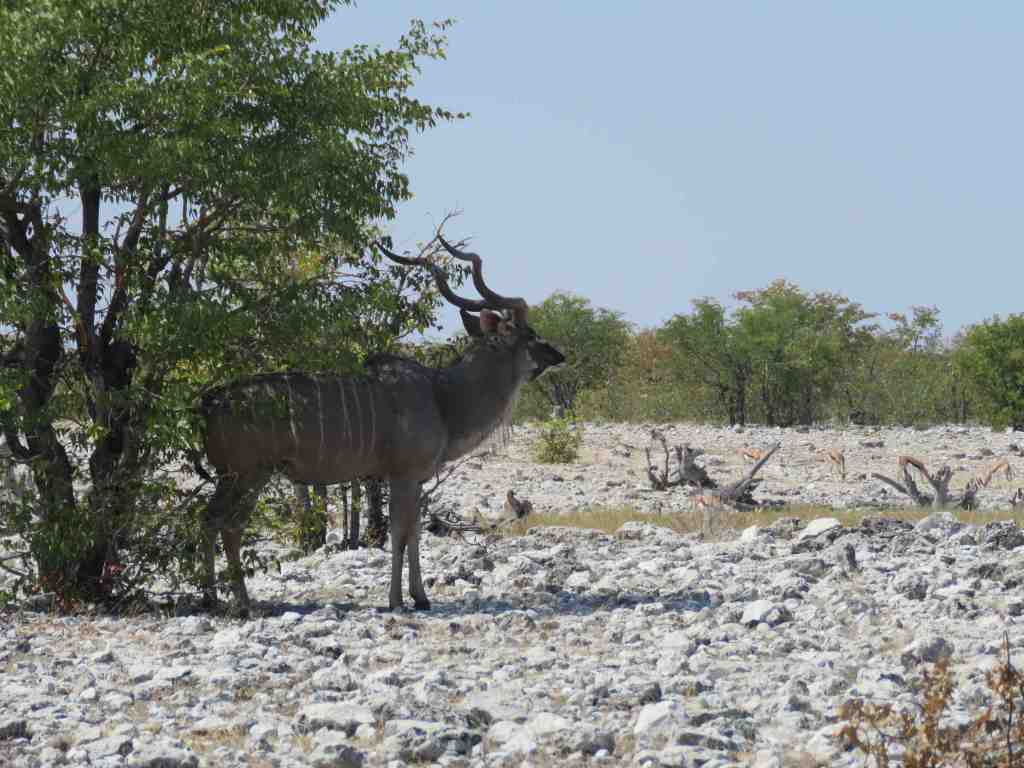
An elegant and very beautiful kudu bull
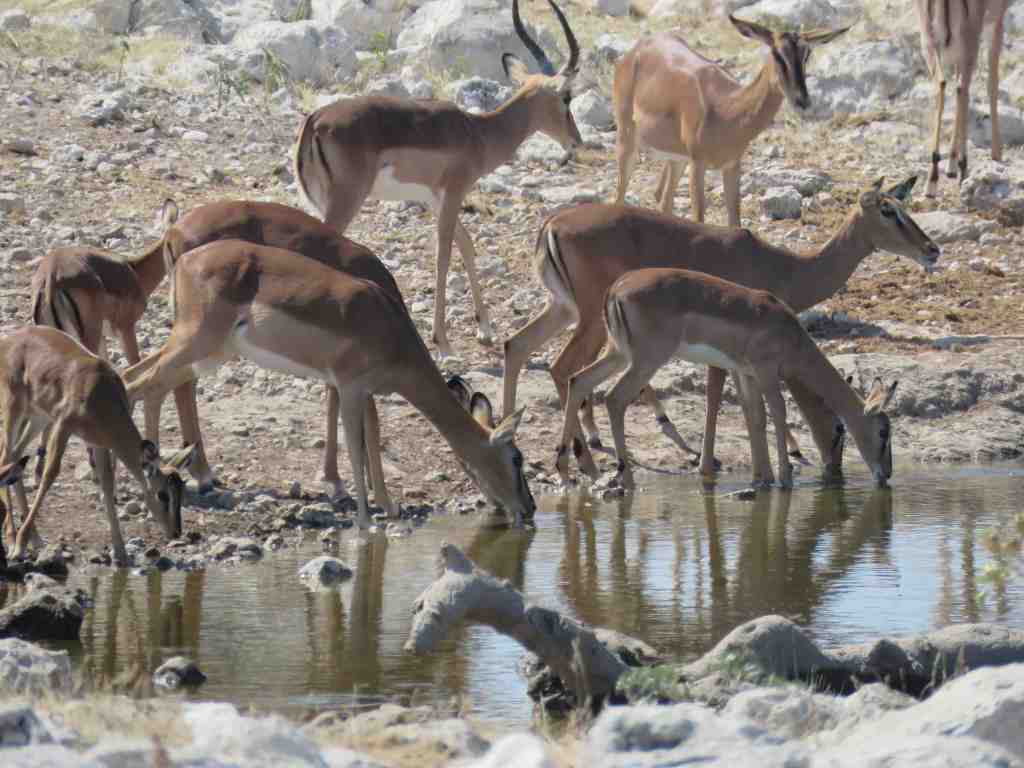
A small herd of Impala
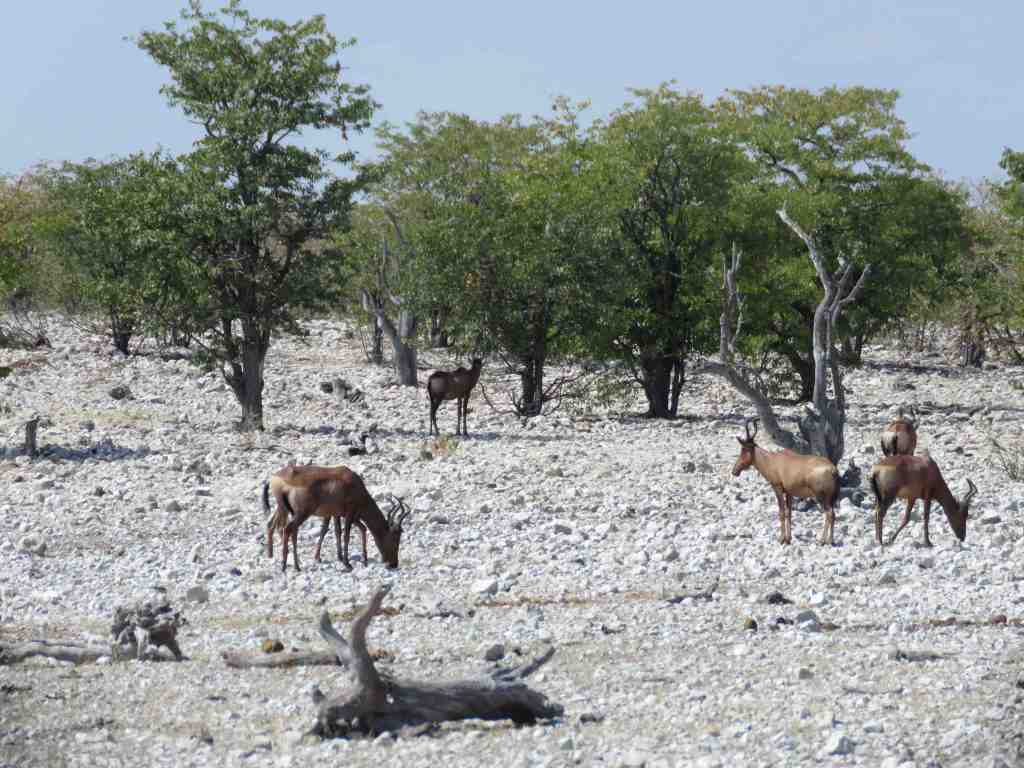
These Red Hartebeest couldn’t care less about us
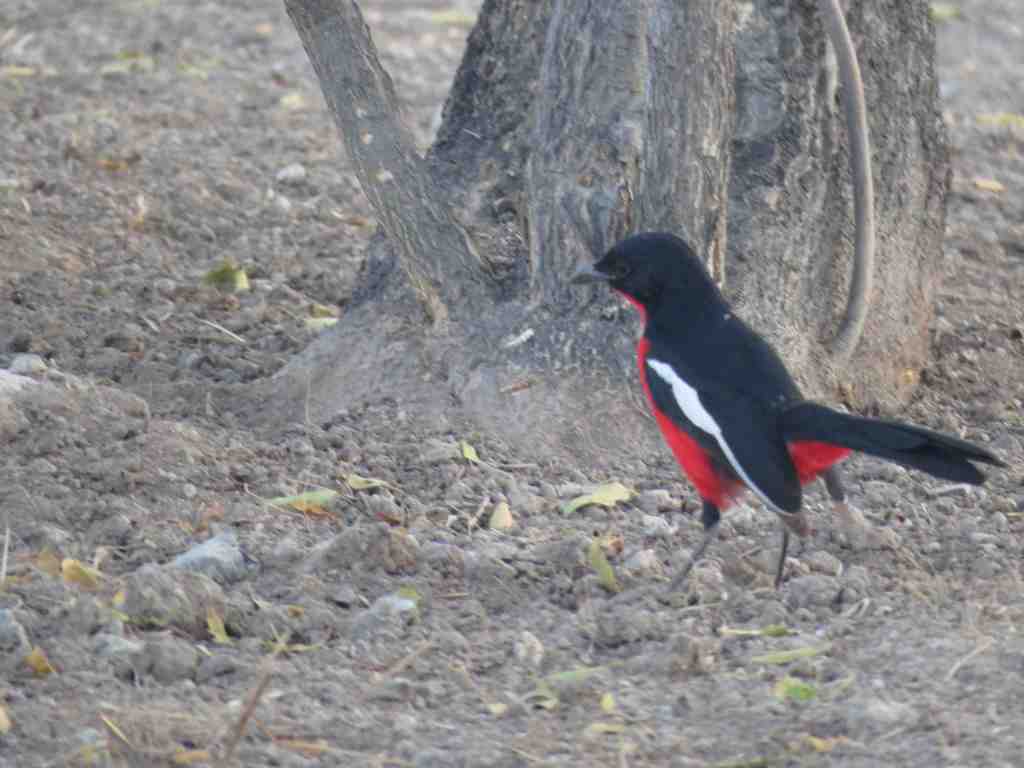
Beautiful Crimson Breasted S

There are few things that calm the soul like sitting in nature and enjoying the sights, sounds and smells of the country. It brings peace to the soul and after the past few frazzled days driving over bad roads; Etosha was just the balm we needed!

The next stop on our trip was Outjo on the way to Epupa Falls. We left the Safari Park, early as the drive to Outjo was to be almost 500 kilometers. We had intended to stay at Etosha’s Olifantsrus Camp and exit from the western gate of the park, but we couldn’t get accommodation there. Speaking to a gentleman in the Park, it seems we were lucky not to get a place at Olifantsrus as the road between Okaukuejo and Olifantsrus is almost impassable due to rain damage.

We drove from Ethosha back towards Outjo, and then turned toward Kamanjab. We stopped for fuel in Kamanjab and were mobbed by women selling craft items. There must have been 29 or 30 women all selling similar items and begging you to buy them. It was a sad sight as the poverty in the area was very apparent. After refueling we made our way toward Opuwo.

We arrived at the Opuwo Country Hotel, where we were booked in for one night. While standing at reception, we asked the owner what the condition of the road was like between Opuwo and Epupa Falls. He said that the road was very bad, so bad in fact that he had stopped offering day trips to Epupa Falls due to the damage caused to his Land Cruisers.

Alec and I discussed the issue and decided that we really didn’t want to drive another bad road, so we made the decision to put Epupa Falls back onto the bucket list, and to turn around and head for Divundu instead. Ray and Alvan continued on to the falls.  

Well, I must close here so I can get this off to Helen. Take care, everyone.

A note aside:

A few of my non-travelling friends may not know what I mean by a veterinary line. A quick explanation is that the south of Namibia is foot and mouth free, which is why they are able to export meat products overseas. The north of Namibia does not have the same status so there is a veterinary line across the country. Meat may be taken south to north, but may not be brought in the opposite direction. This is to ensure that any contaminated meat, blood or other products, from cloven hoof animals, which could cause an outbreak of foot and mouth, are not introduced to the south.

Adventures in Namibia by Guest Blogger Cathy Episode 6

Spitzkoppe and Twyfelfontein

We left Henties Bay with the mist still hanging low and a cold wind blowing. Funnily enough, it was the first time both vans were ready early but we were all looking forward to leaving the cold, damp coast behind for a little warmer weather inland.

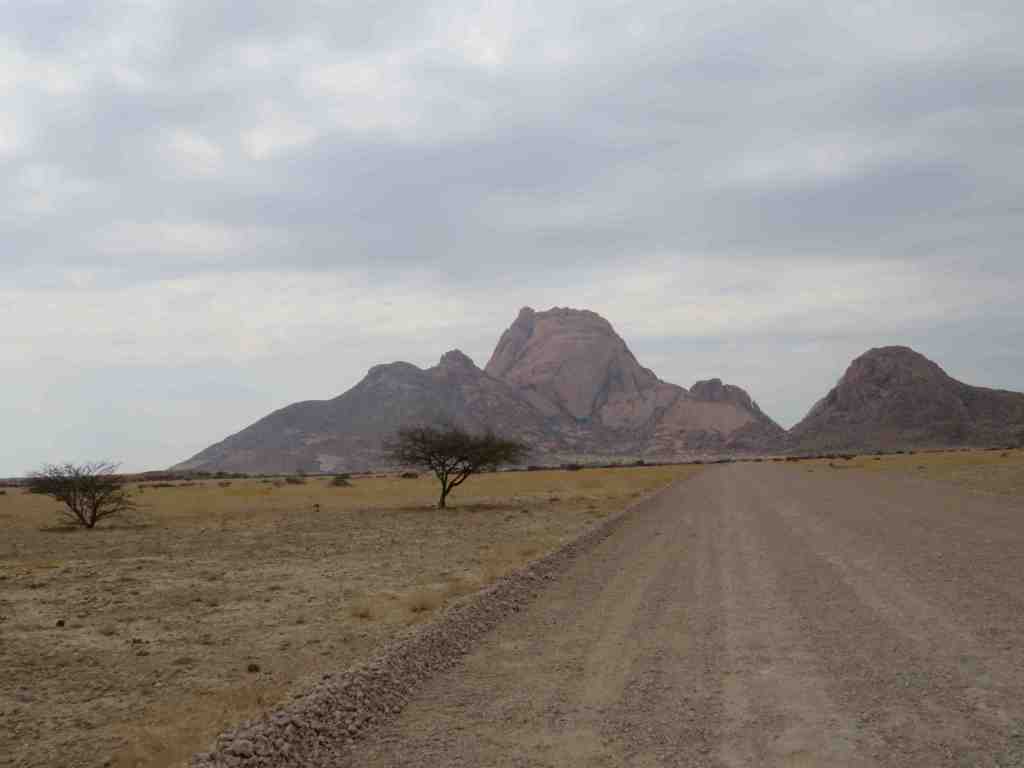
We took the D1918 from Henties. The road was good and we barreled along listening to an audiobook. The surrounding countryside was very flat but in the distance, we noticed ‘lumps’ popping out of the earth. They were very noticeable against the flat plains.

Suddenly these large lumps appeared

As we got closer they took on form and we could see the most enormous granite boulders. These granite hills stood out in stark contrast to all the surrounding country. We turned early off the D1918 and should have continued to the D3716 which would have brought us to the Reception Office at Spitzkoppe. Instead, we entered through the western gate and drove through the park to the reception at the other end.  This gave us a great introduction to the magnificence of the rock formations at Spitzkoppe.

Arriving at Reception we paid our fees and were told to choose any campsite not already occupied. I admit that comment made me smile – did the receptionist think that we were going to challenge someone already camping and demand their spot?

Faithfully obeying her instructions we trundled off to find an unoccupied site which we did close to the Rock Pools. We settled into Campsite #2 with Ray and Alvan next door in #3. We both had a magnificent backdrop of a gigantic granite boulder and a stunning view of the Spitzkoppe in front.   

Our campsite – look how tiny the caravan looks
The view from our camp

Spitzkoppe is an “almost-wild” camp. They provide no showers or water at the campsites, but these are available at the Reception. They do provide a long-drop toilet for each site. Neither Alvan nor I was keen on this contraption – I imagined any number of things lurking at the bottom of that dark hole! Alec looked sideways at me and just shook his head!

We spent the rest of the late afternoon setting up camp – surprisingly enough the ground was not rock hard and the pegs went in quite easily. Alvan made delicious chicken lasagna for supper and we enjoyed the cool evening, a cold drink and the magnificence of the stars. With no light pollution, the stars were truly stunning – little twinkles in a dense, velvet darkness.

The fact that there was no shower gave us a chance to test Alec’s al fresco shower. He had fitted taps under the kitchen basins and a quick-pitch tent to the side of the car’s canopy. That was one of the best showers I’ve ever had.  It was bliss standing under the stars with just a lamp for lighting, enjoying a warm shower after a hot day.

Our first use of Alec’s al fresco shower

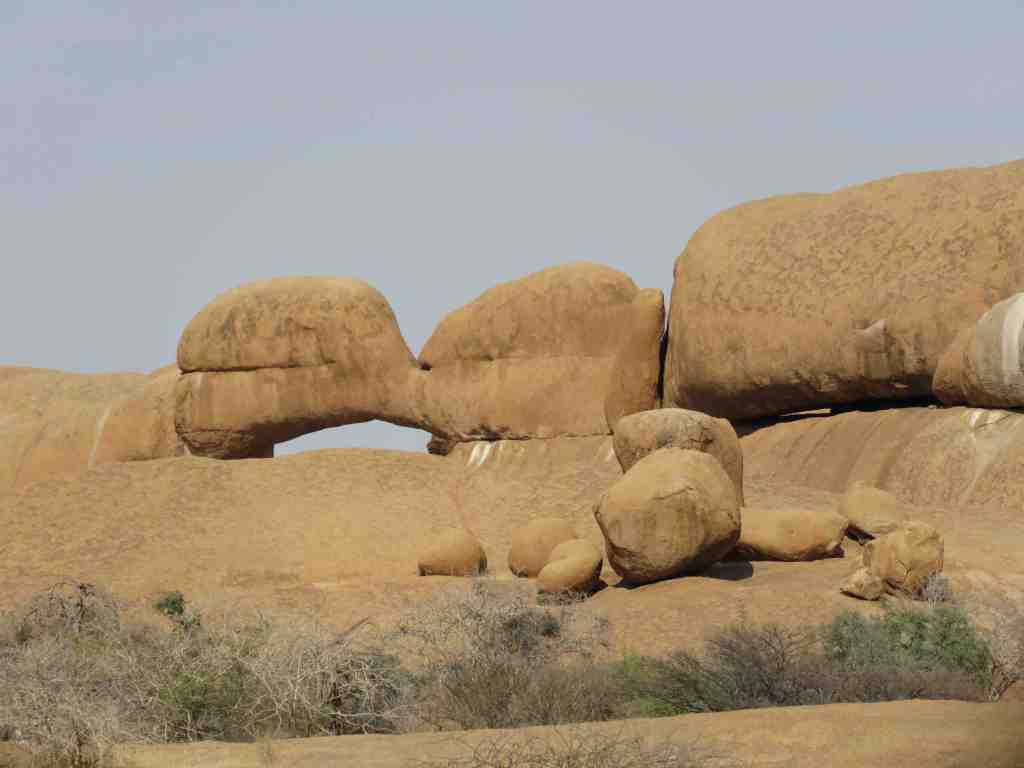
The next morning we set off to discover Spitzkoppe and it is really difficult to convey the grandeur of this place. The granite formations are truly stunning but so large that trying to capture them on film was almost beyond the capability of my little camera. 

Views around Spitzkoppe 1
Views around Spitzkoppe 2
Views around Spitzkoppe 3

On our map (issued by Reception), we noticed two spots marked for Rock Art. We decided to pop in at the Restaurant and have a cold drink before visiting the Bushmen’s paintings. The restaurant had a distinctly bohemian flair with almost everything made from recycled materials. The benches were pallets with foam cushions and the décor a collection of old artifacts, found, I should imagine, in the area.

Bohemian restaurant
Great view from the restaurant

We arrived at the first location for rock art, and found Alvan sitting in their car. As we arrived she climbed out and said that she was waiting for Ray, as he had gone to view the art but she was not prepared to attempt the climb. We looked puzzled until she showed us where you had to go to view this site. I swear my heart stopped! There was a 45º sheer granite rock face with iron rods drilled into the surface. The rods were linked by chains. You had to climb this rock face using the chains to drag yourself up, and then clamber a bit further once at the top.

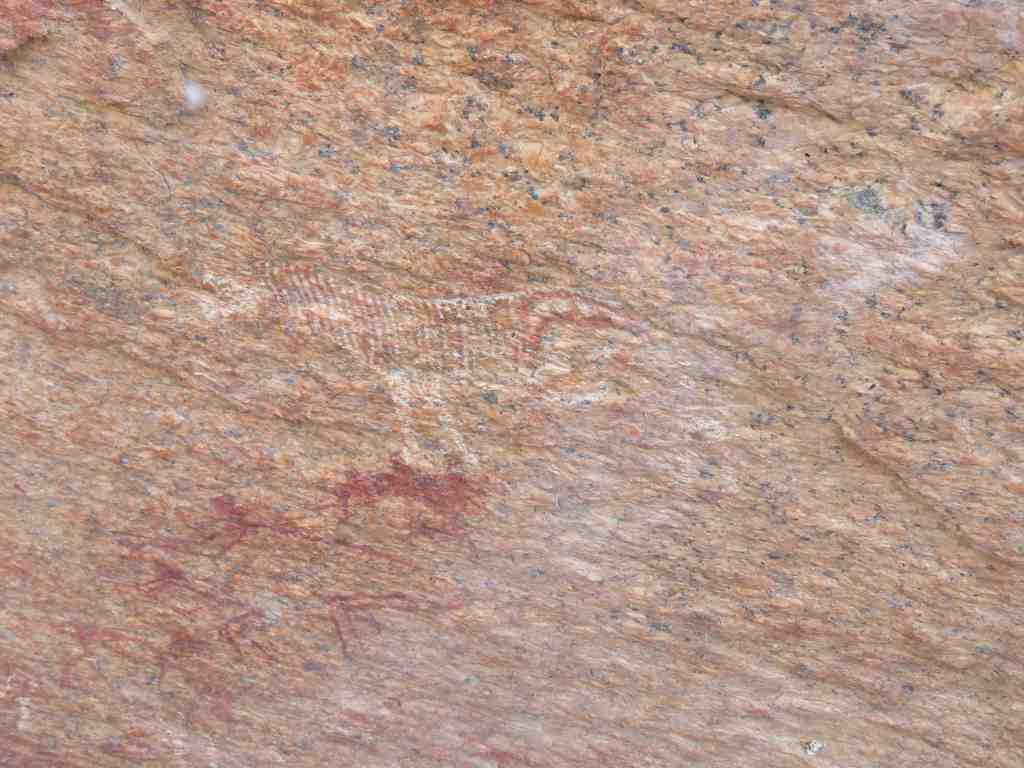
We conceded defeat and agreed with Alvan, that climbing up there was madness! We went on to the alternative site where we were met by a lovely young lady named Ingrid, who took us to a rock face covered with paintings. She explained what they meant and how they came to be painted.

The paintings have been dated between 2,000 and 4,000 years old and were painted by the Khoi San people. The rhino, elephant, lion and giraffe were never hunted as their arrows were of no use against the skin of these animals. But they were used to indicate the way to water and in other ways.

The brown paint was made with animal blood and finely ground red ochre while the white was made with finely ground ostrich eggshell mixed with euphorbia juice.  We stood and marveled that these paintings have lasted for such a long time. How is it that ancient man managed to paint animals onto rock faces and they’ve survived for thousands of years, but our modern paints don’t last on our houses for more than 5?

Our very knowledgeable guide, Ingrid.
This rhino points the way to the Rock Pools for water
A lion painted to warn of danger
A Zebra

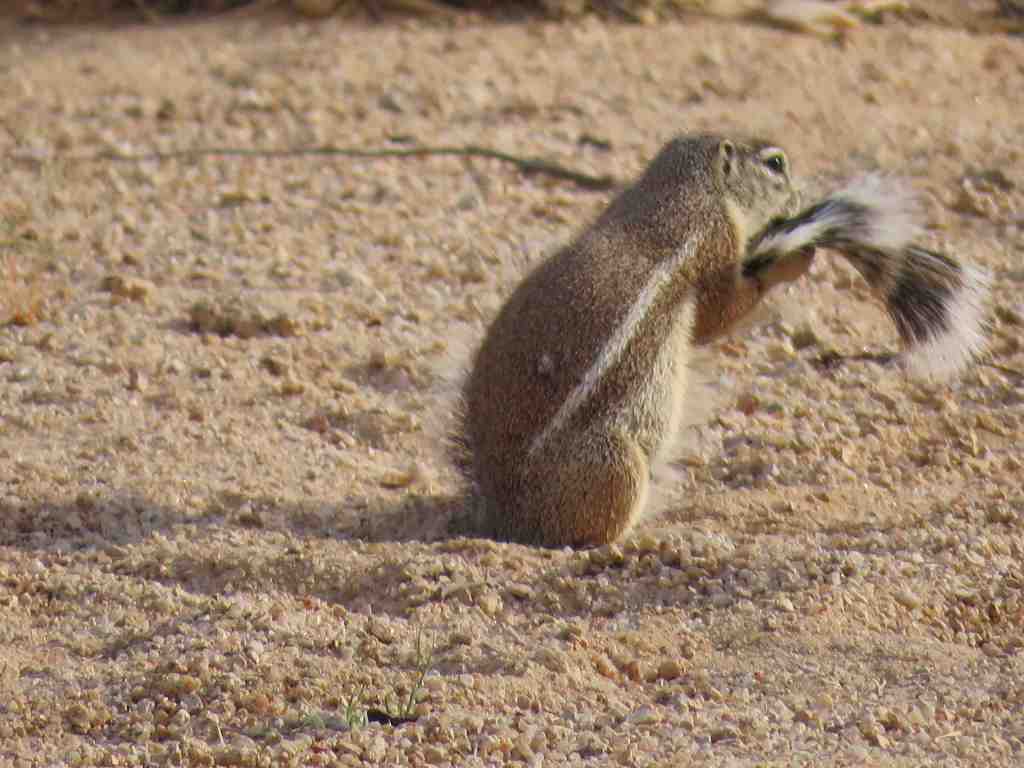
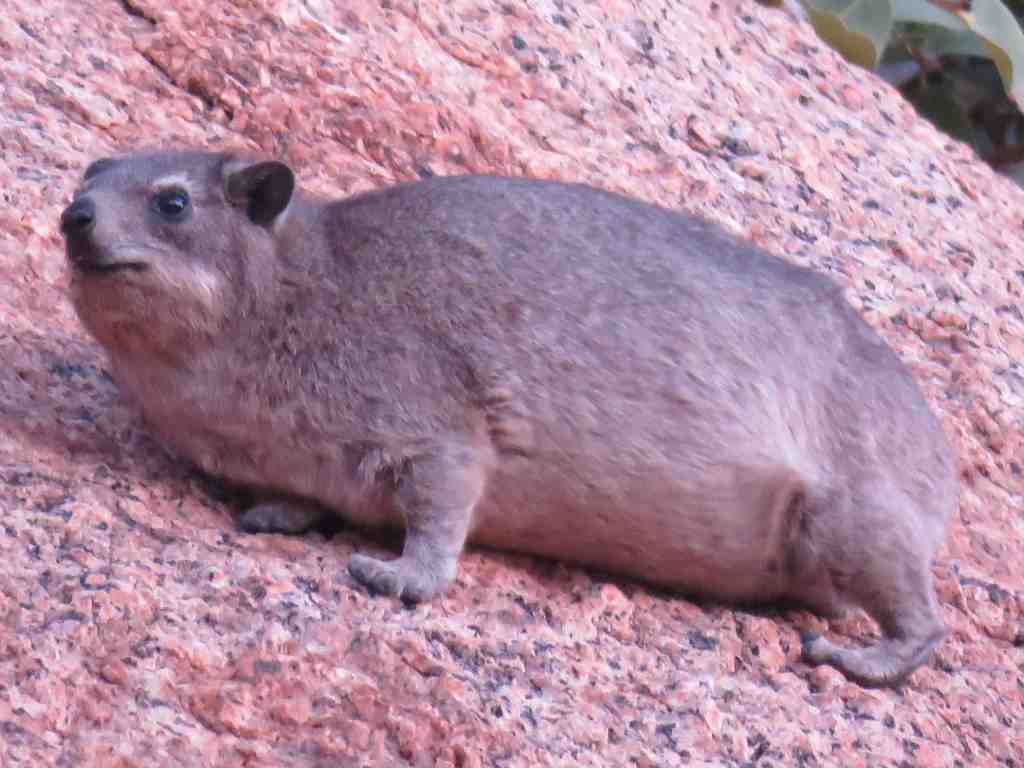
It was now rather late in the afternoon so we returned to pack up camp as we needed to make an early start the next morning. While enjoying a drink, we once again, enjoyed the antics of the wildlife around the camp. There were some gorgeous birds, very fat dassies, playful ground squirrels, and the most gorgeous agama lizards.

Dusky Sunbird objecting to himself!
A quick tail brush-up.
This little bundle of fluff confused us all!
Could I be a Crombec?

Editor’s Note – These two photos are of the same bird. I don’t think it’s a Crombec – it might be a Yellow-bellied Eremomela.

A very fat dassie!
Our beautiful agamas

Spitzkoppe should be a bucket list destination for everyone. The stunning scenery and fantastic rock formations must be seen. These dramatic granite hills will long remain in my memory.

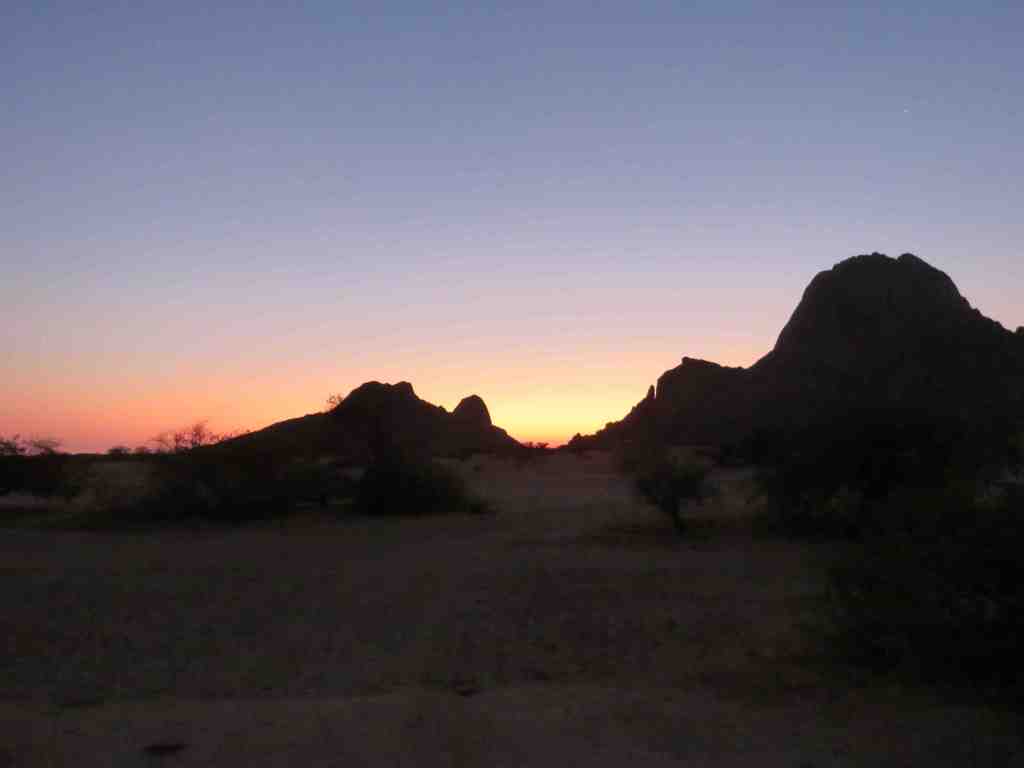
Sunset at Spitzkoppe on our last evening.

The next morning we were off early on our way to Twyfelfontein. What a day’s travel this was going to be. The D3716 to Uis was not bad and we continued our audiobook. We stopped in Uis for fuel and found the most gorgeous coffee shop called Cactus and Coffee. Ray and Alvan stuck to their tradition and had coffee and cake while Alec and I had tea and shared a piece of the most decadent cheesecake. This coffee shop is thoroughly recommended.

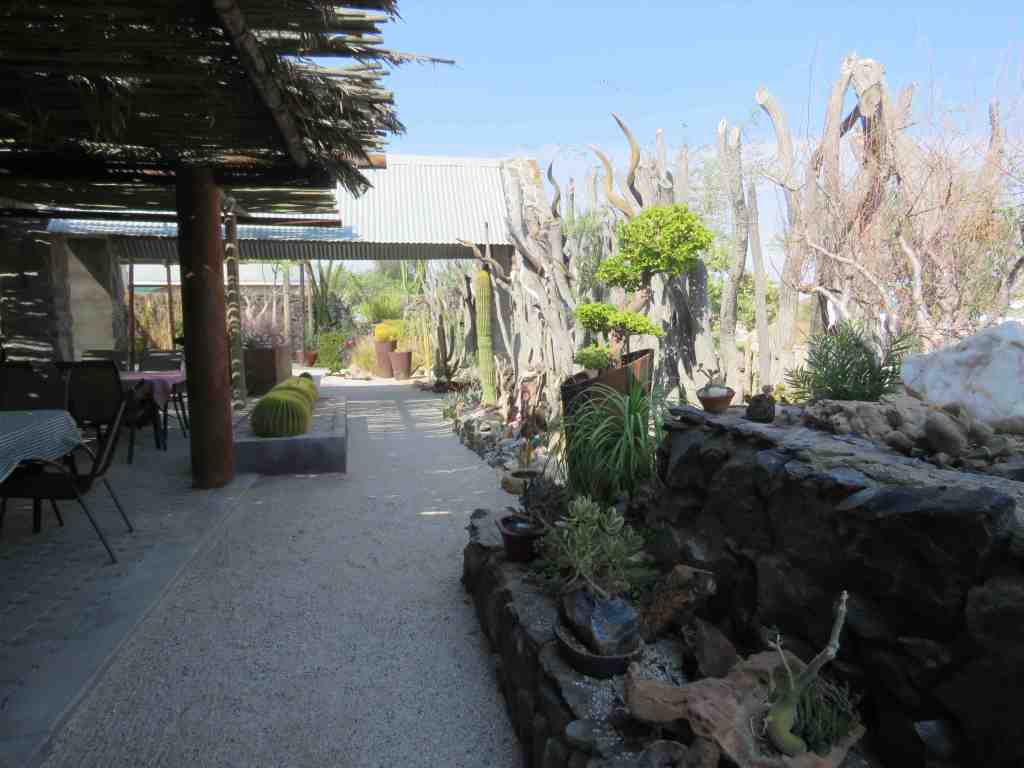
Coffee & Cactus Coffee Shop
Alec, Ray and Alvan at the coffee shop

We left Coffee & Cactus suitably refreshed without realizing what we were about to face.  We tackled probably the worst road that we have ever driven on. In fact, it is an insult to other roads to call this a road! If anyone says for you to drive on the D2612, run in the other direction. This was a rutted, bumpy, rocky mess of a road that is so bad that previous motorists have created a bypass road alongside the main road. Never have we been on such a hugely rutted track, with the complete road covered with corrugations at least 3-4” deep. This was beyond testing bra straps and the strength of fillings. Eventually, my eyeballs felt like they were vibrating in their sockets! Most of the time we were down to 25km/hr and driving on the by-pass road, which came with its fair share of washouts and rocks.

Huge corrugations that make for a most unpleasant drive!

The bad thing about the bypass was that when it gets rutted, everyone seems to move into the grass next to it and another bypass is created. Soon the road stretched 20 or so meters across the veld. We were told that the road was in such bad condition because heavy rains had damaged the surface. I can accept that rain had damaged the surface but I don’t think that road had seen a grader for many, many months.

All along the road there were little stalls, most of which had an elephant as a decorative item. These elephants were crafted from a wide array of materials. This one used elephant bones, others used sticks and mud and still others used cloth. The stalls were selling craft items and many had gemstones for sale. I am no geologist but they looked suspiciously like lumps of quartz to me! At the fuel station at Uis, there was a large sign saying not to buy gemstones as this trade was illegal, so perhaps they were semi-precious stones.

Roadside stalls all use an elephant as decoration

It was an exhausted group that finally arrived at Camp Xaragu near Twyfelfontein. This camp was more than a little disappointing. The shelters for the caravans were very nice, but the ablutions were a bit of a disaster! We used the loo in one, as it worked but the shower didn’t, so we showered next door because that worked (well sort of!)  Ray and Alvan had a similar experience with flooded loos and showers that sort of worked – the donkeys for hot water didn’t do a very good job!

Our stand at Camp Xaragu

The next morning we set off for Twyfelfontein which was about 12 kilometers away. Again the road surface was abysmal and, once more, a bypass road had been created. Really, Twyfelfontein is a World Heritage Site and the Namibian Government should be ashamed of the road access to the site. It is unconscionable that such a magnificent place is impossible to get to without a high-clearance bakkie.

We eventually arrived at the site and parked under shelter, which was very nice as it was already getting hot. We paid our entry fee and were allocated a lovely lady named Mona-Lisa, as a guide to show us the site. A word of warning, the first site is about half a kilometer from the entrance and the path is sandy in places and rocky in others, so good shoes, a hat and water are essential.

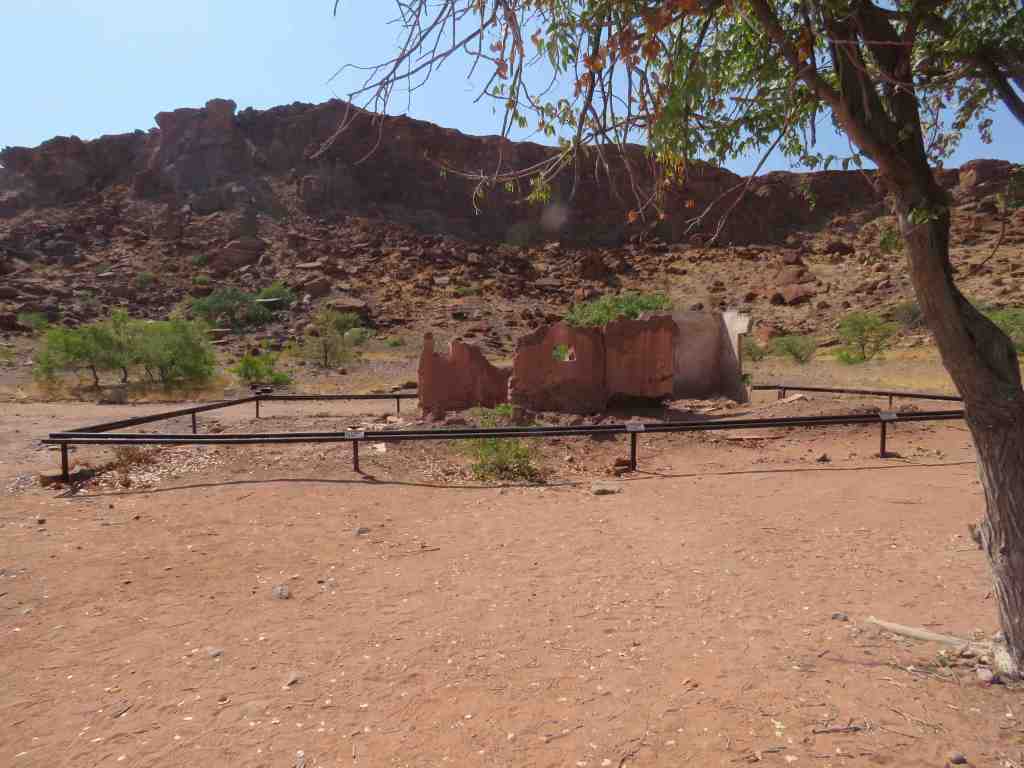
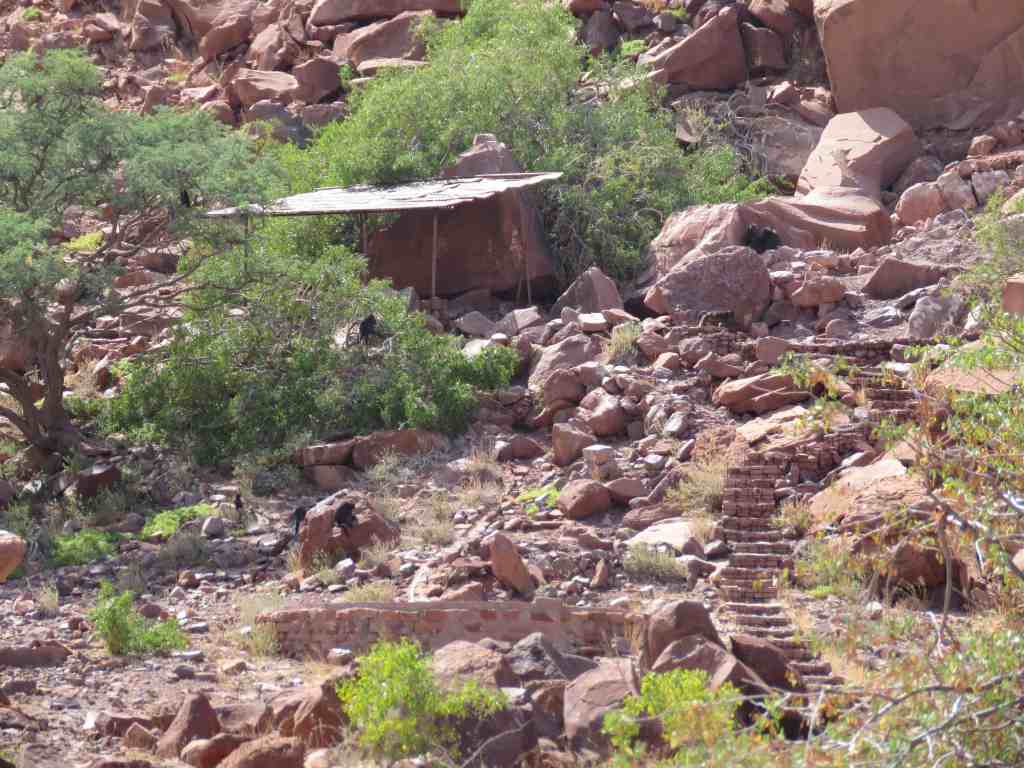
They offer a long walk that takes around 45 mins or a shorter one of 30 mins, which is what Alec and I opted for.  Mona-Lisa led us along the path until we came to this broken-down farmhouse. This is the farmhouse where the original farmer, Mr Levine, lived until drought and a lack of water drove him out. The original spring which provided water is still there but the water flow is so reduced that it is now just a watering hole for the local baboon troop.

The original farmhouse at Twyfelfontein
The spring at Twyfelfontein

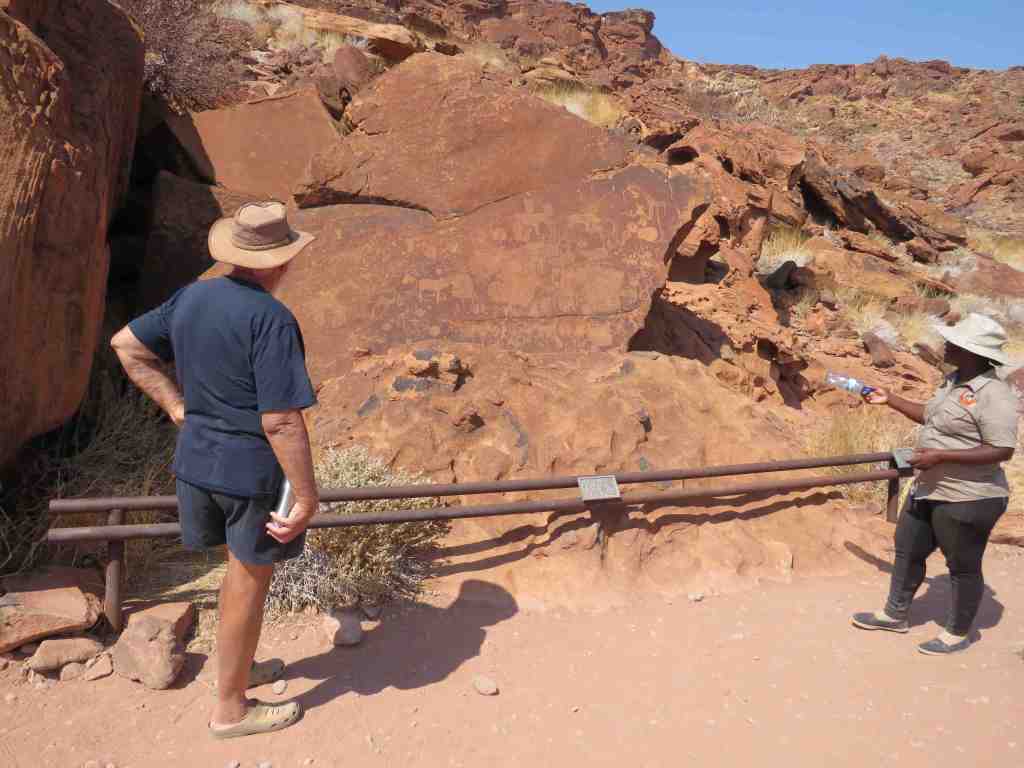
We continued our walk and came to the first set of engravings. At Twyfelfontein, there are no painted images; all of the images have been chipped out of the sandstone by the Khoi San, using a piece of quartz. Again these images have been dated to 4,000 to 2,000 years old.

The images are very clear and Mona-Lisa’s commentary was exceptional. She chatted about these people as though they lived today and she had a wealth of information about them and what the engravings represented. She was an excellent ambassador for the site.

As it was now nearing midday and the temperature had risen significantly, we decided to call it quits and walked back to the reception area for a long, cold drink.

Alec and Mona-Lisa look at the engravings
A gorgeous giraffe

At the reception, there were lots of these great information boards that help you understand all that you have seen.

Lots of Information Boards at Reception
More info boards at Reception

While we enjoyed our walk at Twyfelfontein Ray and Alvan visited two interesting geological sites close by; The Organ Pipes and Burnt Mountain.

The photographs of the Organ Pipes and Burnt Mountain were all taken by Alvan Mandy.

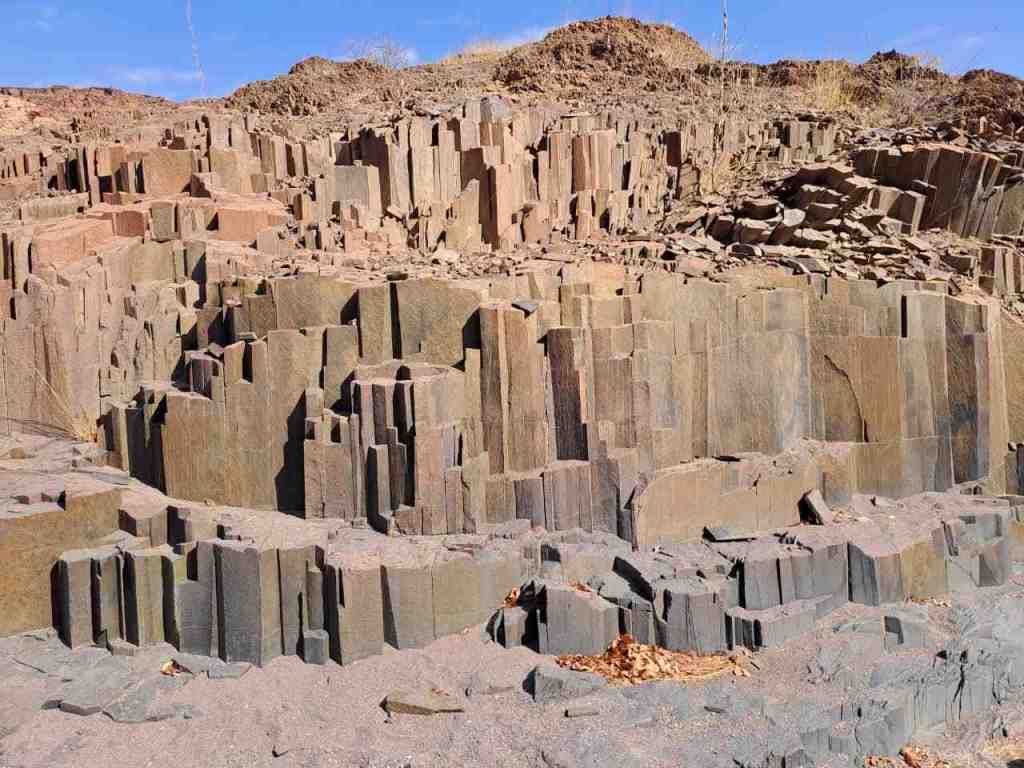
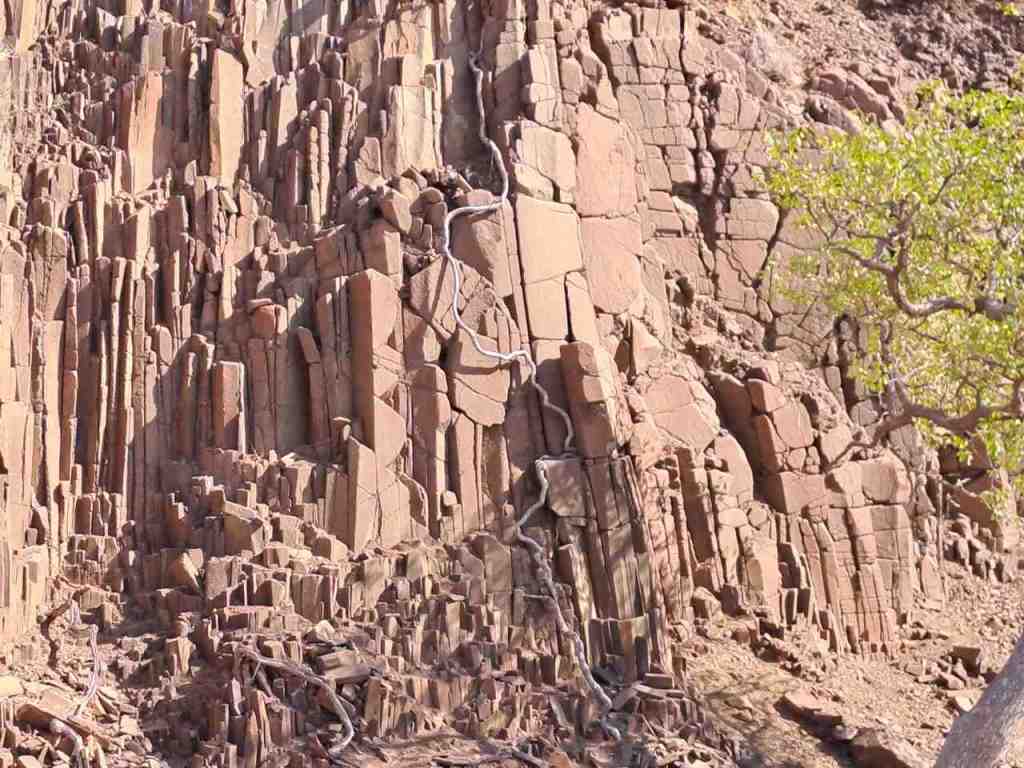
The Organ Pipes are a geological feature that are around 150 million years old. They were formed by lava being forced into slate rock formations. Over millions of years, erosion has exposed the basalts which are arranged in columns looking like organ pipes.

Organ Pipes are an amazing geological feature
This Mopani tree root actually grew UP the rock face and not down!

Ray and Alvan then went on to Burnt Mountain, another geological feature in the area.  The mountain itself comprises Karoo slate which is a beige colour. Slashed through this is a layer of solidified lava. The lava is around 80 million years old and makes a striking contrast with its brown and purple colouring.

Burnt Mountain with its amazing layer of black lava

We were very impressed with Twyfelfontein but felt irritated that such a magnificent place was at the end of such a horrid road. Our camp was also something of a letdown. Never mind, all these things add spice to our adventure around Namibia and next, we are off to Etosha. We’re all looking forward to a visit to a game park. Take care, everyone.
Share Your World Monday 8 May 2023

Here are my answers to this week’s questions from Pensitivity100

Do you feel comfortable walking in your neighbourhood at night?

Darling, I don’t even feel comfortable driving in my neighbourhood at night!

Jokes aside – I live in a very safe neighbourhood and I do feel comfortable walking short distances at night but nowhere in the world would I walk alone at night. This is because anything could happen anywhere. What if I fell or had a heart attack and there was no one around? At a certain age, one has to be sensible.

During the day I walk everywhere alone and don’t feel even the slightest bit unsafe. However, I don’t walk in lonely places for the same reason as not walking alone at night.

When you shop for day-to-day things, do you pay by cash or card?

I always pay using a card. I don’t keep cash on me except when I have to pay my dues for Book Club.

When was the last time you dressed up for a special occasion?

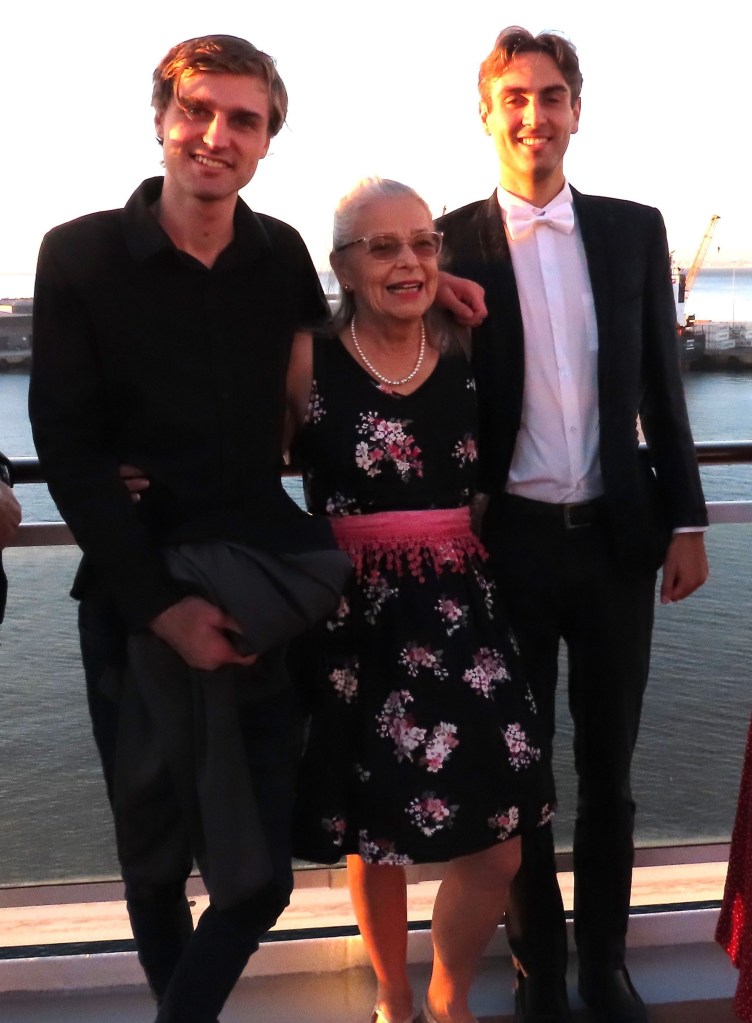
The last special occasion was on board MSC Orchestra a few weeks ago. We were celebrating our daughter’s birthday and having a special get-together as our grandson was about to leave the country. We didn’t have to dress for dinner but the girls and I like dressing up and so does my grandson, Josh. Grandpa and Jay – not so much!

My handsome grandsons – guess which one took dressing for dinner seriously!

Have you ever lied about your age?

My parents lied about my age because when I was a kid, those under 12 got into the drive-in for free. I was 11 for about 4 years.

When people say, “You look good for your age before they even know how old I am, I say, “I’m 90 you know.” The look on their faces is priceless!

Gratitude:

Making someone happy reaps its own rewards.

I am really grateful for my friends and family who always make me feel happy when I am around them.

Adventures in Namibia by Guest Blogger, Cathy Episode 5

Henties Bay

Our last morning in Swakopmund dawned dull and gloomy with very thick mist and a cold wind. The weather fitted our mood, as we were sorry to be leaving this vibrant town with its incredibly friendly people.  Nevertheless, the next leg of our adventure beckoned and around mid-morning, we set off for Henties Bay. It would be a short drive along what is known as a salt road. The surface was excellent and we made good time.

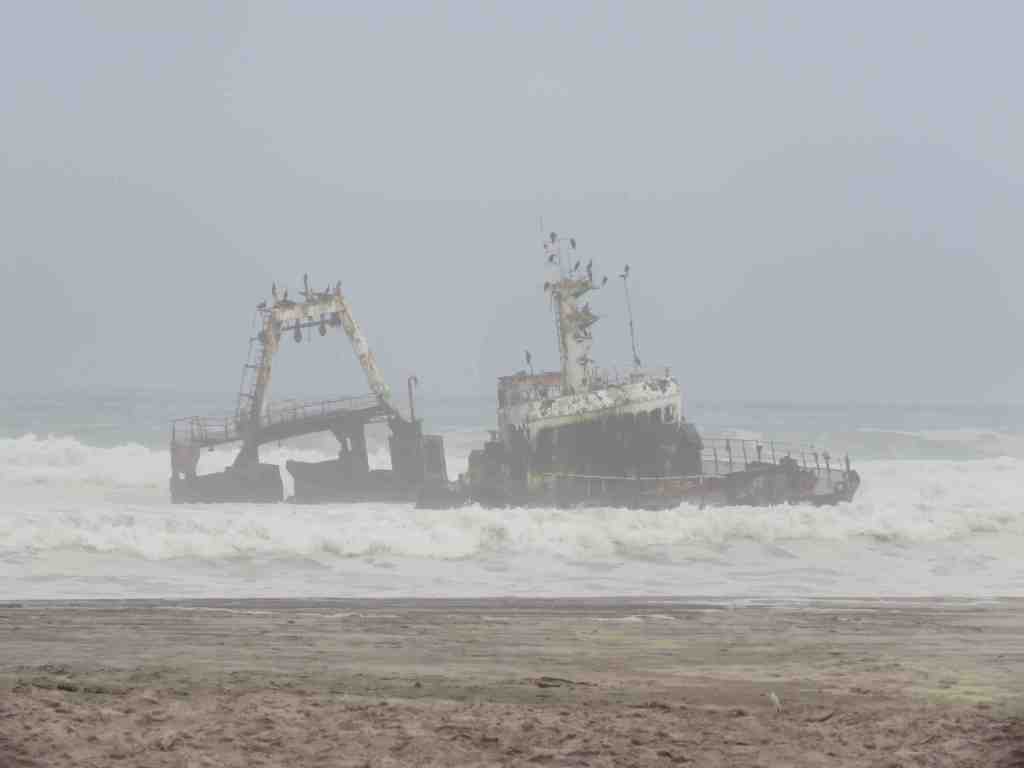
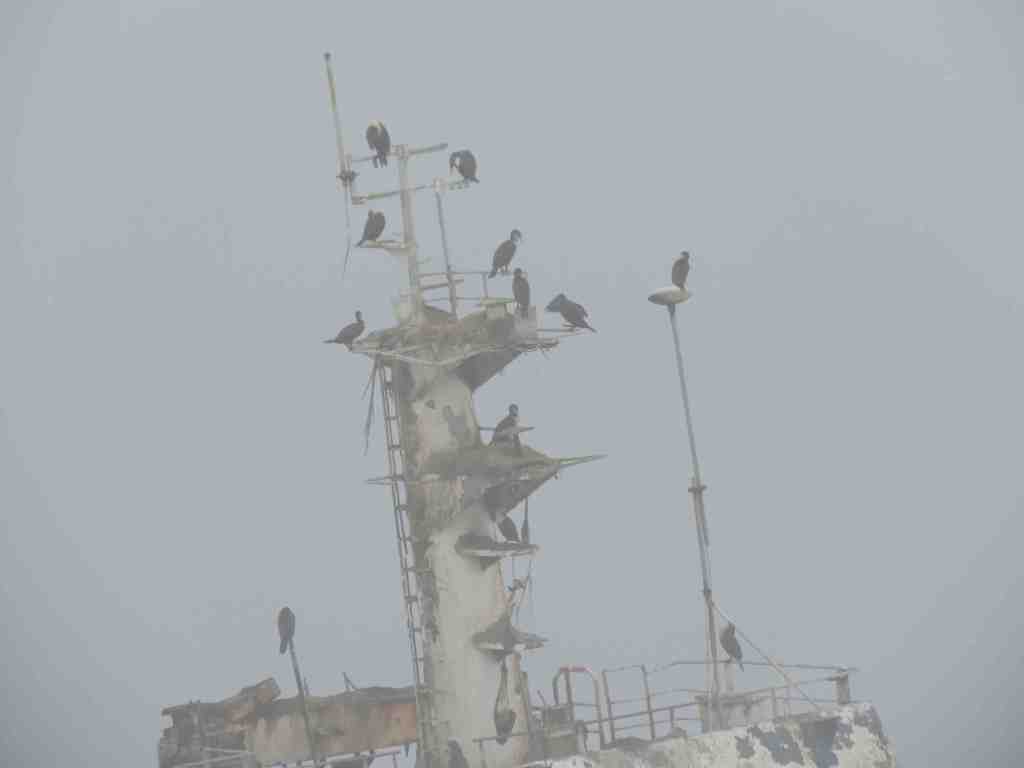
Along the way, we stopped at the wreck of the Zeila. The Zeila was owned by the Hangana Fishing Company based in Walvis Bay. She had been sold for scrap to an Indian scrap yard, and was being towed to Bombay, when she broke her towing line in the early hours of the morning on 25 August 2008 and went aground at a popular fishing spot called “Die Walle”, about 14 kilometers south of Henties Bay. This once proud vessel is now broken up and a perch for cormorants. Such a sad end, but perhaps a little more elegant than being cut up to make tin cans!

The wreck of the Zeila
The Zeila is now a perch for cormorants

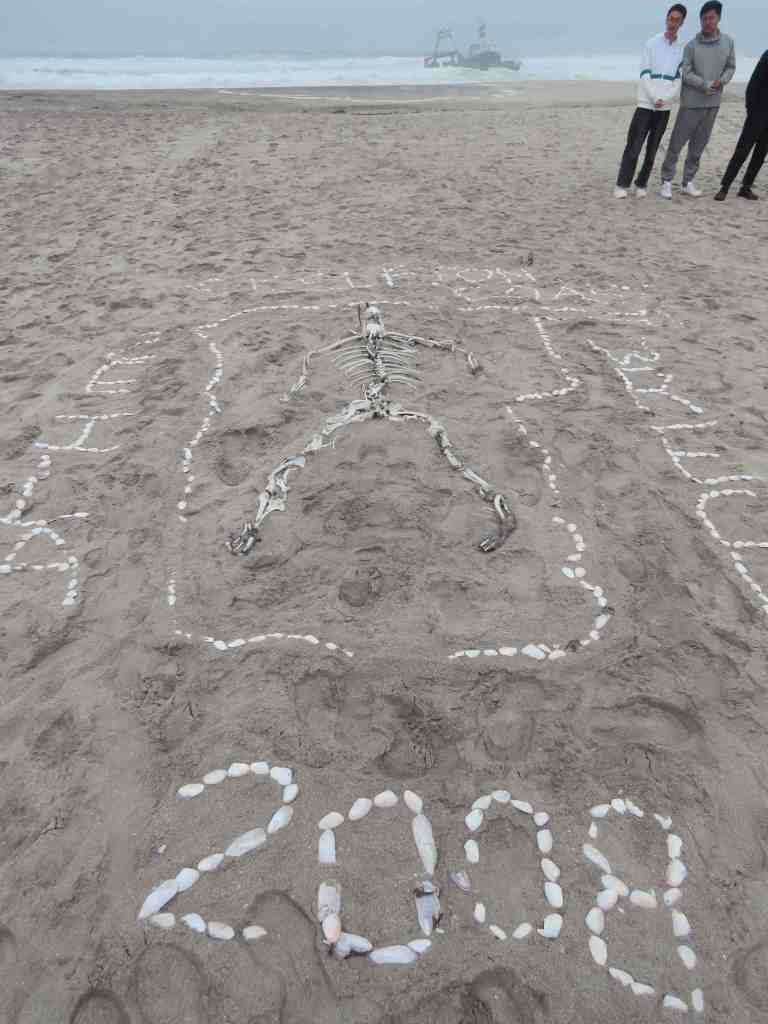
Also at the same spot was a bit of beach art, done by someone with too much time on their hands. The bones all came from seals but the design made them look like it was a human form. I am guessing that this is a much-photographed piece of beach art!

The much-photographed beach art

Driving along the Skeleton Coast road, I could not help but notice how stark the landscape was. I remarked to Alec that it must have been dreadful for a sailor marooned along the coast. No shelter, no water, just sand and scrubby vegetation for miles on end.

I must admit that I thought the Skeleton Coast got its name from all the shipwrecks and sailors that died walking the beaches looking for human habitation. I was assured by locals that that was an old wives’ tale. It was named after skeletons, but the majority of the skeletons found were from whale and seal hunting, and only a few were human.
Driving through the heavy mist it was easy to see how ships could run aground on this coast as it was difficult to see far.

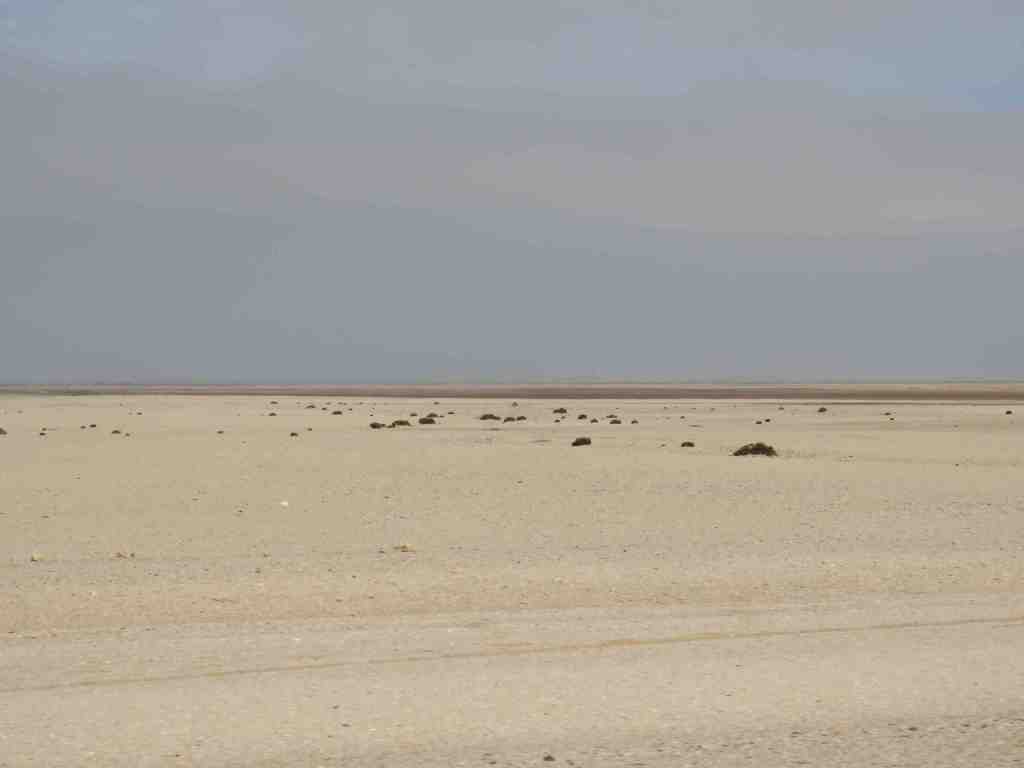
The land along the coast is so desolate

We drove into Henties Bay, with the mist still hanging low and thick. Arriving at Buck’s Camping Lodge we set up camp and the mist was still there, making everything damp and very cold. In fact, the mist did not lift for the entire stay at Henties.

Soon after we arrived, we were surprised by a visit from an old friend from our days in Oranjemund. We had telephoned her from Swakopmund and she arrived to enjoy a cup of coffee and a chat to catch up around 20 year’s news! It was great to see her and we thoroughly enjoyed her visit.

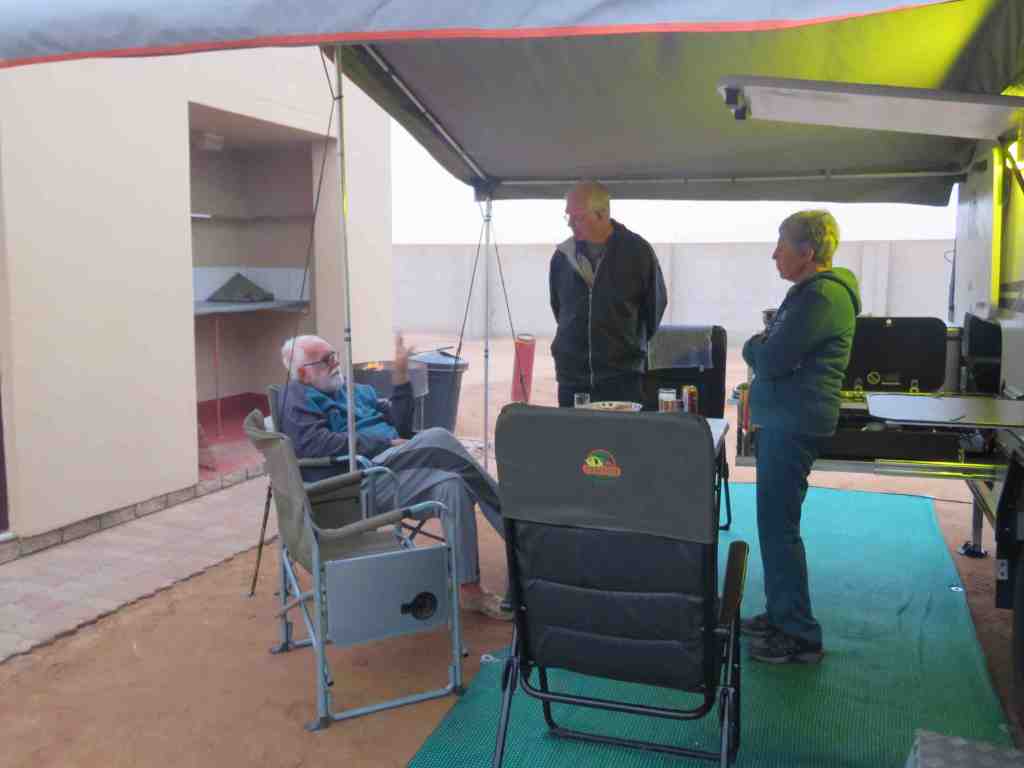
Everyone wrapped up in a cold, miserable Hentties Bay

The next morning Ray and Alvan decided to explore the town, while Alec and I took a drive up the coast to Cape Cross as we wanted to visit the seal colony. After paying our entry fee, we drove along the beach and passed a sign saying camping site. What a ghastly place to camp, so exposed and you would have to be a very rugged camper to put up with that site!

As we neared the parking area it was very apparent that the seal colony was nearby. The noise was deafening and the smell came a close second! Before going to admire the seals we visited the cross or padrão that was erected by the Portuguese navigator Diogo Cão in 1486.

In 1484, Diogo Cão, was sent to search for a sea route from Portugal to the Spice Islands and India and to explore undiscovered regions along the west coast of Africa. Each time he found a place that may be of value to Portugal, he was to erect a stone cross and claim the land for his home country.

Diogo Cão arrived at Cape Cross in January 1486 and he erected a limestone padrão, weighing around 360kg and standing around 2 meters tall.

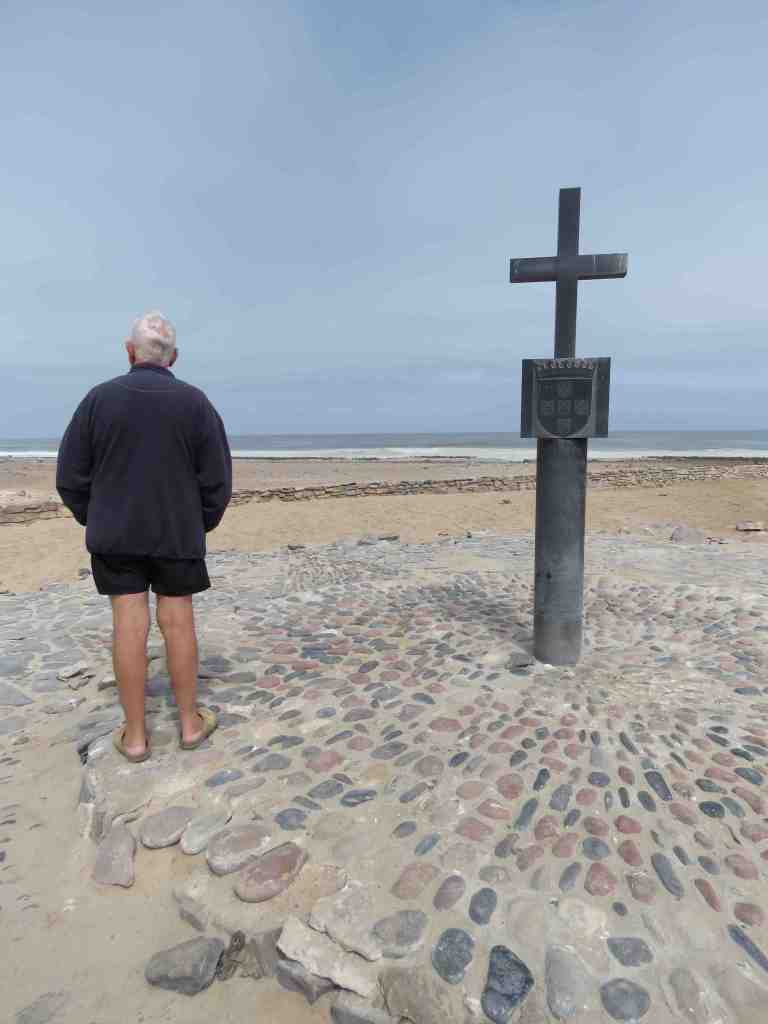
The original cross stood at the cape for more than 400 years until, in January 1893, it was removed by Captain Becker of the German Navy and taken to Germany. The original limestone cross was replaced by a wooden cross, which was later replaced by a granite replica of the original in 1895. The German cross included the German coat of arms and the inscription in German as well as the original Latin.

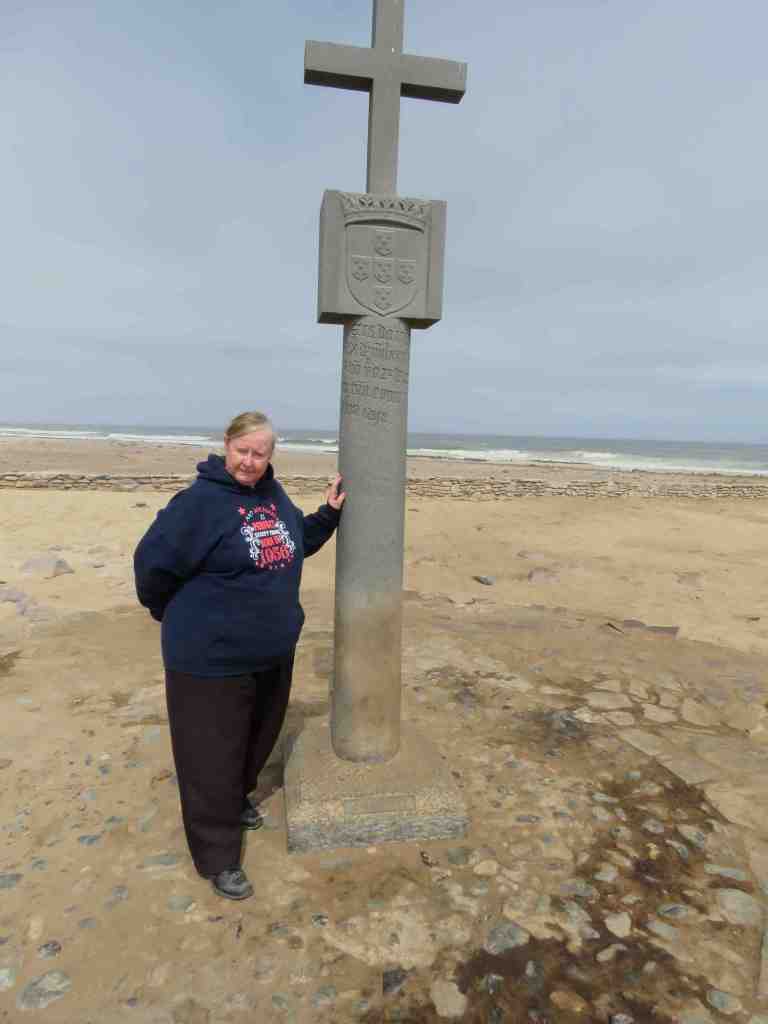
In 1980, the Namibian National Monument’s Council commissioned an exact replica of the original padrão and had it erected in the exact spot where the original had stood.

Alec standing by the German replica of the original cross
I’m standing next to the Namibian Replica of the cross

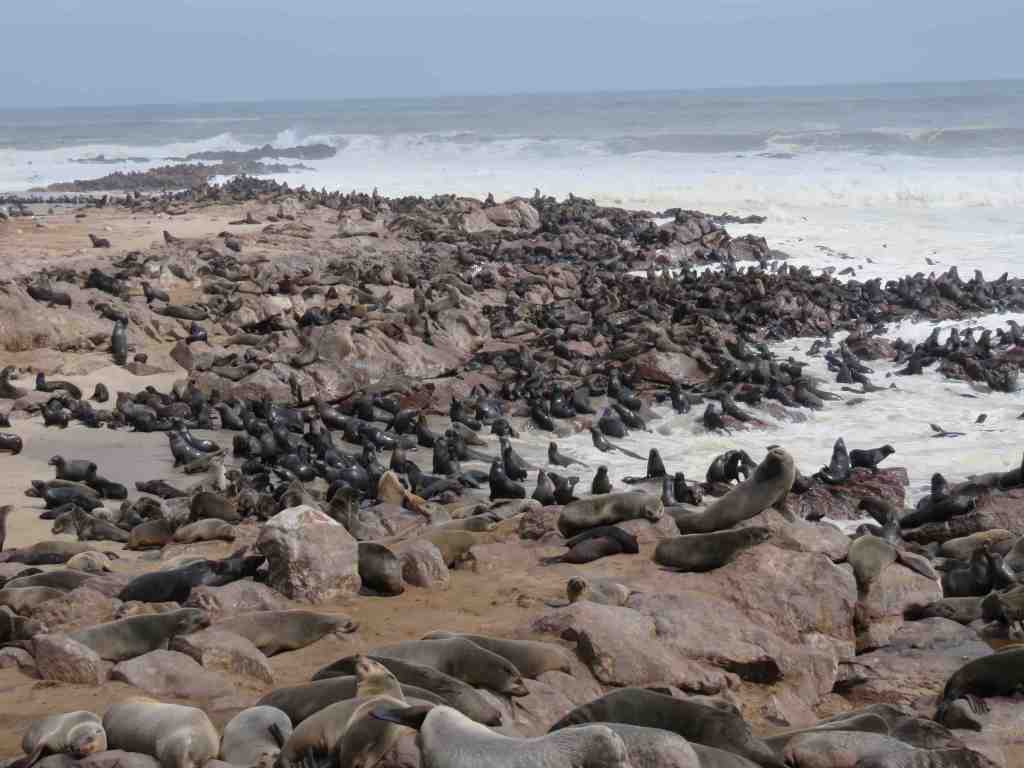
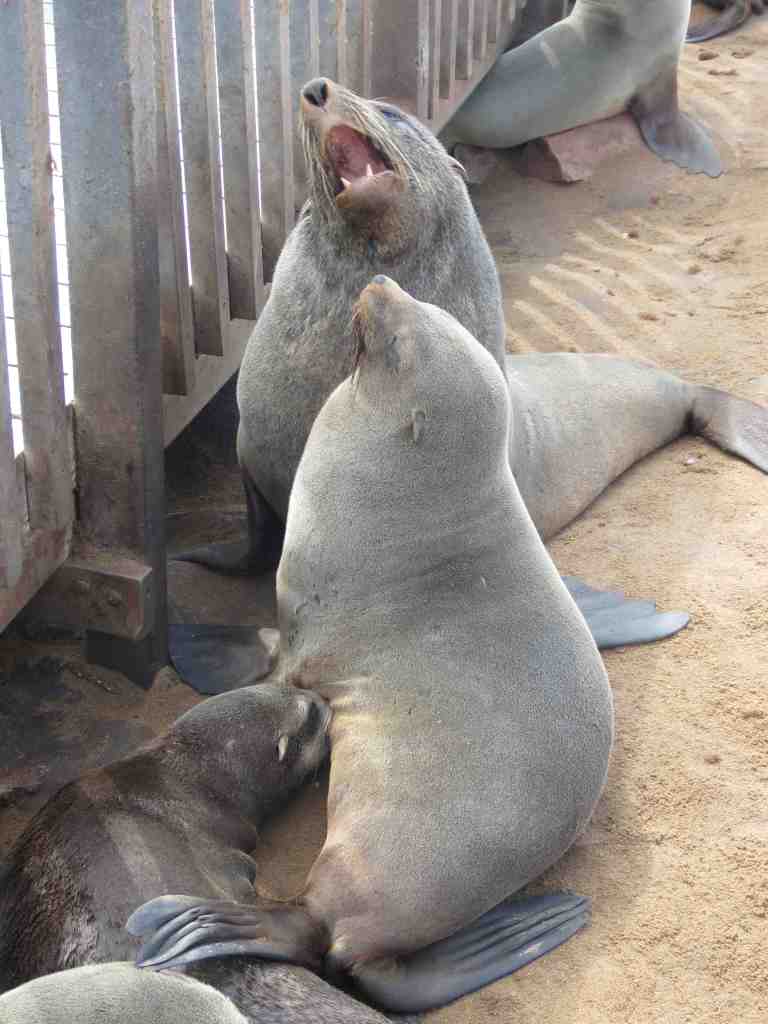
Having admired the crosses, we wandered over to get a closer look at the seals. I was astounded at how many there were, there must have been literally thousands of seals spread along the beach as far as the eye could see.  This is one of the largest Cape Fur Seal colonies in the world, a claim that is very easy to believe. We walked along the boardwalk and were able to enjoy viewing many seal up close as they basked on the rocks. Looking out to sea you could see hundreds of flippers and heads as the seals hunted for fish in the breakers around the bay.

Thousands of seals as far as the eye can see
his bull grumbled as this cow stumbled over him.
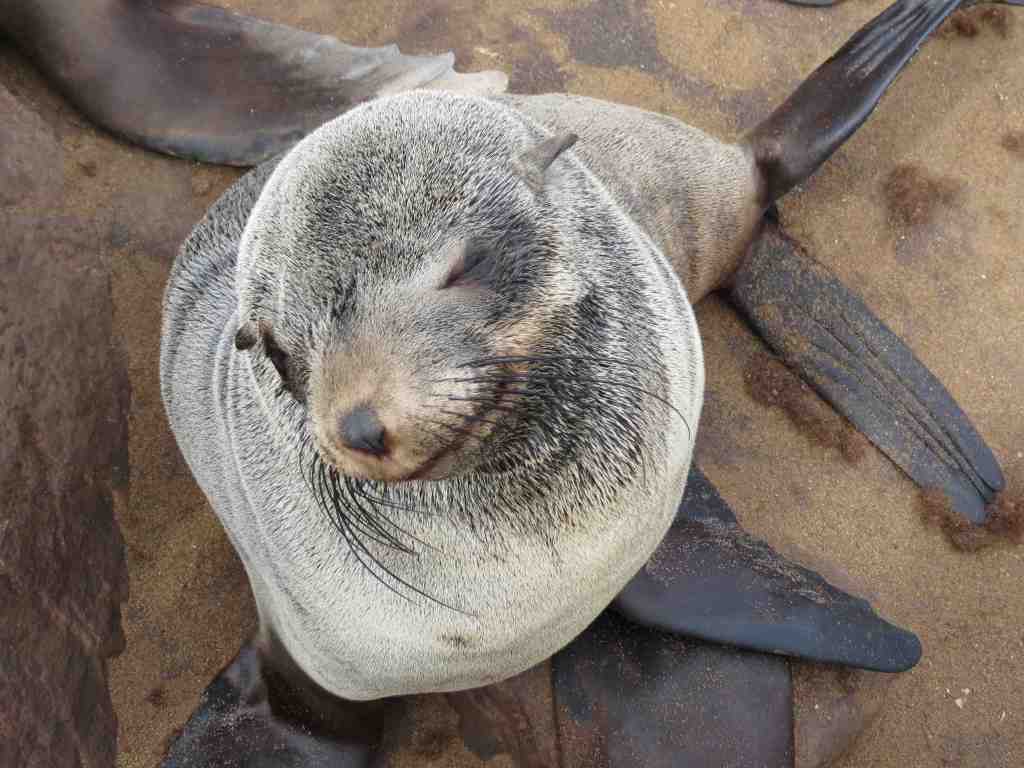
Who couldn’t love this face?

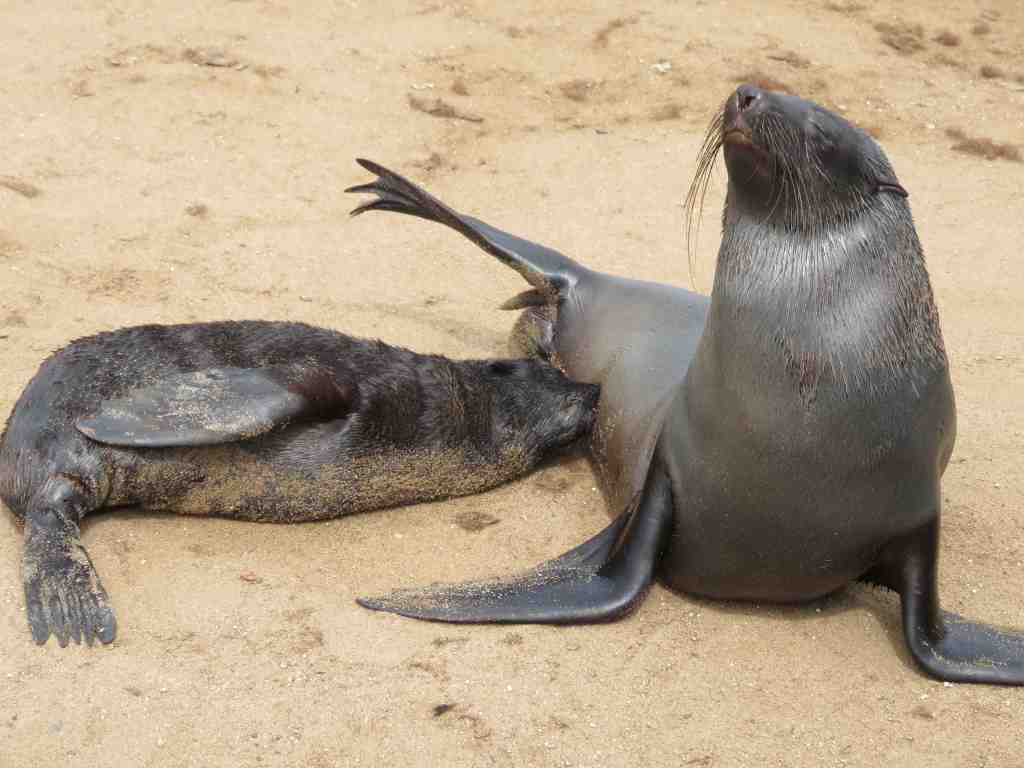
Walking along, we admired the enchanting faces and were lucky enough to come across a female nursing her pup, which must have been born very late. We were told that the majority of pups are born in late November and early December. This little chap is around five months late!

This little chap is late and still nursing

I am so relieved that animal rights groups have put a stop to the barbaric clubbing of the pups for their pelts. I much prefer seeing them with their mothers or playing in the water than on someone’s back!

This was a fascinating visit and we thoroughly enjoyed it, even with the smell and noise!

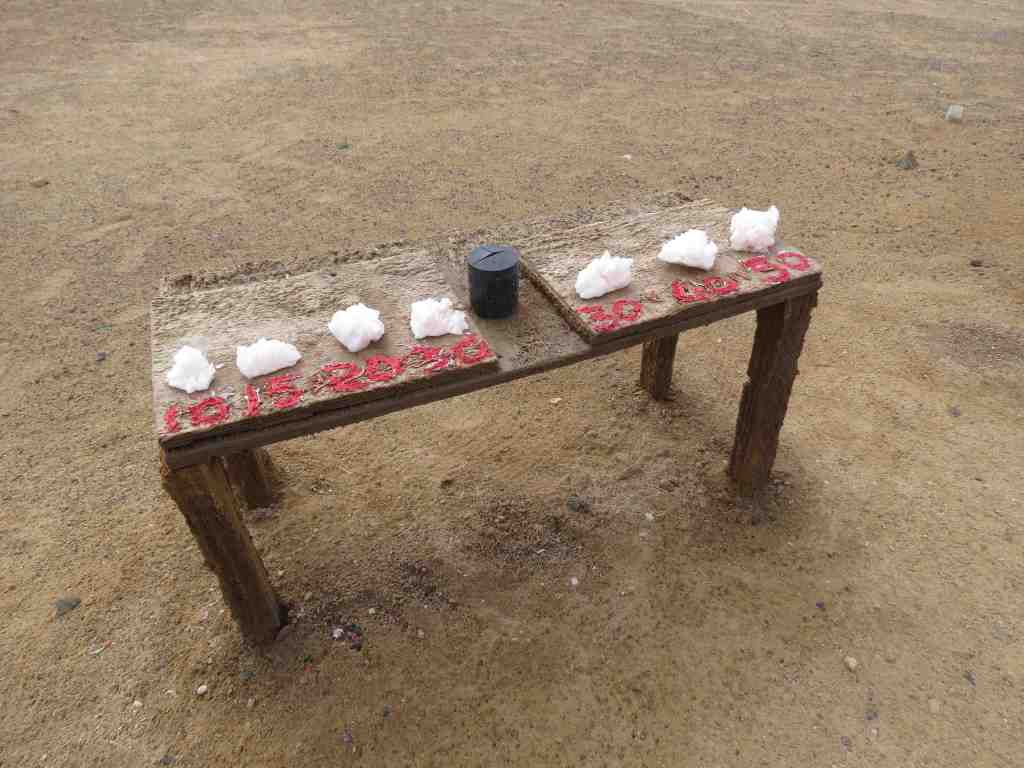
Driving back past another of the numerous salt works found along the coast, we were intrigued by dozens of these little stands dotted along the road. We stopped and found that they were honesty stands selling salt crystals. Obviously, budding entrepreneurs collected the prettiest crystals they could find from the salt pans and placed them on crude stands along the road. Each crystal was priced and there was a little box for the money.  At this stand, there was money in the box (thank heavens this wasn’t SA – that stash would have been lifted in a flash!!) but I really couldn’t see the difference between a crystal in the N$10 box versus one marked N$50. You have to admire the entrepreneur that is selling crystals they had no hand in making and obviously doing reasonably well out of it.

The salt crystal business along the road.

I can’t say that we were sorry to depart from Henties. The entire time we were there it was damp and very cold. Buck’s Camping Lodge, had smallish stands, each with their own ablutions. The ablutions were clean but looked a little tired and tatty.  The campsite is safe and patrolled at night.

Now we are off back into the interior, where it’ll be much hotter. I hope you enjoyed my history lesson for today, and hopefully, within the next day to two, I’ll find WIFI to send it on to you. We are off to Spitzkoppe, which will be very different to sea, beaches and seals. Take care, everyone!