I’ve been blogging about TOMT since 2016, and the style has evolved quite a bit over the years. In the early days I simply snapped a few photos and wrote a short summary of the event. As time went on, I found myself taking more pictures and writing far more detailed accounts.
But of course, I’m not the one out there on the water. By 2022, I wanted my readers to feel the thrill and adrenaline of catching such an incredible fish. So I began asking—well, insisting—that the anglers send me their own stories.
There was plenty of resistance at first. Every one of them protested that they “can’t write”… and then proceeded to give me the most fantastic stories (which just required a tiny bit of editing).
In the final lead‑up to the 20th Two Oceans Marlin Tournament, I’ll be sharing anglers’ stories from 2022 through to 2025—one each day until the tournament begins
The Catitude Story As Told By Uncle Ted
Sunday 13 February 2022
The first day of the TOMT started with the team being in a high state of excitement as they anticipated a great day at sea. But as the day wore on very little occurred. We considered throwing in the towel and heading back to shore but being at sea is always better than being at home. Just half an hour, we said to each other and then another and another until the lines-up hour drew closer. Suddenly with one hour’s fishing time left, all hell broke loose when Mike spotted a black fin behind Catitude and yelled, “Marlin!” Ted was at the wheel and turned the boat and the boredom of the last few hours disappeared in an instant. Adrenalin coursed through our bodies as we all sprang into action, Colin and Mike grabbing the spare rods, Michel struggled into the fighting harness and reeling in the aggressive fish. The four other experienced fishermen yelled instructions in language that would make a pirate blush!

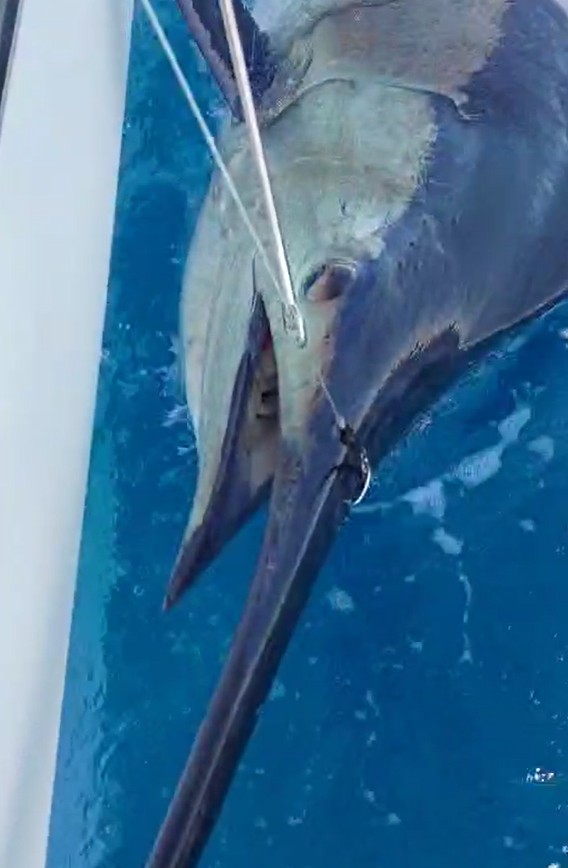
All this swearing must have helped because soon a 60kg marlin was brought to the side, handled with the utmost care, and after being filmed and photographed by Ted and Mike allowed to swim away, none the worse for his little adventure with a very excited Frenchman.
By Ted Horn
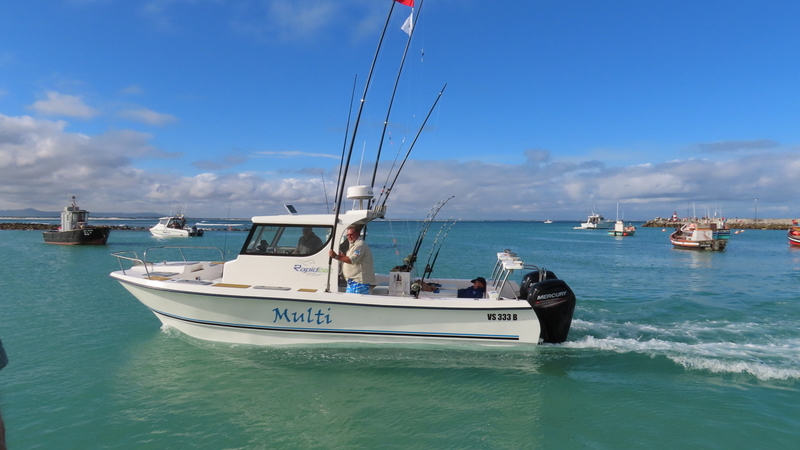
Multi’s Story by Roger Barret
Sunday 13 February 2022
It was the first day of TOMT 2022. Team Multi went out to sea targeting the very elusive Marlin species and dream sport fish for many an angler.
Having a very quiet morning session changed to a very exciting late afternoon. At about 14:45, Team Multi hooked up on the Japan lure and things got interesting on the boat. The fish never showed itself and didn’t behave in any way like a Marlin usually does.
The skipper, Vleis Visagie, decided to back up the boat to the fish because we thought it was a Mako shark. When the fish showed itself at the boat and Darius Steyn touched the leader we all saw it was a Black Marlin. Then all demeanour changed. The Marlin lit up at the boat and for the first time, fought back.
The fish wasn’t tired at all. Luckily for us, Darius got hold of the leader again, and he just held on. Darius got some battle scars for grabbing and holding on to the bill. Everything happened so fast, but in the end, the fish was landed, measured, hook removed and the marlin was safely, and still full of energy, released. It wasn’t Andre Pawson’s first Marlin, but it was his first Black Marlin.
Thanks to the crew of Multi, who worked together extremely well to catch this awesome fish, and the unforgettable memories that were made that day. Thank goodness we landed and safely released the fish. And thank God for the privilege.
Lega Sea’s Story By Crew Member Daniel
Tuesday 15 February 2022
Spykertjie the Marlin
Angler: Ruben Burger (Aged 18 years)
On our first day of fishing in the Two Oceans Marlin Tournament, we did not get a fish to stick. When we set out on the second fishing day, we were all positive and super excited as we had a good feeling about it this time. Throughout the day, we worked hard and listened to the reports on the radio of other boats hooking up and losing. Eventually, a fish was landed. Over the radio, they said it was on a Lumo Green Kona. We brought in the portside long and changed Konas. We put the Lumo Green Kona on and sent it back out. We watched the Kona to see if it was smoking properly.
JP even turned and said, “Check that thing, it’s smoking like a champ!” As we looked away to walk to the cabin, Julian said, “JP, there’s a marlin mark at 20m.”
JP looked on the sounder and said, ‘No, that’s not him. You are looking for a big red sausage.”
As JP said that, all we heard was a snap and a screaming reel. The fish screamed off at a rate of knots!
And JP yelled, “That’s him! That’s him! That’s him!”
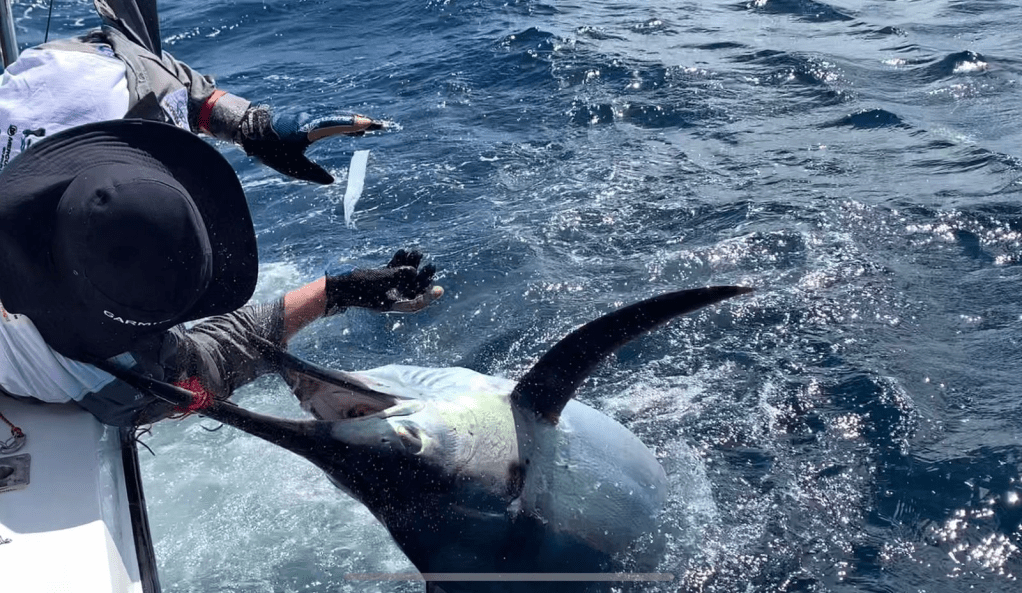
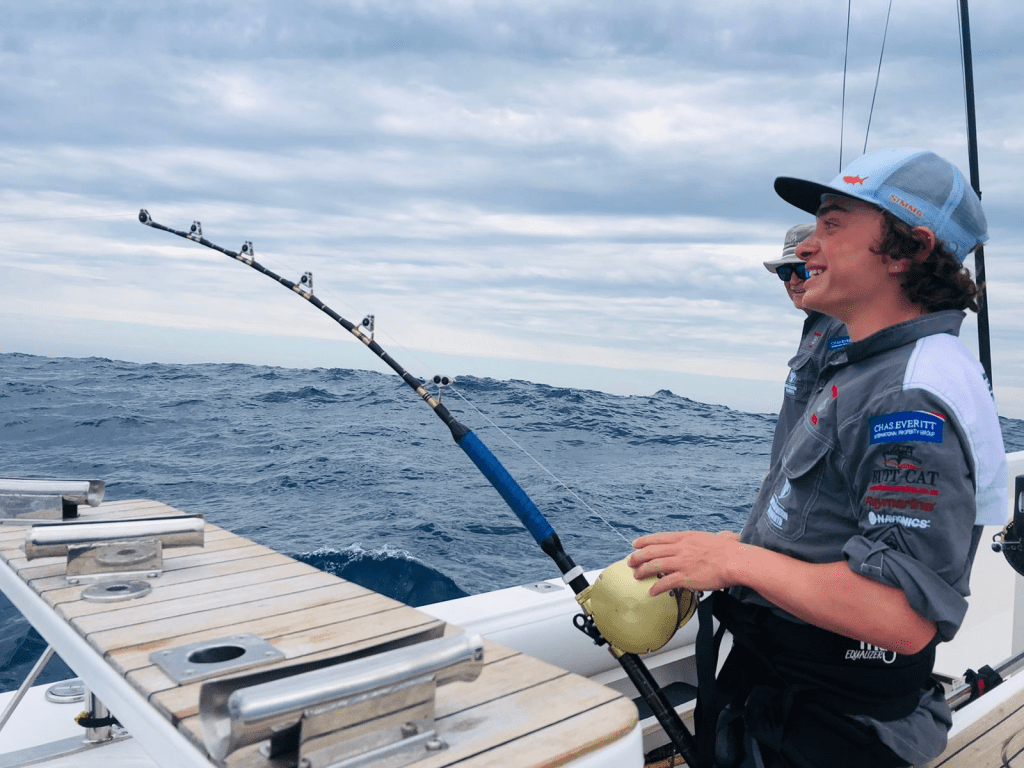
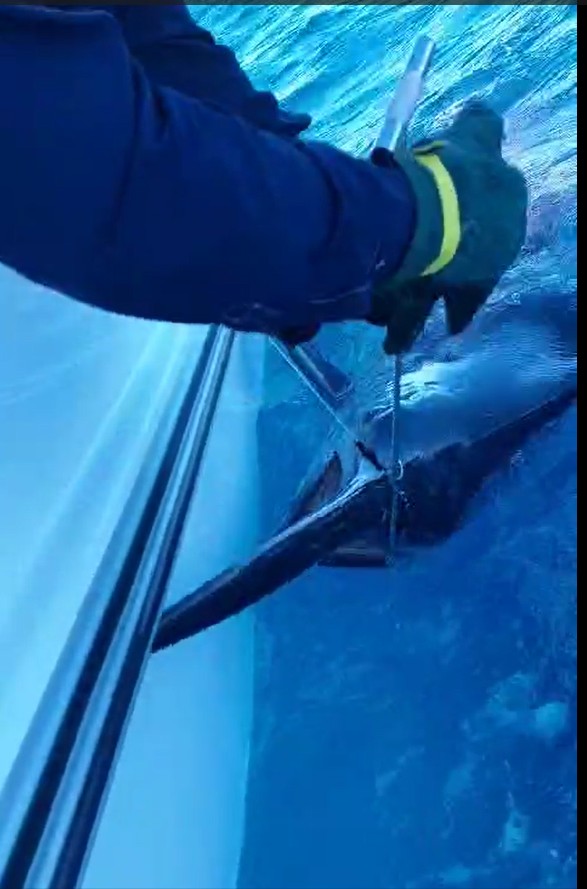
We cleared the deck as fast as possible and just like that – fish on. Ruben had just hooked into his first-ever Marlin. After chasing this fish for 10 years, he finally had it on the line. After 40 minutes of intense and technical fighting with complex boat manoeuvres and a calm, collected angler, the fish came up next to the boat and was leadered, and the bill was grabbed. Ruben had done it! He had just landed the fish of his dreams! After a quick high five on the fin from Ruben, and the hooks removed, the Marlin swam off beautifully, completely lit up, showing off its magnificence before disappearing back into the depths. Hands were shaken, congratulations were given, and a tear of joy was shed by Ruben. He had done it! And we were back in the competition! All in all, it turned out to be a perfect day with a memory that will last a lifetime!

Mojo’s Story by Gareth Beaumont
Tuesday 15 February 2022
Marlin Mojo
After three days of not raising a fish, the mood on Mojo was a bit glum. The skipper even threatened to sell the boat and find a new hobby.
We had changed lures countless times, and with the sea being a bit short I was not happy with the way one of the lures were swimming. I decided to revert back to one of my old faithful Konas (even though it hadn’t raised a fish in 2 years). About 20 minutes later, I was checking the spread and as I looked at my old faithful there was a fin and a flash and a screaming reel, then the pandemonium ensued!
Rods cleared, teasers out, rigger up, some shouting and swearing and Hannes got in the chair. We were finally on a fish. The fish never jumped, and we were unsure whether it was a marlin or a mako, so we radioed in the hookup as such.
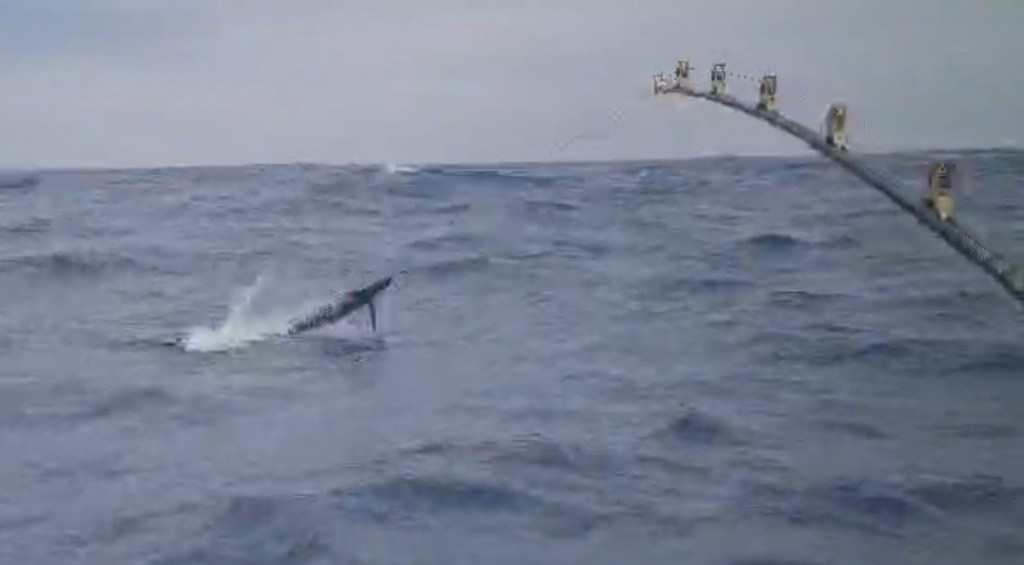
A few minutes into the fight, we were blessed with the sight of a beautiful marlin jumping out of the water a few hundred metres away. Now knowing it was a marlin, everyone settled down and focused on the task at hand, as calmly as one can in that situation. I cannot stress how critical good communication between the skipper and angler is while fighting a marlin. Fortunately, Hannes was very vocal and kept all of us well informed of every move the fish made! After about 20 minutes, I had the leader in hand, and as I put pressure on the fish, it lit up as only a stripey can, absolutely beautiful! We got her alongside and got the hook out quickly.
After a few photos, it was time to release the fish, and it swam away strongly back into the big blue. High fives all around on a job well done. It was back to work, now even hungrier for another bite. We had another strike about 2 hours later, but it didn’t stick. However, we were still happy and grateful for the one we had released.
Hannes got his first marlin in sixteen years of fishing in the TOMT. Jacques got his first marlin on Mojo and his first stripey ever, and most importantly, team Mojo got their mojo back.

Bad Company’s Story by Mike Broderick
Tuesday 15 February 2022
We were trolling near the 100m contour when the middle starboard rigger clip exploded with a bang that woke up the entire crew, including the skipper.
Stuart Campbell was the designated angler, and this would be his first Marlin. He had tried for years, all over the place, but always missed the magic time slot.
It sounded straight down for the first 20 minutes. Fear, uncertainty, and doubt crept in. Suddenly, the sea behind the boat exploded, and a beautiful black jumped completely clear of the water.
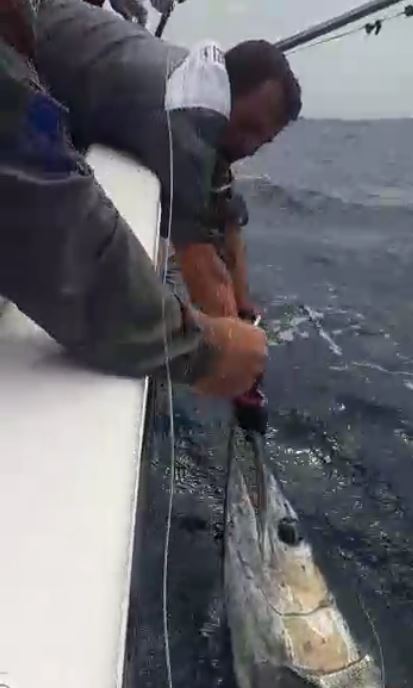
After another 20 minutes, the fish was safely released.
Stuart said, “This is the only other, first time I did it, that I will remember forever.” (If you know what I mean) 😉
And the winner of The Sixteenth Two Oceans Marlin Tournament was Bayswater. Their story appears in both Afrikaans and English.
Bayswater se Storie deur Piet Wessels
Donderdag 17 Februarie 2022
Die derde dag van visvang het ons geweet dit sal die laaste dag wees wat ons iets kan vang in die kompetisie. Ons het reeds twee visse veloor, een op dag 1 na amper ‘n uur en half 20 meter van boot af wat ons hom aangehad het en nog een op dag 2.
Ons het besluit om dieselfde Konas te sleep aangesien dit al drie visse geraise het vir ons die week sover. Ons het maar dieselfde area gewerk wat ons Dinsdag gewerk het, volgens my was dit die beste kleur water en temperatuur was goed. Die see was rof en dit het maar moelik gegaan om die Konas reg te laat swem.
Ons het nog getrol toe sien Kokkie ‘n vis wat swem agter ons right long. Dit was dieselfde lure waarop ons twee ander visse gehak het vroeer die week. Die vis het ‘n hele ruk agter die lure geswem maar wou nie byt nie.
Kokkie sê, “Toe kom ons maak ‘n lang draai en bly op die area.”
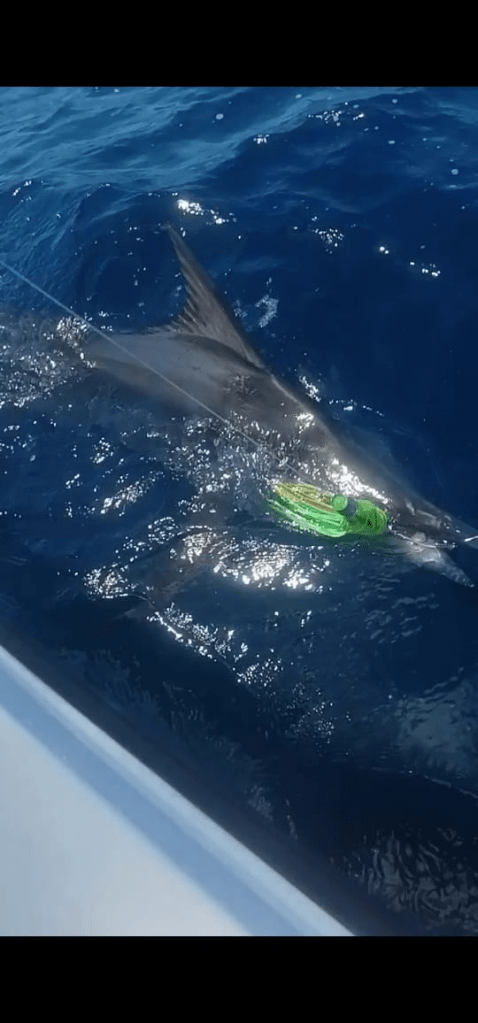
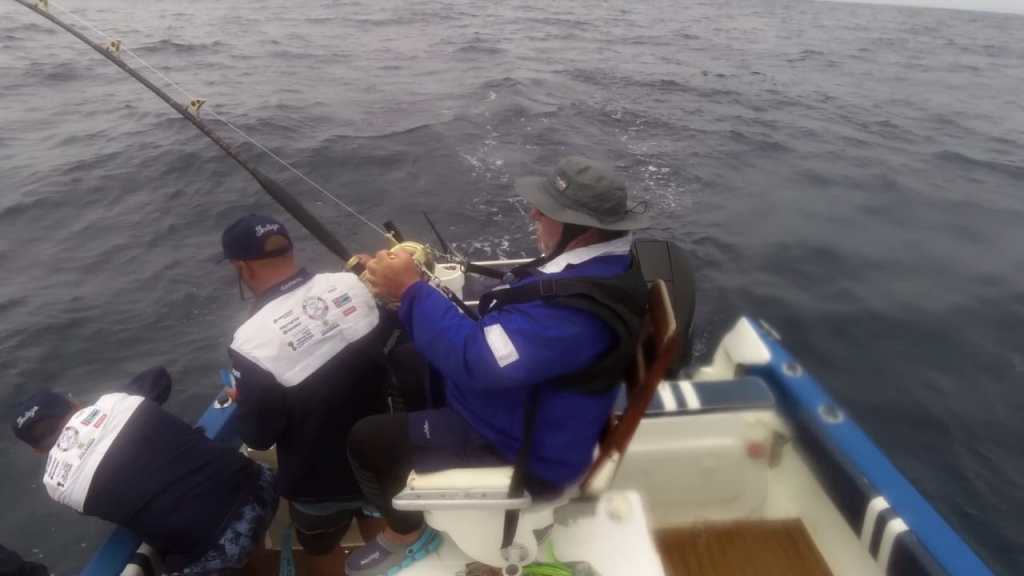
Ons was so halfpad gedraai toe klap die ourigger en die vis was aan. Hy het soos ‘n mal ding agter die boot gespring. Oupa Dawie was in die stoel. Ons het die vis mooi rustig baklei met die rowwe see. Vyf-en- twintig minute later was hy langs die boot en Kokkie het hom geleader. Dis was ‘n swart marlyn van ongeveer 100-120kg. Ons het die vis se hoeke uitgehaal, hom mooi laat swem langs die boot en toe laat gaan. Dit was n voorreg om weer ‘n vis te vang in die kompetisie.

English translation
On the third fishing day of the tournament, we knew that it would be our last chance to get a marlin. We had already lost two, one on the first day after fighting it for an hour and a half, then losing it within 20 metres of the boat, and on the second fishing day, we also lost one.
We decided to use the same Konas, seeing that they had worked well for us thus far. We worked in the same area as on Tuesday, and I believed the water was the best colour and temperature for marlin. The sea was rough, and it was difficult to get the Kona to swim.
We trolled, and then Kokkie saw a fish swimming behind right long. We were using the same lure that we had the previous two fish on earlier in the week. The fish followed the lure for quite a while but would not bite.
Kokkie said, “Let’s make a wide turn and stay in the area.”
We had turned halfway when the outrigger was hit, and the fish was on. The fish went wild and jumped behind the boat. Oupa Dawie was in the chair. We calmly fought the fish in the rough sea. Twenty-five minutes later, he was beside the boat and Kokkie leadered him. It was a Black Marlin of about 100 to 120 kilograms. We took out the hook, and let him swim away next to the boat. It was a privilege to once again catch such a fish in the competition.
Watch this space for more exciting man vs malin stories.














 Adventuring into Retirement